
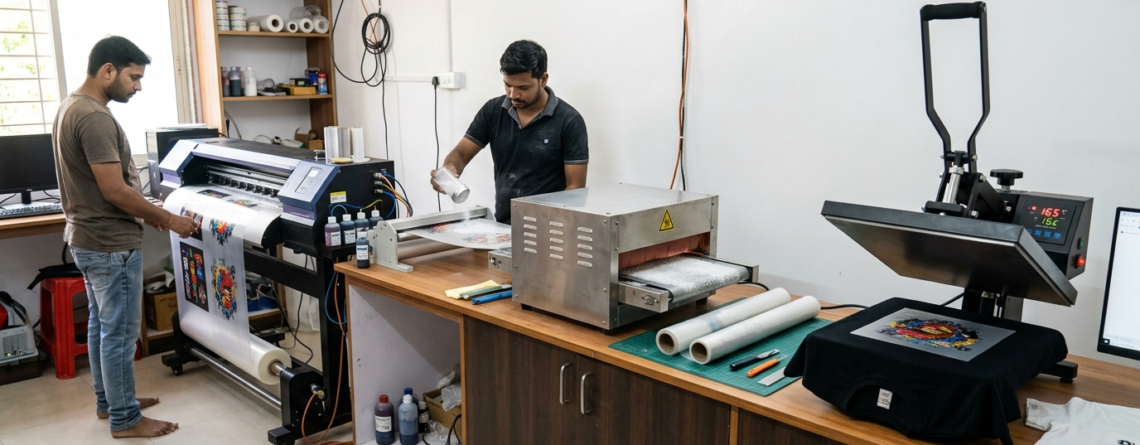
DTF Printing Business Profit Margin: Introduction to Hot Melt Adhesive Powder in DTF Printing 2026
When people calculate DTF Printing Business Profit Margin, they often look only at the printer, ink, film, and T-shirt cost.
That is a mistake.
Chat with our team for printers, consumables, film, powder and business setup guidance.
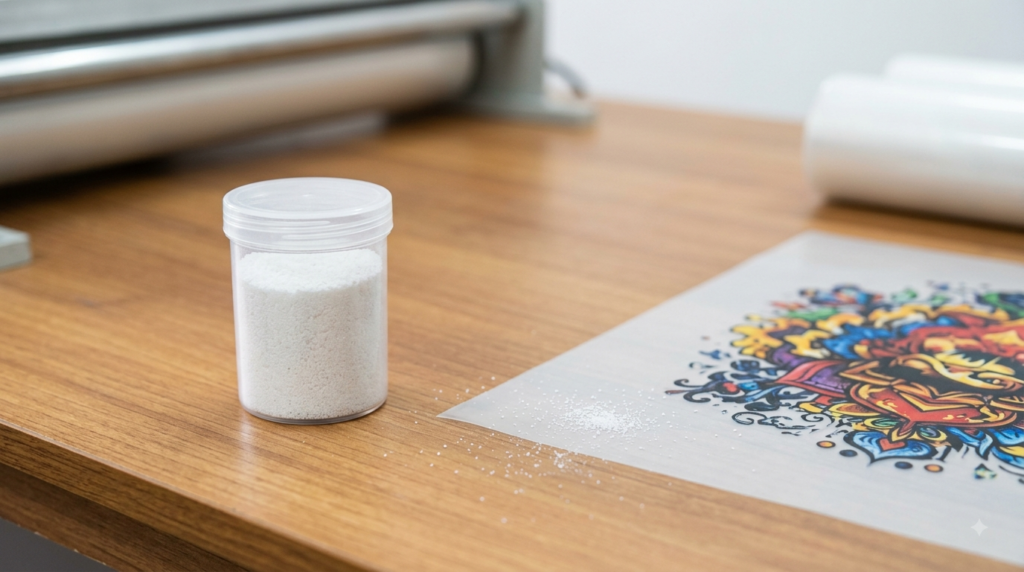
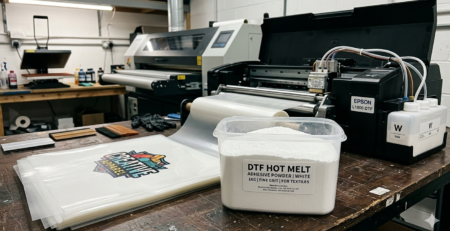
Hot melt adhesive powder is also an important part of the DTF process. It helps the printed design bond with the garment after heat application. A poor powder can lead to weak adhesion, poor wash durability, uneven transfer, and more rejected pieces.
In a small DTF business, even a little wastage matters.
For example, if you produce 30 transfers every day and several transfers need to be reprinted because of poor powder application, your real profit is lower than the number shown in your basic calculation.
So, understanding powder quality is not just a printing issue. It is also a DTF Printing Business Profit Margin issue.
Why Hot Melt Powder is Essential for DTF Transfers and DTF Printing Business Profit Margin
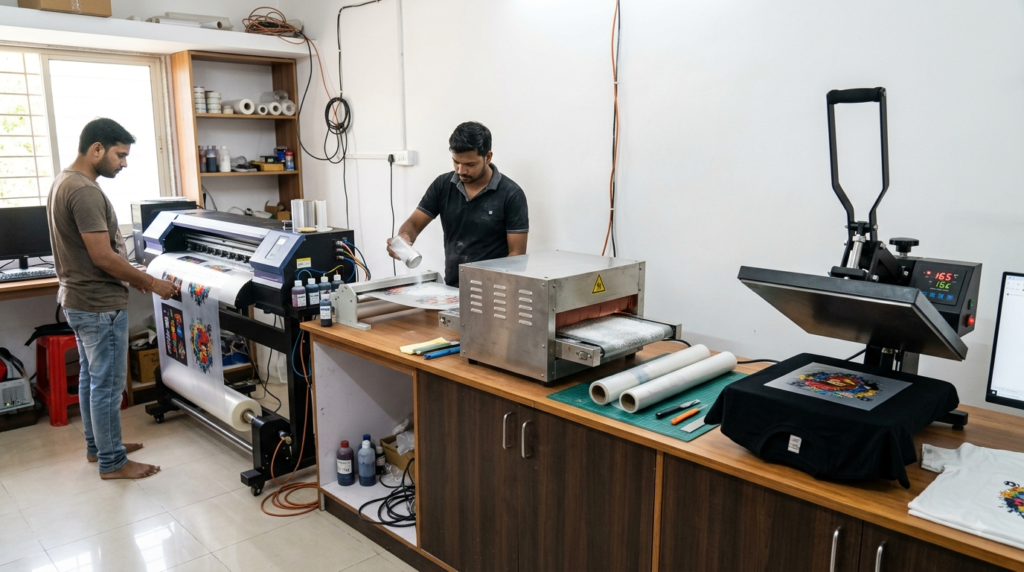
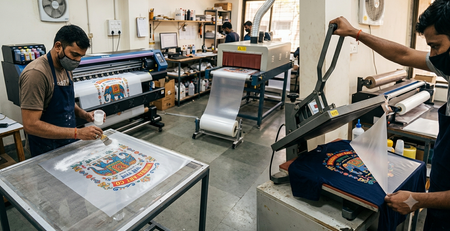
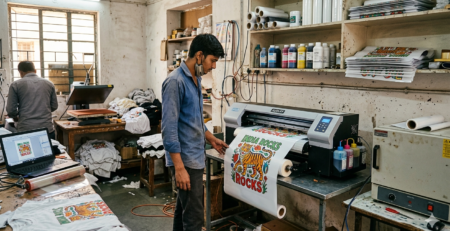
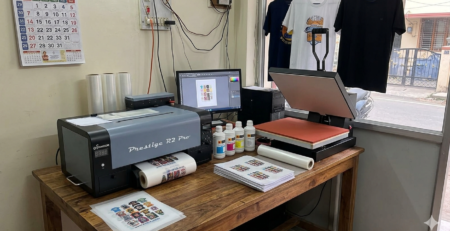
The basic DTF process is simple:
- Print the design on PET film.
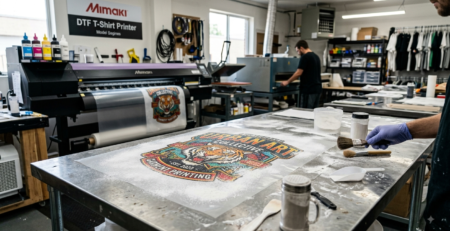
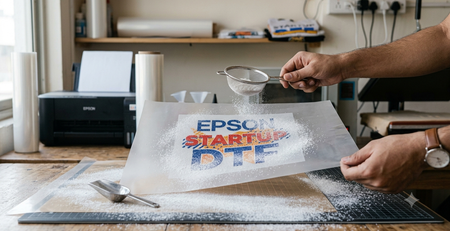
- Apply hot melt adhesive powder.
- Remove excess powder.
- Cure or melt the powder.
- Heat press the transfer onto fabric.
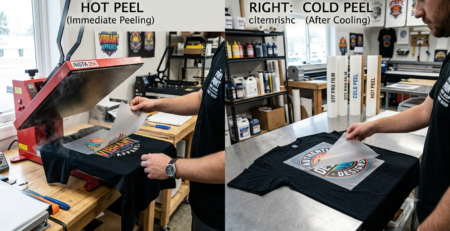
- Peel the film according to the film manufacturer’s instructions.
FESPA explains the DTF workflow in a similar way, including applying adhesive powder evenly, removing excess powder, and heating the powder before transferring the design to the garment.
The powder is therefore not an optional material. It is part of the transfer system.
For a business owner, the important point is consistency.
Cheap powder may look attractive when you compare the price per kilogram. But if it causes more rejects, poor adhesion, or an uncomfortable finish, the saving can disappear quickly.
A good powder should give reliable adhesion without making the printed area unnecessarily hard.
That balance can directly influence your DTF Printing Business Profit Margin.
Key Features to Look for in Quality DTF Adhesive Powder
Before buying powder in bulk, check these practical points.
1. Particle Size
Powder particle size affects how evenly the adhesive covers the printed area. Different applications can require different grades.
2. Adhesion
The powder should bond properly after curing and heat pressing. A transfer that starts peeling after washing is a costly problem.
3. Softness
For T-shirts and casual clothing, customers normally prefer a transfer that does not feel excessively stiff.
4. Melting Behaviour
The powder should melt properly within the recommended process settings. Do not copy random temperature settings from another brand. Follow the powder and film supplier’s instructions.
5. Wash Durability
Always test the finished transfer rather than judging powder only by how it looks immediately after pressing.
Research on hot-melt adhesive powders shows that particle characteristics and adhesive chemistry can influence how these materials behave during textile bonding.
For a commercial printer, consistency matters more than simply finding the lowest price.
Top Hot Melt Adhesive Powder Brands Available in India
There are several Indian suppliers and marketplace sellers offering DTF adhesive powder. The names below are useful starting points for comparison, but buyers should check current specifications, pack sizes, reviews, and availability before purchasing.
Living Lion
Living Lion is one name buyers may encounter while comparing DTF consumables in India.
When testing a new powder, do not immediately purchase a very large quantity. First test it on the films, inks, fabrics, and heat-press workflow you actually use.
Check:
- Transfer appearance
- Adhesion
- Hand feel
- Wash performance
- Powder wastage
- Compatibility with your workflow
BhartiPrint (Bharti Creation)
BhartiPrint, associated with Bharti Creation, is another supplier name worth considering during a local market comparison.
For a small DTF shop, supplier support can be almost as important as the powder itself.
Ask for the technical specification and recommended curing process before making a bulk purchase.
Desmat Sublimation (Koncept)
Desmat Sublimation, also known as Koncept in some listings, is another option Indian buyers may come across.
Do not compare products only by the word “premium” on the package. Compare actual performance on your own garments.
A powder that performs well on polyester may behave differently on cotton or blended fabrics.
3alps Digital Printers
3alps Digital Printers is another supplier to include when researching DTF consumables.
If you are comparing suppliers, request a sample first where possible.
A simple side-by-side test can tell you much more than a product description.
Shagun Enterprise
Shagun Enterprise is another name that may appear in the Indian DTF supply market.
For regular production, ask about:
- Pack sizes
- Batch consistency
- Storage recommendations
- Technical support
- Bulk pricing
- Replacement policy
These details can matter when your daily production increases.
InksfyDTF (Etsy India)
Marketplace sellers such as InksfyDTF can also appear in searches for DTF powder.
Marketplace buying can be convenient, but always check seller reviews, product specifications, delivery conditions, and return terms.
Kamicraftsales (Etsy India)
Kamicraftsales is another marketplace seller that may be considered when comparing DTF consumables.
The same rule applies: test before scaling.
The best powder for your business is not necessarily the one with the lowest listed price. It is the one that gives consistent results at a reasonable total cost.
Price Range of DTF Hot Melt Powder in India (per kg)
Prices change according to grade, particle size, pack size, supplier, and current offers.
As a current reference point, DTFShop lists a 1 kg hot melt powder in the ₹800 range and a 5 kg option around ₹4,100 at the time checked. These are listed prices and can change.
This gives a useful example of why bulk purchasing can reduce the material cost per kilogram.
But do not calculate your DTF Printing Business Profit Margin using powder price alone.
Your actual transfer cost may include:
- DTF ink
- PET film
- Adhesive powder
- Electricity
- Printer maintenance
- Printhead wear
- Cleaning materials
- Failed prints
- Labour
- Heat pressing
- Packaging
- Delivery
- Design time
A simple example:
Suppose one transfer sells for ₹200.
If the total variable cost is ₹80, the gross contribution is ₹120.
But if wastage, labour, packaging, and other expenses add another ₹30, the effective contribution becomes ₹90.
This is why real-world DTF Printing Business Profit Margin can be very different from a simple selling-price-minus-ink calculation.
Comparison of Indian Brands: Performance & Quality
Instead of saying one brand is automatically “best”, use a simple testing method.
| Test | What to Check |
|---|---|
| Adhesion | Does the design bond evenly? |
| Wash test | Does it remain attached after washing? |
| Hand feel | Is the transfer reasonably soft? |
| Coverage | Does powder cover the printed area evenly? |
| Wastage | How much excess powder is discarded? |
| Curing | Does the powder melt consistently? |
| Cost | What is the real cost per usable transfer? |
Run the same artwork through each powder.
Use the same:
- Printer
- Ink
- Film
- Fabric
- Heat press
- Pressure
- Processing method
Then compare the finished transfers.
This is a much better way to choose powder than relying on packaging claims.
Where to Buy Hot Melt Adhesive Powder in India (Online & Offline)
DTF consumables are available through specialist suppliers, local printing markets, and online stores.
DTFShop.in DTF Powder Collection currently lists DTF hot-melt powder options, including 1 kg and 5 kg packs.
When buying online, check the exact product specification before ordering.
A useful starting combination for a small business can be:
<span style=”color:blue”>🔵 ProlificGeeks DTF Printer L1800</span>
<span style=”color:blue”>🔵 XP600 DTF Printer</span>
<span style=”color:blue”>🔵 i3200 DTF Printer</span>
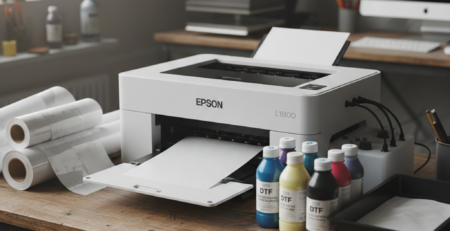
These models are listed by DTFShop as options for different production levels. The L1800 is positioned toward entry-level work, while XP600 and i3200 systems are aimed at higher productivity.
For consumables, DTFShop also lists:
<span style=”color:blue”>🔵 DTF Hot Melt Powder 1KG</span>
and
<span style=”color:blue”>🔵 DTF Hot Melt Powder 5KG</span>.
These product examples are useful for comparison rather than a recommendation that one machine or powder will suit every business.
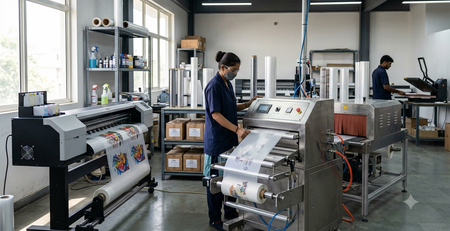
For higher-volume operations, DTFShop also lists industrial XP600 and i3200 systems with powder-shaker configurations.
Tips for Storing and Using DTF Hot Melt Powder
Good storage can prevent avoidable problems.
Keep the Powder Dry
Moisture can affect powder flow and application. Keep the container properly closed.
Avoid Extreme Heat
Store consumables according to the supplier’s instructions and away from unnecessary heat.
Do Not Mix Unknown Batches
If you change suppliers or grades, keep the new powder separate until you have tested it.
Remove Excess Powder Carefully
Too much powder can create an unnecessarily heavy transfer. Too little can reduce adhesion.
Test Before Bulk Production
Print a small sample before running hundreds of pieces.
Track Your Powder Usage
This is especially useful for calculating DTF Printing Business Profit Margin.
For example, if you buy 5 kg but use significantly more powder per transfer than expected because of poor application, the apparent bulk saving may not be a real saving.
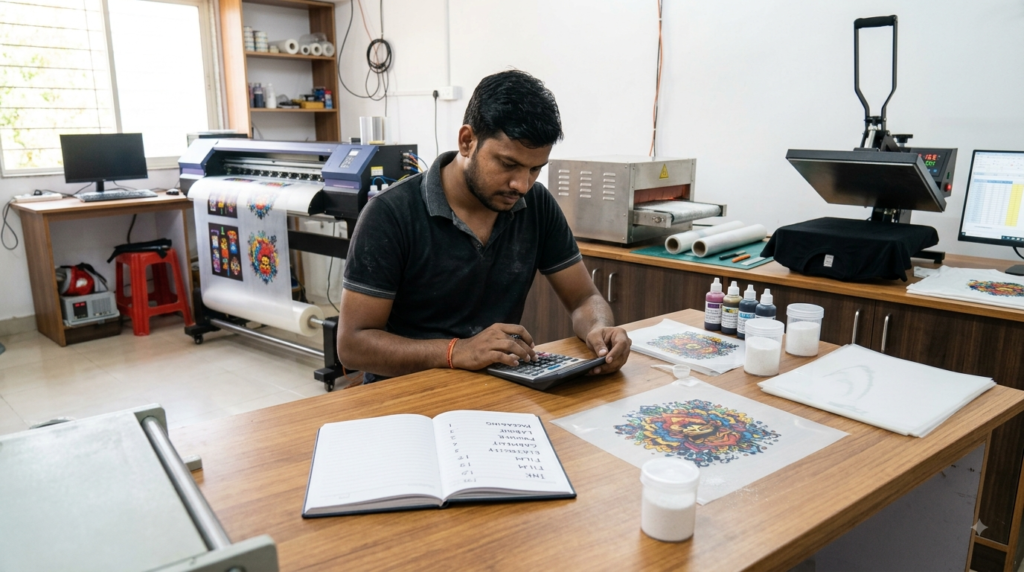
Keep a Simple Cost Sheet
Record:
- Film cost
- Ink cost
- Powder cost
- Garment cost
- Electricity
- Labour
- Packaging
- Rejected prints
Review the numbers every month.
Frequently Asked Questions (FAQs)
Is DTF printing profitable in India?
It can be, but profitability depends on pricing, order volume, material costs, wastage, equipment, labour, and customer acquisition. There is no single guaranteed margin for every DTF business.
How much does DTF powder cost per kg?
Prices vary by supplier and grade. As one current market example, DTFShop lists a 1 kg powder pack around ₹800 at the time checked.
Does expensive powder always give better results?
No. Price is only one factor. Test adhesion, softness, wash performance, curing, and wastage before deciding.
Which DTF printer should a beginner consider?
A smaller A3 setup can make sense for low-volume work. DTFShop lists L1800 and XP600 options for smaller businesses, while i3200 systems are positioned toward higher production.
How can I improve my DTF Printing Business Profit Margin?
Start by calculating the complete cost of every usable transfer. Reduce wastage, monitor consumables, price products properly, maintain the printer, and avoid buying equipment that is much larger than your actual order volume.
Is DTF powder reusable?
Do not assume that collected excess powder is safe to reuse indefinitely. Follow the powder supplier’s instructions and avoid contaminating fresh powder with ink, dust, or other material.
What is more important: printer speed or powder quality?
Both matter, but they solve different problems. A fast printer cannot compensate for poor transfer adhesion. For a small business, consistent quality can be more valuable than maximum production speed.
Conclusion: Best Brand Recommendation for Indian DTF Businesses
There is no universal powder brand that is automatically best for every Indian DTF business.
The smarter approach is to test two or three suitable options using your actual printer, film, ink, garments, and heat-press process.
For a new business, start with small quantities. Measure your actual material consumption. Track rejected transfers. Then calculate your true DTF Printing Business Profit Margin.
The same principle applies when choosing equipment.
A beginner doing a few orders per day may not need an industrial machine. A workshop producing hundreds of transfers may quickly outgrow a small converted printer.
DTFShop currently lists different equipment levels, including <span style=”color:blue”>🔵 ProlificGeeks DTF Printer L1800</span>, <span style=”color:blue”>🔵 XP600 DTF Printer</span>, and <span style=”color:blue”>🔵 i3200 DTF Printer</span>, giving businesses different starting points depending on production needs.
In the end, healthy DTF Printing Business Profit Margin comes from controlling the whole workflow—not from saving a few rupees on one consumable.
Buy based on testing.
Track every cost.
Keep quality consistent.
And scale only when your order volume supports it.
Product Suggestions (Blue Color)
<span style=”color:blue”>🔵 ProlificGeeks DTF Printer L1800</span> — A practical entry-level option for smaller production.
<span style=”color:blue”>🔵 XP600 DTF Printer</span> — A faster option for businesses moving beyond basic startup volumes.
<span style=”color:blue”>🔵 i3200 DTF Printer</span> — Better suited to businesses planning higher production.
<span style=”color:blue”>🔵 DTF Hot Melt Powder 1KG</span> — Useful for initial testing before moving to larger packs.
<span style=”color:blue”>🔵 DTF Hot Melt Powder 5KG</span> — A bulk option for businesses with regular powder consumption.
Current DTFShop listings support these product categories and configurations; availability and pricing can change.
External References + Credits
- FESPA — Useful technical guidance on DTF workflow, adhesive powder application, curing, and garment transfer.
- ResearchGate — Research literature can help explain hot-melt adhesive chemistry, particle behaviour, and textile bonding.
- PrintIndustry.com — Useful industry-oriented material for broader printing-business research.
- InkJetInsights.com — Useful for keeping up with inkjet and digital-printing topics.
Credit: Information references from Fespa, PrintIndustry, and other public sources.

LEAVE A COMMENT