
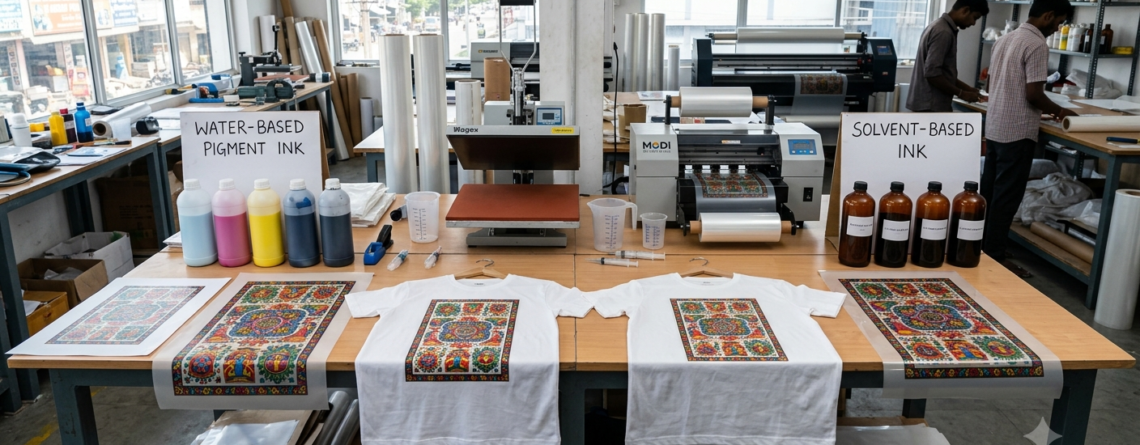
Water-Based vs Solvent DTF Ink: Which Is Better for Indian Conditions 2026
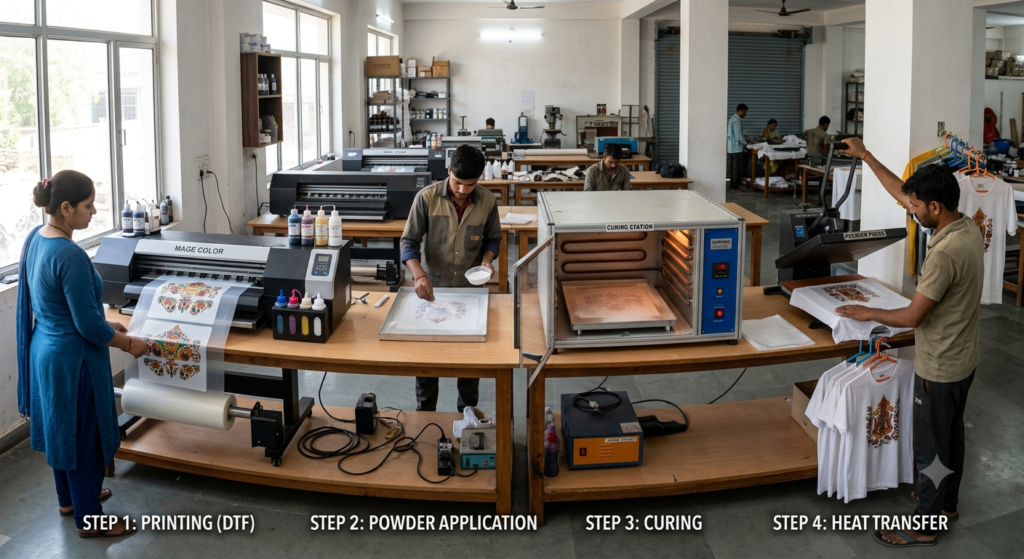
Direct-to-Film printing looks simple from the outside. Print the design, apply powder, cure it, and press it onto a T-shirt.
But anyone running a DTF setup knows that the result depends on several things working together: printer, ink, PET film, adhesive powder, curing, heat press, and storage.
Chat with our team for printers, consumables, film, powder and business setup guidance.
This becomes even more important in India because working conditions can change a lot. A shop in Delhi may deal with dry heat, while a workshop in Mumbai, Kolkata, or Chennai may face high humidity.
So, when choosing DTF ink for Indian conditions, it is not enough to ask, “Which ink gives brighter colours?”
You also need to consider humidity, drying, printhead compatibility, cleaning, wash durability, production speed, and the type of garments you print.
Most standard textile DTF systems use specially formulated water-based pigment ink. However, solvent-based DTF products are also marketed for certain applications. The important point is that you should never assume that any generic solvent or water-based ink will work in a DTF printer. Ink chemistry must match the printer, printhead, film, and complete transfer process.
For Indian businesses, DTF ink for Indian conditions should therefore mean ink that performs consistently in your actual working environment—not simply the cheapest bottle available.
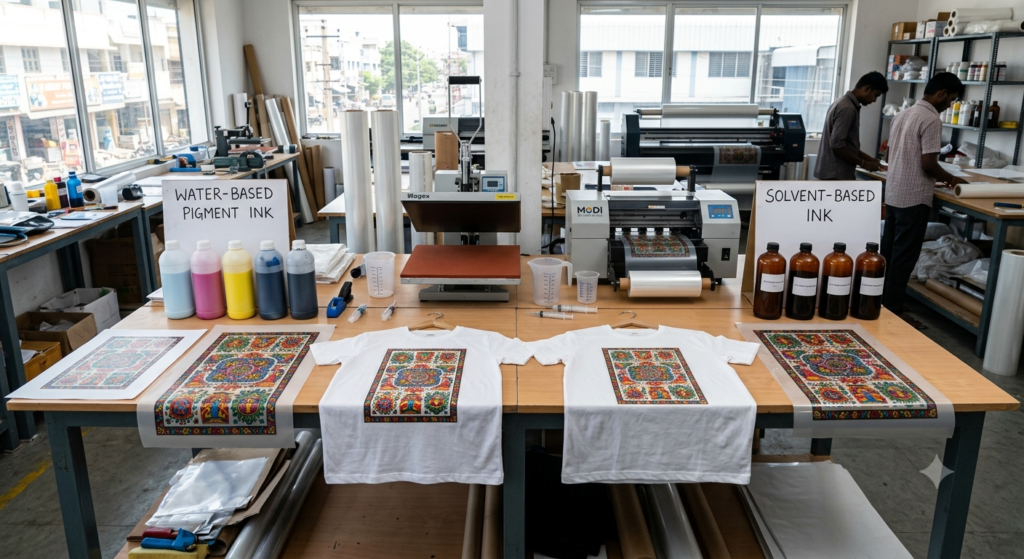
Why Hot Melt Powder is Essential for DTF Transfers
Ink creates the image, but hot-melt adhesive powder helps turn that image into a usable transfer.
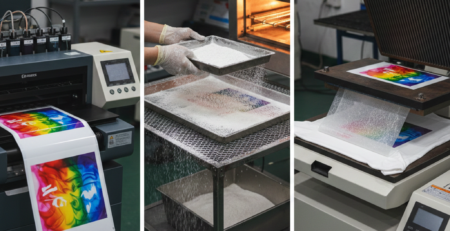
After printing, powder is applied to the wet ink. During curing, the powder melts and forms the adhesive layer that bonds the printed design to the fabric.
This is why ink and powder should be treated as a pair.
A technically good ink can still produce poor transfers if the powder is unsuitable or badly cured.
For example, imagine a small T-shirt business printing 30 shirts for a local event. The prints look excellent immediately after pressing. But after washing, the edges begin lifting.
The problem may not be the artwork or printer. It could be powder application, curing, film, pressing—or compatibility between the consumables.
This is also why choosing DTF ink for Indian conditions requires looking beyond colour quality.
A reliable DTF setup should give you:
- Clean colour reproduction
- Stable white ink
- Good film adhesion
- Proper powder bonding
- Consistent curing
- Good wash resistance
- Repeatable results in changing humidity
FESPA also recommends maintaining suitable environmental conditions, checking ink condition, agitating cartridges, and performing nozzle checks before production.
Key Features to Look for in Quality DTF Adhesive Powder
The adhesive powder is important, but the ink still has to be compatible with it.
When testing DTF ink for Indian conditions, look at the complete transfer rather than judging the ink directly from the bottle.
1. Humidity performance
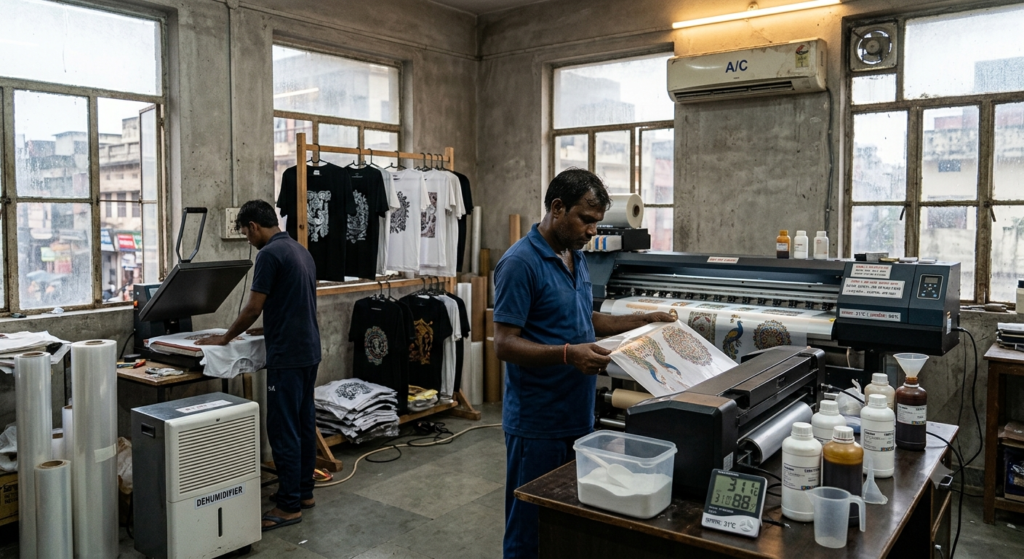
Humidity can affect drying and handling. In a humid workshop, freshly printed film may behave differently from the same film in a dry environment.
Keep your production area as stable as practical.
2. Printhead compatibility
Always check the manufacturer’s compatibility information.
Popular DTF setups use printheads such as XP600 and Epson i3200. DTFshop.in, for example, lists DTF ink compatible with Epson-based systems including XP600, i3200, DX5, DX7 and L1800 configurations.
3. White ink stability
White ink needs special attention because pigment can settle.
Regular maintenance and circulation are important. A good-looking CMYK print is not enough if the white layer becomes inconsistent.
4. Drying and curing
Water-based DTF ink contains water and other formulation components, so the drying environment matters.
Do not blindly copy another printer’s temperature and timing. Start with the ink, film, powder and printer manufacturer’s recommendations, then test.
5. Wash durability
Always conduct a real wash test before accepting a large production order.
One transfer that looks perfect on the press may behave differently after repeated washing.
Top Hot Melt Adhesive Powder Brands Available in India
The following names are useful when researching DTF powder options in India. However, performance can vary by product grade, film, ink and curing method.
The same principle applies to DTF ink for Indian conditions: test the complete combination before purchasing large quantities.
Living Lion
Living Lion is one name Indian DTF operators may come across when researching hot-melt powder.
For a new business, it is sensible to test a small quantity first. Check adhesion, hand feel, powder coverage and wash performance.
BhartiPrint (Bharti Creation)
BhartiPrint, associated with Bharti Creation, is another option available in the Indian market.
Instead of selecting powder purely by price, compare it on the same printer, film, ink and fabric.
Desmat Sublimation (Koncept)
Desmat Sublimation, including Koncept-related products, is another name found in Indian DTF consumables.
For commercial production, consistency between batches is an important point to ask about before buying larger quantities.
3alps Digital Printers
3alps Digital Printers supplies digital-printing consumables and is another supplier worth considering when comparing DTF materials.
Again, a sample test is more useful than judging solely from product descriptions.
Shagun Enterprise
Shagun Enterprise is another name used in the Indian DTF consumables market.
Before finalising any powder, test it on the fabrics your customers actually use.
InksfyDTF (Etsy India)
Online marketplaces can be useful for smaller quantities and testing.
For a home-based operator, buying a smaller pack first can reduce the risk of getting stuck with a material that does not suit the printer setup.
Kamicraftsales (Etsy India)
Kamicraftsales is another online option that may appear during DTF consumable research.
For marketplace purchases, check the product specification, pack size, seller information and return conditions carefully.
Price Range of DTF Hot Melt Powder in India (per kg)
Prices can vary depending on powder type, grade, packaging, supplier and quantity.
A practical market comparison may look roughly like this:
| Powder Type | Approx. Price/kg |
|---|---|
| Entry-level | ₹350–₹600 |
| Standard commercial | ₹600–₹900 |
| Premium | ₹900–₹1,500 |
| Specialty soft-feel | ₹1,200–₹2,000 |
Treat these figures as a general buying range, not a fixed market price. Product prices change.
The same rule applies when calculating DTF ink for Indian conditions. Do not calculate only the bottle price.
Instead, consider:
Ink cost + film + powder + wastage + maintenance + rejected prints = real printing cost.
A slightly more expensive ink can sometimes be cheaper overall if it reduces clogs, failed transfers and customer complaints.
Comparison of Indian Brands: Performance & Quality
There is no single powder or ink that will be perfect for every Indian DTF shop.
A better method is to run your own controlled test.
| Test | What to Check |
|---|---|
| Print quality | Colour, gradients and fine details |
| White layer | Opacity and consistency |
| Powder coverage | Even application |
| Curing | Complete melting without over-curing |
| Transfer | Clean peel and bonding |
| Hand feel | Softness and flexibility |
| Wash test | Peeling, cracking or fading |
| Cost | Actual usable transfer cost |
For DTF ink for Indian conditions, use the same artwork, printer, film, powder, fabric and heat press while comparing inks.
That way, you are actually testing the ink rather than changing five variables at once.
Water-Based vs Solvent DTF Ink for Indian Conditions
This is the key question.
Water-based DTF ink
Modern textile DTF ink is generally formulated as water-based pigment ink. It is designed specifically for DTF workflows rather than being ordinary inkjet ink.
Advantages include:
- Low-odor operation
- Easier cleaning
- Strong suitability for textile DTF
- Good colour performance
- Compatibility with common DTF workflows
The main challenge in Indian conditions is environmental control. High humidity can influence drying and handling, so production should be kept as consistent as possible.
Solvent-based ink
Solvent-based inks can provide fast drying and strong adhesion in applications where their chemistry is specifically designed for the substrate and printer.
But that does not automatically make solvent ink better for textile DTF.
Solvent systems can involve VOCs and may require stronger ventilation and additional safety controls.
More importantly, you should only use a solvent-based formulation when the printer and transfer system are specifically designed for it.
So, for most conventional textile DTF businesses, a properly formulated water-based pigment DTF ink is the more practical starting point.
That makes water-based DTF ink for Indian conditions the sensible choice for many garment-printing shops.
Where to Buy Hot Melt Adhesive Powder in India (Online & Offline)
DTF consumables are available through specialist suppliers, printing-equipment dealers and online stores.
DTFshop.in currently lists DTF equipment and consumables, including printers, inks, PET film and hot-melt powder.
For example, businesses can research:
<span style=”color:blue”>🔵 ProlificGeeks DTF Printer L1800</span>
<span style=”color:blue”>🔵 XP600 DTF Printer</span>
<span style=”color:blue”>🔵 i3200 DTF Printer</span>
<span style=”color:blue”>🔵 DTF Hot Melt Powder 1KG</span>
<span style=”color:blue”>🔵 DTF PET Film Roll</span>
These are not automatically the right choices for every business. The L1800 is generally positioned toward entry-level work, while XP600 and i3200 systems are aimed at higher productivity.
If you are buying DTF ink for Indian conditions, ask the supplier:
- Is it compatible with my exact printhead?
- Is it intended for textile DTF?
- Does it require white-ink circulation?
- What storage conditions are recommended?
- What film and powder combinations have been tested?
- Is technical support available?
These questions can save much more money than simply searching for the lowest price.
Tips for Storing and Using DTF Hot Melt Powder
India’s climate makes storage particularly important.
Keep powder dry
Humidity can cause powder to clump.
Keep the container properly sealed when not in use.
Avoid direct heat
Do not store powder next to a curing oven, heater or hot machinery.
Keep ink away from contamination
Ink bottles should remain closed when not being used.
Don’t mix ink brands casually
Different ink formulations can behave differently. Changing ink without properly flushing and preparing the system can create problems.
Test after changing consumables
If you change ink, film or powder, run a small test before starting a large order.
This is one of the simplest ways to protect your business.
Frequently Asked Questions (FAQs)
Is water-based DTF ink better for Indian conditions?
For many textile DTF businesses, yes. Properly formulated water-based pigment ink is widely used in DTF systems and avoids many of the VOC and ventilation concerns associated with solvent chemistry.
Does humidity affect DTF printing?
Yes. Humidity can affect drying, powder handling and overall production consistency. Environmental control is especially useful during monsoon periods.
Is solvent DTF ink more durable?
Not automatically. Durability depends on the complete ink, film, powder, curing and transfer system. A solvent label alone does not guarantee a better textile transfer.
Can I use normal inkjet ink in a DTF printer?
No. DTF ink is specially formulated for the DTF process, film and printhead. Ordinary inkjet ink is not a safe substitute.
Which printer is good for a beginner?
A smaller L1800-based setup can make sense for beginners, while XP600 and i3200 systems can suit businesses that need more productivity. Your order volume and budget should guide the choice.
How should I choose DTF ink for Indian conditions?
Start with compatibility. Then test colour, white ink performance, drying, transfer quality, wash resistance and maintenance requirements in your own workshop.
Should I buy ink in bulk?
Only after testing it. A small trial is usually safer than buying several litres and discovering that the ink does not work well with your printer or film.
Conclusion: Best Brand Recommendation for Indian DTF Businesses
There is no universal winner between water-based and solvent-based ink.
For conventional textile DTF printing, properly formulated water-based DTF ink for Indian conditions is generally the more practical option for many businesses. It fits the standard DTF workflow and avoids many of the ventilation and VOC concerns associated with solvent chemistry.
But the ink is only one part of the system.
Your printer, printhead, PET film, powder, curing temperature, humidity and heat press all affect the final result.
If you are starting small, focus on consistency rather than chasing the most expensive consumable.
Test one ink.
Test one film.
Test one powder.
Wash the finished transfer.
Then compare your actual results.
For a growing setup, options such as <span style=”color:blue”>🔵 XP600 DTF Printer</span> or <span style=”color:blue”>🔵 i3200 DTF Printer</span> can be considered when production requirements increase, while <span style=”color:blue”>🔵 ProlificGeeks DTF Printer L1800</span> can be a more entry-level option. DTFshop’s current guides similarly position these systems at different production levels.
The best DTF ink for Indian conditions is ultimately the one that works reliably with your complete setup, your local climate and the type of garments you actually sell.
Product Suggestions (Blue Color)
For natural internal linking within the article, these DTFshop.in products are relevant:
- <span style=”color:blue”>🔵 ProlificGeeks DTF Printer L1800</span> — entry-level DTF setup
- <span style=”color:blue”>🔵 XP600 DTF Printer</span> — suitable for growing production
- <span style=”color:blue”>🔵 i3200 DTF Printer</span> — higher-production option
- <span style=”color:blue”>🔵 DTF Ink Kit CMYKKWW 600ML + 100ML Cleaner</span> — CMYK + white ink kit
- <span style=”color:blue”>🔵 DTF Hot Melt Powder</span> — adhesive powder for transfer production
DTFshop.in states that its CMYKKWW ink kit is compatible with several Epson-based DTF configurations, including XP600, i3200 and L1800 systems.
External References + Credits
Helpful references for researching DTF printing, textile printing and ink technology include:
- FESPA — practical digital-printing and textile-printing information. FESPA’s DTF guidance covers printer preparation, ink handling, film positioning and environmental conditions.
- PrintIndustry.com — useful printing-industry reference material.
- ResearchGate — useful for accessing technical and academic research on printing and textile processes. A published DTF example describes printing on transfer film, applying adhesive powder, thermal curing and heat pressing.
Credit: Information references from Fespa, PrintIndustry, and other public sources.

LEAVE A COMMENT