

UVDTF Printing – Ultimate Guide to the Top 5 Most Asked Questions
UVDTF printing is a transfer process used to decorate suitable hard surfaces. The name often gets confused with garment DTF, so the most helpful starting point is the finished item: a rigid bottle and a washable cotton T-shirt need different decoration workflows.
These five questions cover the process, the equipment and the checks worth making before accepting a customer order.
Chat with our team for printers, consumables, film, powder and business setup guidance.
1. What is UVDTF printing?
A compatible UV printer prints and cures a design onto its specified transfer-film system. The design is then applied to a suitable object using the matching carrier process. This can help decorate curved or awkward objects without loading the whole object onto a flatbed printer.
Typical applications include tested coated bottles, acrylic gifts and suitable hard-surface branding. “Suitable” matters: texture, coatings and surface preparation can change adhesion.
2. How does the A/B film process work?
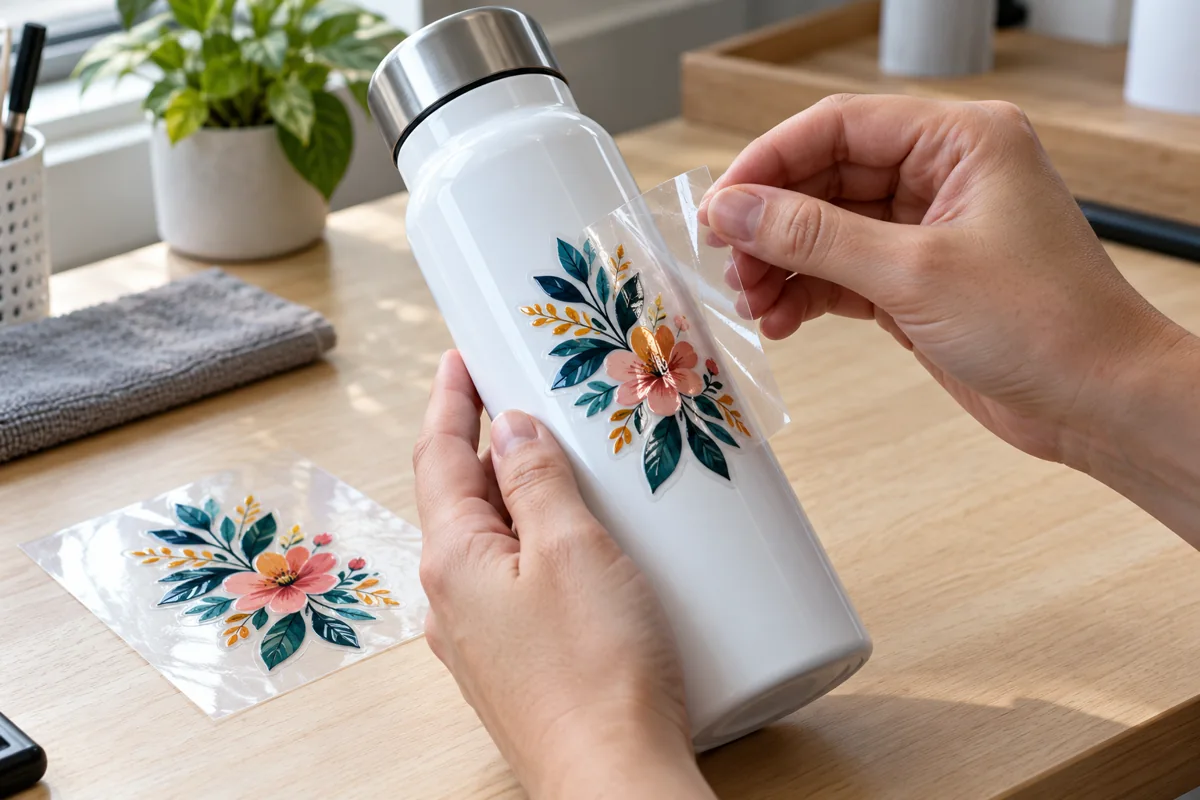
In a standard A/B workflow, the design is printed and UV-cured on the specified adhesive A film. Matching B carrier film is laminated according to the system instructions. The transfer is positioned on the prepared object, applied as specified and the carrier removed carefully.
Lamination is therefore part of many UV DTF workflows. Do not assume that an A+B label means no laminating step is needed. Follow the exact film and machine instructions, including any conditioning or care period after application.
3. How is UV DTF different from garment DTF?
Garment DTF uses compatible textile ink, PET film, hot-melt adhesive powder, curing and heat pressing onto suitable fabric. Standard UV DTF hard-surface transfers use a different ink and film system. Do not substitute one process’s consumables for the other.

For T-shirts and hoodies, start with a tested textile process. For hard goods, evaluate UV DTF on the actual surface and agree its care requirements. A raised glossy finish does not establish wash durability on clothing.
4. What equipment and consumables are needed?
Plan a suitable UV DTF printer, compatible ink, matched films, the required laminating arrangement and supported software. Include workspace, installation, training, maintenance and the safety measures required by the equipment and consumables.
For example, review the Audley A3 UV DTF printer, UV DTF CMYKWV ink and 12-inch UV DTF A+B film. Confirm that the exact combination is supported and check the current inclusion list. For a wider system, compare the appropriate 24-inch UV DTF printer and its specified media.
5. What should be tested before selling the finished item?
Use the blank, coating and artwork you actually intend to sell. Inspect transfer edges, fine detail, colour and adhesion, then evaluate the intended care conditions using suitable supplier guidance or testing. Keep an approved sample as a reference.
Do not infer dishwasher safety, food-contact approval or outdoor service life from a generic water-resistance claim. Do not promise first-week production, doubled revenue or a fixed payback period without evidence from your own operation.
Your first practical step
Choose one customer application and request a sample on that exact product. Record the full process, costs and handling time. That gives you a useful basis for choosing equipment and setting customer expectations, rather than relying on a glossy demonstration alone.


LEAVE A COMMENT