

UVDTF Printing – The Ultimate Future Forecast for a Game-Changing Technology
The future of UVDTF printing is most useful to a print business when it is framed as a set of decisions to test. More applications, improved handling and automation may create opportunities, but they do not remove the need for compatible materials and an approved sample.
Build an investment decision around the products customers request and the output your shop can deliver reliably. Predictions about an entire industry are not a production plan for an individual business.
Chat with our team for printers, consumables, film, powder and business setup guidance.
Start with suitable hard-surface products
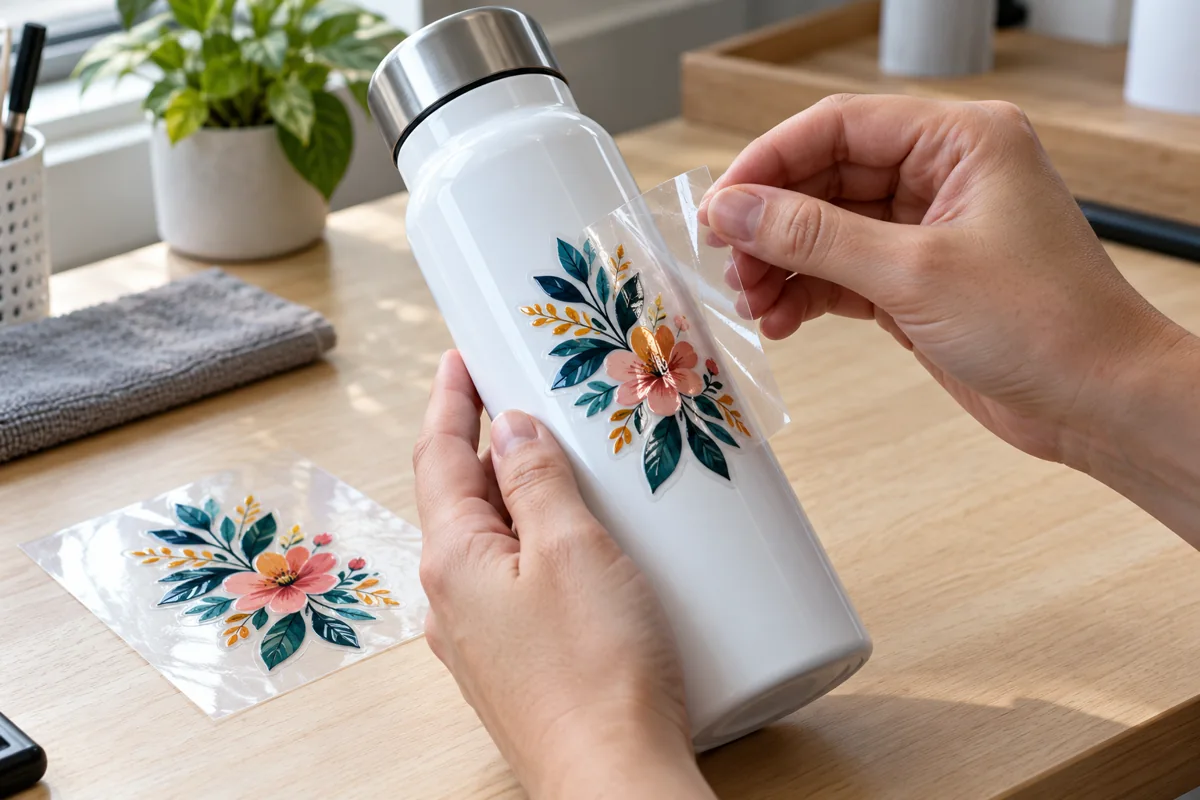
UV DTF can be evaluated for compatible bottles, acrylic gifts, signage and other hard objects that are awkward to print directly. The transfer process can separate printing from application, which may help a shop organise small personalised orders.
Surface coatings, texture, curvature and care conditions still matter. Do not promise adhesion to every material or assume that a successful sample on one bottle applies to another supplier’s coating.
Look for better repeatability
Useful developments include more consistent media handling, easier supported maintenance and clearer workflow controls. Assess them by a repeat batch, not only a demonstration of one attractive sample.
Keep records of the blank, ink, film, settings and application method. These records help you determine whether a change improves repeatability or merely changes the appearance of one print.
Evaluate automation against the complete workflow
Automated feeding and lamination may reduce particular handling tasks, but need appropriate setup and trained supervision. Time the whole batch, including loading, cutting, application and inspection. The slowest stage may be outside the printer.
Compare current equipment such as the Audley A3 UV DTF printer and Audley 24-inch UV DTF printer against your actual order sizes. Request the present specification, inclusion list and support terms. A future feature mentioned in industry discussion is not necessarily included in the machine offered today.

Keep materials and care requirements explicit
Use the specified UV DTF ink and matched UV DTF A+B film where compatible. Standard hard-surface UV DTF is a different process from textile DTF with hot-melt powder and heat pressing.
Scratch resistance, water resistance, outdoor life and dishwasher suitability describe different tests. Request evidence for the exact intended use. Avoid unqualified claims such as “scratch-proof”, “works everywhere” or “safe for every product”.
Treat environmental and safety claims as evidence questions
Ask for the relevant safety data, handling instructions and any application-specific certification being claimed. A change in curing technology does not establish that an ink, transfer or finished item is harmless in every setting.
Follow the equipment and consumable instructions for installation, ventilation, maintenance and waste handling. Do not use a sales label as a substitute for that information.
A realistic way to explore a new market
- Choose one product range for which there is identifiable demand.
- Approve a sample on the exact blank and define the care instructions.
- Measure the material, handling and reject costs of a small batch.
- Check delivery commitments and after-sales support.
- Expand only when repeatability and repeat demand support the decision.
UV DTF may broaden a shop’s hard-goods offering. It does not automatically replace sublimation, textile DTF, DTG or direct UV printing. Each process should be selected for the finished product it can produce reliably.




LEAVE A COMMENT