
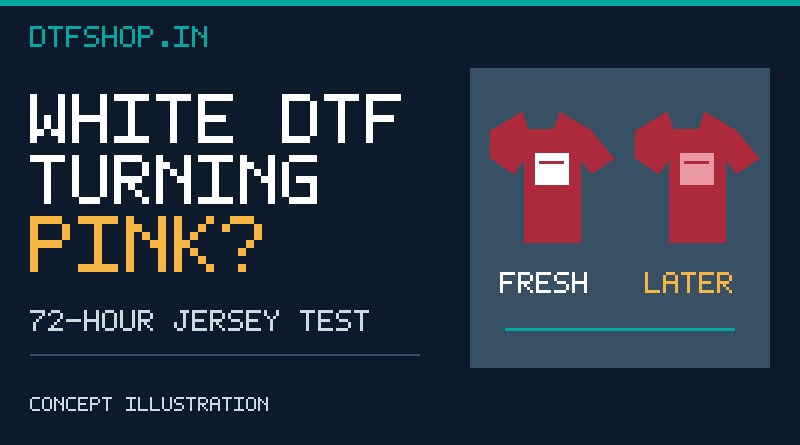
White DTF Prints Turning Pink on Polyester Jerseys? A 72-Hour Dye Migration Test
A white sponsor logo looks perfect when the heat press opens, but the next morning it has turned pink on a red polyester cricket jersey. The print may still be firmly attached. This is a classic warning sign of DTF dye migration on polyester, rather than necessarily a fault in your white ink. Here is a practical sample approval test for Indian sportswear, school uniform and teamwear decorators.
Why a delayed colour check matters
A 23 November 2026 report citing CITI described stronger September textile and apparel exports, while apparel exports remained weaker over the first half of the fiscal year. This is broad industry context, not a DTF demand statistic. For shops taking repeat jersey orders, a documented approval sample is a practical way to control the cost of rework regardless of market conditions.
Chat with our team for printers, consumables, film, powder and business setup guidance.
1. Distinguish dye migration from a printing fault
Disperse dyes used in polyester and sublimation decoration can move into a heat-applied graphic when exposed to heat. A white logo may take on the garment’s colour, and the change may develop after pressing. Transfer Express’s technical guidance explains this phenomenon and the use of compatible low-temperature or blocking transfer systems. A pink cast on a red jersey is different from a missing white nozzle, an insufficiently opaque white layer or a peeling adhesive. If the transfer looks wrong on the film before pressing, inspect the printer and RIP first. If the colour appears only after application on the suspect polyester, migration becomes a stronger possibility. Neither observation alone is conclusive.
2. Prepare three matched comparison groups
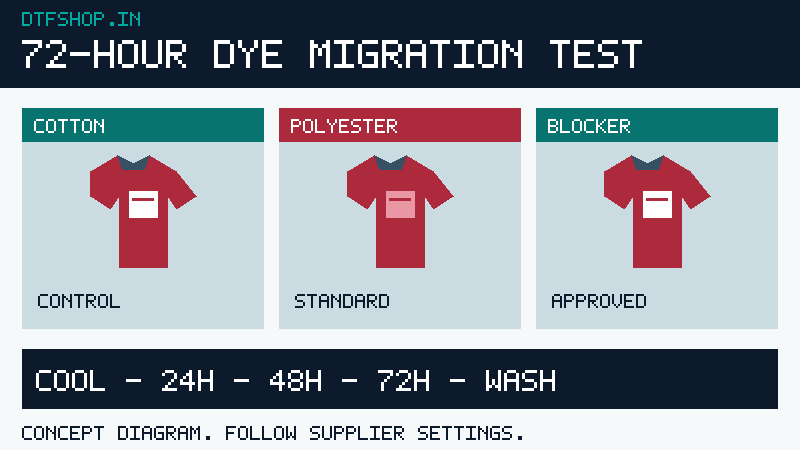
Use the actual garment colour and dye lot intended for the order. Reserve sacrificial blanks or representative offcuts with the same finish. Print identical white and pale-colour test graphics. Group A is a known-good light cotton control with the standard transfer; group B is the suspect polyester with the same standard transfer, provided the supplier permits that substrate; group C is the same polyester with a supplier-approved dye-blocking transfer system. Make at least two specimens per group when material permits, one for retention and one for washing. Keep artwork and ink batch constant wherever the systems allow. Cotton is a diagnostic reference, not an equivalent fabric. Group C may need different application settings; compare complete approved systems rather than claiming the powder alone caused the difference.
Ask your supplier whether the film, powder, ink, cure and finishing steps are compatible with the intended polyester or sublimated fabric. Record garment and consumable lot numbers, press model, actual approved recipe, operator and date. Follow the garment care label. Do not apply an incompatible standard transfer merely to complete the comparison.
3. Apply and cool without adding unnecessary heat
Use the transfer and press manufacturers’ specified temperature, dwell, pressure, peel method and finishing sequence. Verify temperature by the press manufacturer’s recommended method when calibration is in doubt. Low-temperature application can help only when the adhesive is designed to bond at that temperature. Reducing a standard powder’s cure or press temperature without approval risks poor adhesion. Avoid extra finishing presses unless required, and never handle hot platens. Let samples cool separately on a clean surface under the supplier’s instructions rather than piling warm garments together.
4. Inspect after cooling, 24, 48 and 72 hours
Store the labelled samples together at ordinary room conditions, protected from sunlight, contamination and unnecessary heat. Compare under consistent neutral lighting against the retained reference. Photograph with the same lighting, camera settings and neutral reference card where practical; photos are a visual record, not calibrated colour measurements. Score each specimen: 0 = no visible change, 1 = slight tint, 2 = obvious tint, 3 = unacceptable discolouration. Agree acceptance criteria with the customer before production. For an approved white logo, any visible tint may be unacceptable. A DTF sportswear practitioner guide from Brandum likewise recommends testing before committing to a large job. Our 72-hour screen is a conservative shop checkpoint, not a formal test standard or proof that migration cannot occur later.
After the supplier’s minimum waiting period and the planned 72-hour inspection, wash the designated specimens according to the garment and transfer care instructions. Recheck colour, edge adhesion and cracking after drying. Keep the unwashed reference. For contractual colour tolerances or unusually demanding service conditions, arrange suitable laboratory testing.
5. Interpret the results before buying new consumables
If A remains white, B becomes pink and C remains acceptable, the evidence supports a substrate-specific migration problem and the approved C workflow is a candidate for production. If A and B are already tinted immediately, inspect the white ink, RIP, printhead and opacity. If B and C both change, hold the order and ask the garment and transfer suppliers about a compatible alternative. If C stays white but peels, it still fails: colour blocking and bond strength are separate acceptance criteria. A specialist dye-blocking heat-transfer vinyl may be a suitable alternative when compatible with the job; STAHLS’ silicone dye-block product is an example of a purpose-built alternative, not a DTF powder or a recipe for DTF.
6. Worked example: 150 team jerseys
Assume an order of 150 jerseys and a hypothetical direct replacement cost of ₹240 per rejected decorated garment. If ten jerseys develop unacceptable tint, direct replacement costs ₹2,400 before freight and labour. Six sacrificial sample garments at the same illustrative cost total ₹1,440. In that scenario, preventing ten rejects would leave ₹960 in avoided direct cost after the samples, before extra consumables or labour. These are example assumptions, not DTFShop prices, predicted defect rates or guaranteed savings. For expensive blanks, ask the supplier for representative same-lot offcuts to lower test costs.
7. Record a repeatable approval
Keep a job sheet with fabric type, colour and lot; transfer system and lot; cure and press recipe; cooling/peel method; photographs at each interval; wash result; and owner/customer approval. Repeat the screen when the garment dye lot or transfer recipe changes. Do not release an unvalidated batch merely because the deadline is close. For related problems, see our polyester adhesion guide, sportswear printing guide and colour proofing checklist.
FAQs
Will adding more white ink stop dye migration? Not reliably. Opacity and resistance to migrating dye are different properties. Increasing ink may also affect the transfer’s feel and cure.
Is every black DTF powder a dye blocker? No. Colour alone does not establish blocker chemistry or compatibility. Request the technical data and approved workflow from the supplier.
Can I lower press temperature for any DTF film? No. Use only a compatible system with documented low-temperature bonding and peel requirements.
Can a pink logo be fixed by pressing again? Do not assume so. Extra heat may worsen migration; an unacceptable specimen should be held for evaluation or remade using a validated alternative.
Choose the right consumables for your jersey order
Visit DTFShop.in for DTF film, ink, powder and technical support. Share the garment type, colour, whether it was sublimated, your current consumable specifications and the sample inspection results. Ask for a compatible system and test quantity before committing to bulk material. No particular DTFShop consumable is represented as a dye blocker without its product documentation.



LEAVE A COMMENT