
How to Fix DTF Print Adhesion Problems on Polyester Fabric 2026
Introduction to Hot Melt Adhesive Powder in DTF Printing
DTF printing works very well on polyester. It is widely used for sportswear, uniforms, jerseys, fashion garments, and promotional clothing. But polyester can be a little less forgiving than cotton.
If the transfer starts lifting from the edges, peeling after washing, or failing to bond properly, the problem is usually somewhere in the DTF process. It may be the adhesive powder, curing, heat, pressure, fabric finish, or even the timing of the transfer.
Chat with our team for printers, consumables, film, powder and business setup guidance.
This is why DTF Print Adhesion on Polyester Fabric needs to be treated as a complete process rather than simply increasing the heat.
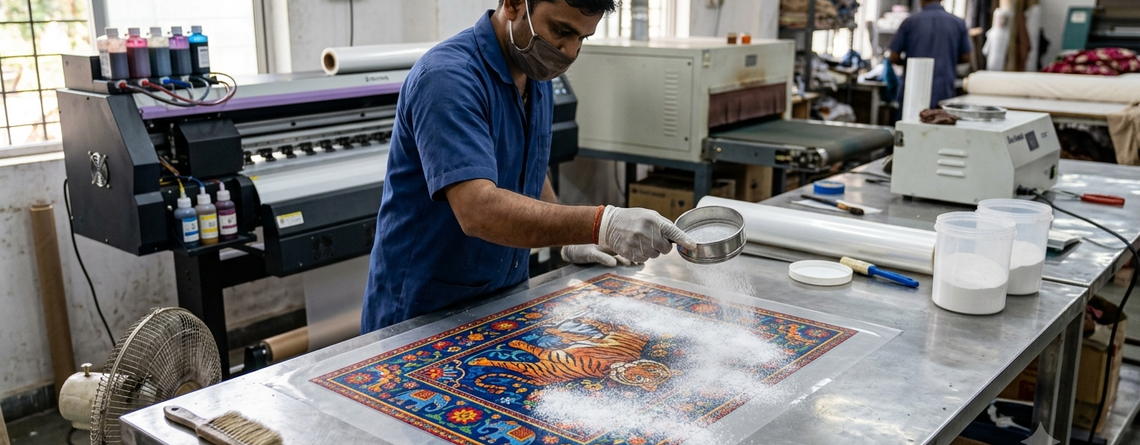
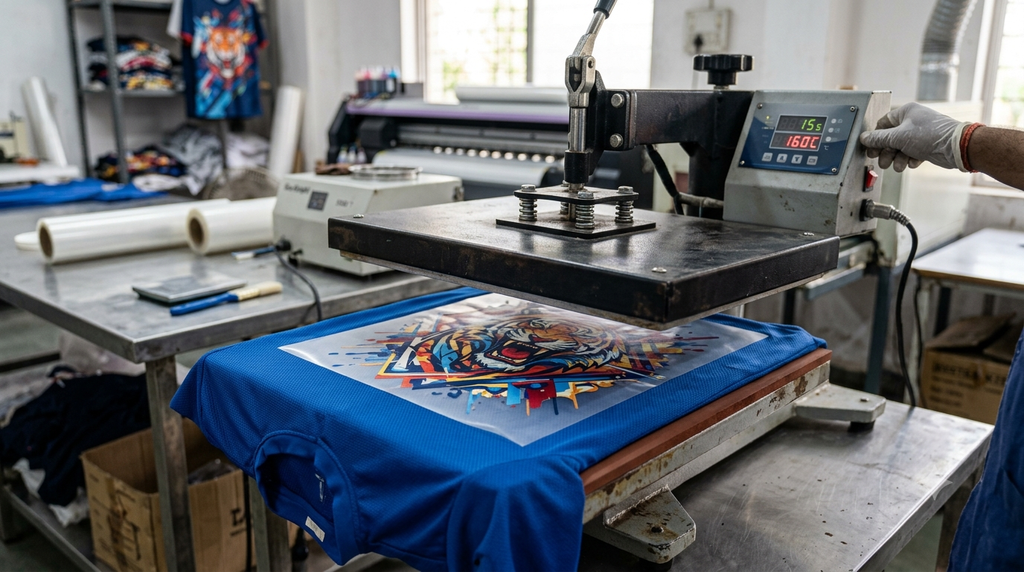
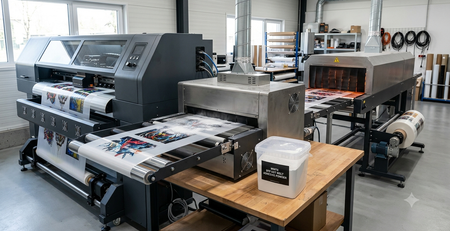
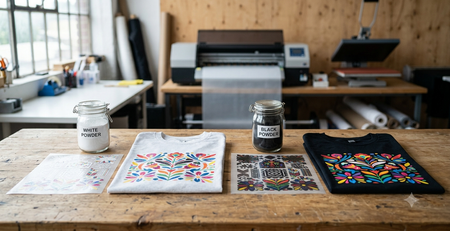
A DTF transfer normally contains printed ink, adhesive powder, and a PET film carrier. The adhesive powder melts during curing and later bonds the printed design to the garment. FESPA describes the DTF process as printing onto film, applying adhesive powder, curing it, and then transferring the design to the textile.
Polyester can accept DTF transfers, but the correct combination of powder, temperature, pressure, and time matters.
Why Hot Melt Powder is Essential for DTF Transfers
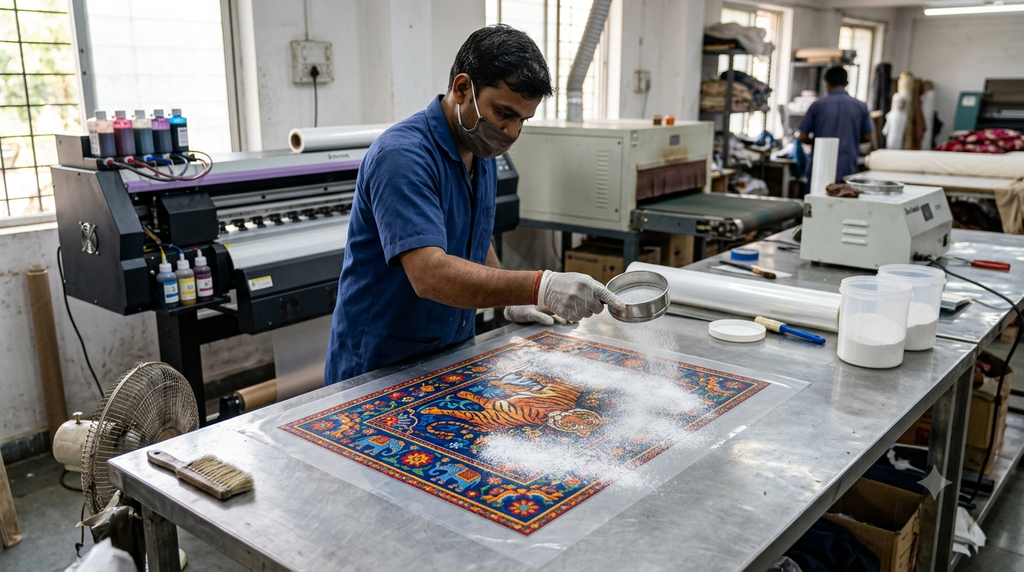
Hot melt powder is the bonding layer between the printed DTF design and the fabric.
Without enough adhesive powder, the design may look perfect immediately after pressing but begin to lift later. Too much powder can create a thick or rough finish. Uneven powder can also produce weak areas.
For polyester, this becomes even more important because the fabric surface is smooth and may contain finishing treatments.
A common mistake is to assume that more heat will solve poor DTF Print Adhesion on Polyester Fabric. It does not always work that way.
If the powder is not properly cured, increasing the final press temperature may not create a reliable bond. On the other hand, excessive heat can increase the risk of polyester damage or dye migration.
The better approach is to control the entire process.
Key Features to Look for in Quality DTF Adhesive Powder
When choosing DTF powder for polyester, look at more than just the price per kilogram.
1. Consistent particle size
Powder should spread evenly over the wet printed area. Inconsistent particles can cause uneven coverage.
2. Good flexibility
A soft TPU-based powder is commonly used for apparel because the finished transfer needs to flex with the fabric.
3. Reliable melting behavior
The powder should melt consistently during curing without burning or creating excessive residue.
4. Wash durability
A good transfer should remain bonded after normal washing when the garment and transfer are processed according to their recommended settings.
5. Suitable for synthetic fabrics
Always check the supplier’s recommended fabric compatibility. Polyester, nylon, cotton, and blends can behave differently.
6. Low tendency to clump
Moisture can make adhesive powder clump. Clumped powder is difficult to distribute evenly and can create weak spots.
For DTF Print Adhesion on Polyester Fabric, consistency is often more important than simply choosing the cheapest powder.
Top Hot Melt Adhesive Powder Brands Available in India
The Indian market has many DTF powder suppliers. Prices, pack sizes, particle sizes, and specifications can change, so test a small quantity before moving to bulk production.
Living Lion
Living Lion lists TPU hot melt powder for DTF printing and offers it in bulk quantities. Its listed product specifications include powder intended for DTF PET film and a soft adhesive application.
This type of powder can be considered when a print shop wants a reasonably priced consumable for regular production. Always run a wash and stretch test on your own polyester garments before committing to a large order.
BhartiPrint (Bharti Creation)
BhartiPrint lists TPU hot melt powder for DTF heat-transfer printing. The company also provides DTF printing services, which can be useful for businesses that do not want to maintain a complete printer setup.
For a small apparel business, buying ready-made DTF transfers can sometimes be more practical than producing every transfer in-house.
Desmat Sublimation (Koncept)
Desmat Sublimation, also known as Koncept in the printing market, is another name buyers may encounter while comparing textile-printing consumables.
When comparing powders, do not judge only by the brand name. Ask for the technical specifications, recommended curing range, particle size, and fabric compatibility.
3alps Digital Printers
3alps Digital Printers is listed among Indian DTF suppliers and printing-equipment businesses. Buyers looking at bulk powder should confirm the minimum order quantity and exact powder specification before ordering.
For production shops, consistency from one batch to another is important. A cheaper powder is not necessarily cheaper if it creates peeling, rework, or rejected garments.
Shagun Enterprise
Shagun Enterprise supplies DTF equipment and hot melt adhesive products. Its published DTF information references PET film and hot melt powder in the DTF workflow.
This type of supplier may be worth considering when you are sourcing multiple parts of a DTF setup rather than powder alone.
InksfyDTF (Etsy India)
Marketplace sellers such as InksfyDTF can be useful for smaller quantities or testing. However, marketplace listings can change, so check the current product specifications, seller information, quantity, and shipping terms before ordering.
Kamicraftsales (Etsy India)
Kamicraftsales is another Etsy seller that can be considered when comparing small-batch craft and transfer supplies.
For commercial polyester printing, however, it is better to test the actual powder on your own garment rather than assuming that a powder performing well on cotton will produce identical results on polyester.
Price Range of DTF Hot Melt Powder in India (per kg)
DTF powder pricing in India varies widely according to particle size, polymer type, quality, packaging, quantity, and supplier.
Public listings currently show examples around ₹400–₹900 per kg, while some premium or specialized powders can cost more.
For example, Living Lion publicly lists a DTF hot melt powder around ₹450/kg, while other Indian supplier listings show different prices depending on MOQ and specifications.
Do not select powder only because it has the lowest price.
Suppose Powder A costs ₹450/kg but causes 5% of your polyester transfers to fail. Powder B costs ₹700/kg but gives much more consistent results. Powder B may actually cost less after accounting for wasted garments, film, ink, labor, and customer complaints.
Comparison of Indian Brands: Performance & Quality
A simple way to compare powders is to run the same test.
Use the same:
- Polyester fabric
- DTF film
- DTF ink
- Design
- Powder quantity
- Curing method
- Heat press
- Pressure
- Press time
Then compare the results.
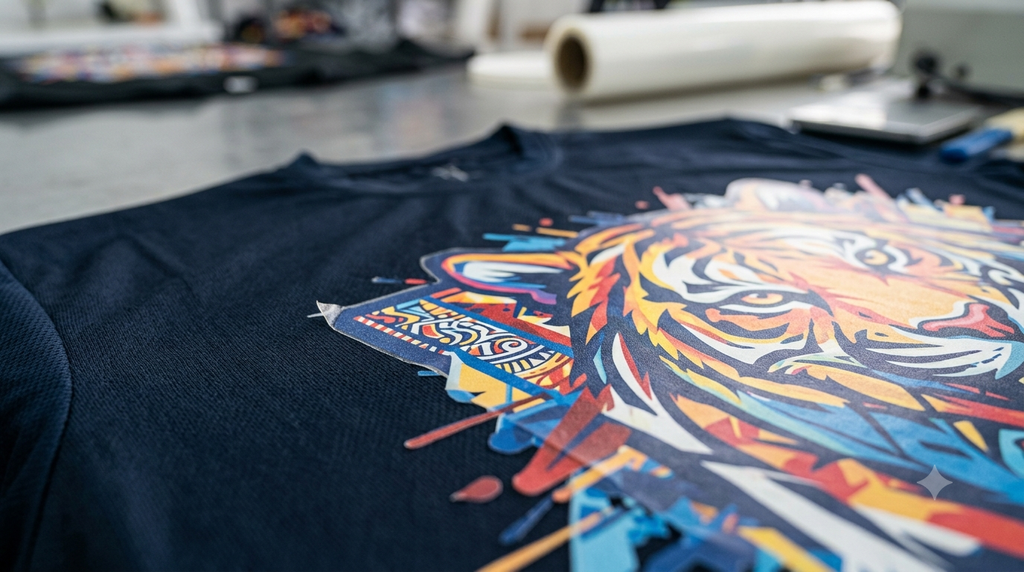
Check the edges immediately after pressing. Next, stretch the garment gently. Finally, perform several normal wash tests.
For DTF Print Adhesion on Polyester Fabric, the most useful test is not how the transfer looks immediately after pressing. The real test is how it behaves after washing, stretching, and regular garment use.
A practical scoring sheet can include adhesion, softness, stretch, wash resistance, color appearance, and edge lifting.
Where to Buy Hot Melt Adhesive Powder in India (Online & Offline)
You can source DTF powder through specialist DTF suppliers, textile-printing distributors, marketplaces, and local printing-equipment dealers.
Online buying is convenient, but check:
- Product specifications
- Particle-size range
- Material type
- Minimum order quantity
- Manufacturing date
- Storage instructions
- Seller support
- Return policy
For larger production, buying locally can have an advantage because you may be able to inspect samples and discuss the powder with the supplier.
If you already use a DTF printer, ask your supplier whether the powder is compatible with your current film, ink, curing system, and polyester garments.
Tips for Storing and Using DTF Hot Melt Powder
Storage is often overlooked.
Keep powder sealed when it is not being used. Moisture can cause clumping, and clumped powder will not distribute properly.
Store it away from direct sunlight and excessive heat. Use clean, dry equipment when applying the powder.
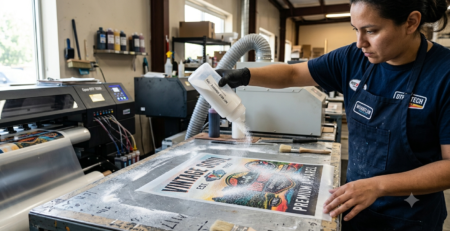
During production, apply powder while the printed ink is still suitable for powder coating. Spread it evenly and remove excess powder before curing.
Do not keep changing several settings at the same time.
For example, if a polyester transfer is peeling, first check the powder application. Then check curing. Then check heat-press pressure and time. This makes troubleshooting much easier.
A practical troubleshooting checklist
Problem: Edges are lifting
Check pressure, powder coverage, garment surface, and press contact.
Problem: Entire print peels
Check powder curing, transfer temperature, and whether the adhesive is suitable for the fabric.
Problem: Print looks good but fails after washing
Check curing and final pressing. Also check whether the garment manufacturer has applied a finish that affects adhesion.
Problem: Polyester changes color
Reduce unnecessary heat exposure and investigate dye migration. Some polyester and especially sublimated garments are more sensitive to heat.
Problem: Powder feels rough
Check whether too much powder has been applied or whether excess powder was not removed properly.
Problem: One side sticks better than the other
Check whether your heat press is applying even pressure. Uneven pressure can create inconsistent bonding.
The key lesson is simple: DTF Print Adhesion on Polyester Fabric is controlled by balance. More heat is not automatically better.
Frequently Asked Questions (FAQs)
Does DTF stick to polyester?
Yes. DTF can be used successfully on polyester and polyester blends when the transfer materials and pressing process are suitable for the fabric.
Why is my DTF transfer peeling from polyester?
Common reasons include poor powder coverage, incomplete curing, unsuitable press settings, uneven pressure, fabric coatings, or excessive heat exposure.
What powder is best for polyester DTF?
There is no single powder that is best for every polyester garment. TPU-based DTF powders are commonly used for flexible apparel transfers, but the supplier’s fabric and temperature recommendations should be checked.
Should I increase heat when DTF is not sticking?
Not immediately. First check powder coverage, curing, pressure, film type, and garment condition. Too much heat can create other problems with polyester.
Can sublimated polyester be used with DTF?
It can be challenging because sublimation dyes can migrate when exposed to heat. Always test the actual garment before commercial production.
How can I improve DTF wash durability?
Focus on complete powder curing, correct heat-press pressure and time, suitable adhesive powder, and proper post-pressing. Then perform your own wash test.
Is expensive DTF powder always better?
No. Price is only one factor. A powder should be judged by adhesion, flexibility, wash durability, consistency, and compatibility with your workflow.
Conclusion: Best Brand Recommendation for Indian DTF Businesses
There is no universal winner for every DTF printing business.
If you are starting small, focus on a powder that is available in manageable quantities and can be tested before bulk purchase. If you operate a larger production unit, consistency, batch quality, technical support, and reliable supply are more important.
For DTF Print Adhesion on Polyester Fabric, the best approach is to test two or three suitable powders on the exact polyester garments you normally print. Compare the transfers after pressing, stretching, and washing.
Also remember that powder is only one part of the process. Good PET film, compatible ink, correct powder application, proper curing, and even heat-press pressure all work together.
A strong-looking transfer that fails after the first few washes is not a successful transfer.
Take the time to test your settings, record what works, and keep the same production conditions once you find a reliable combination. That simple habit can reduce waste and make polyester DTF printing much more predictable.
Product Suggestions (blue color)
These are relevant DTFShop.in products that can naturally support the workflow discussed above. Current listings include DTF printers, hot-melt powder, and consumables.
- <span style=”color:blue”>🔵 ProlificGeeks DTF Printer L18050</span> — compact converted DTF option for smaller production.
- <span style=”color:blue”>🔵 XP600 DTF Printer with Powder Shaker</span> — useful when you want printing and powder handling in one workflow.
- <span style=”color:blue”>🔵 I3200 DTF Printer with Vacuum Powder Shaker</span> — aimed at higher-volume production.
- <span style=”color:blue”>🔵 DTF Hot Melt Powder 1KG, 80–200 Micron</span> — a directly relevant consumable for testing DTF adhesion.
- <span style=”color:blue”>🔵 DTF Hot Melt Powder 5KG, 80–200 Micron TPU</span> — a larger-pack option for regular production.
Browse DTFShop.in DTF Printers
External References + Credits
- FESPA – Printing Direct-to-Film Transfers — useful background on DTF printing, powder application, curing, and textile compatibility.
- FESPA Hellas – DTF Direct-to-Film Overview — explains the DTF workflow and use on polyester and other textiles.
- ResearchGate — useful for finding technical and academic research related to textile printing and adhesive materials.
- PrintIndustry and InkJetInsights can also be used as industry-reading references when expanding the article with additional technical material.
Credit: Information references from Fespa, PrintIndustry, and other public sources.

LEAVE A COMMENT