
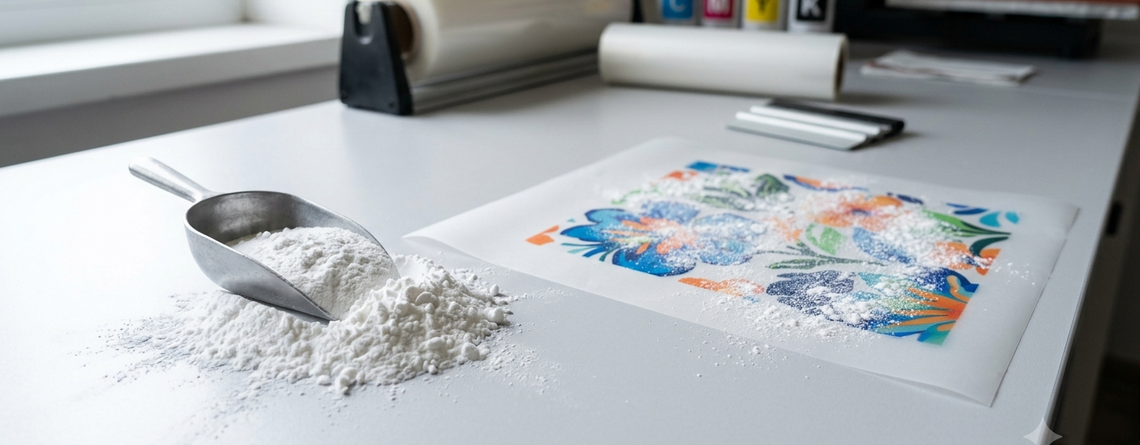
Eco-Friendly DTF Printing in India: Ultimate Guide to Sustainable Printing 2026
DTF printing has become a practical option for Indian apparel businesses. Small T-shirt shops, online sellers, uniform suppliers, and custom-merchandise businesses can produce colourful designs without maintaining large inventories.
But the printer and ink are only part of the process. Hot melt adhesive powder is equally important because it helps the printed design bond to the garment.
Chat with our team for printers, consumables, film, powder and business setup guidance.
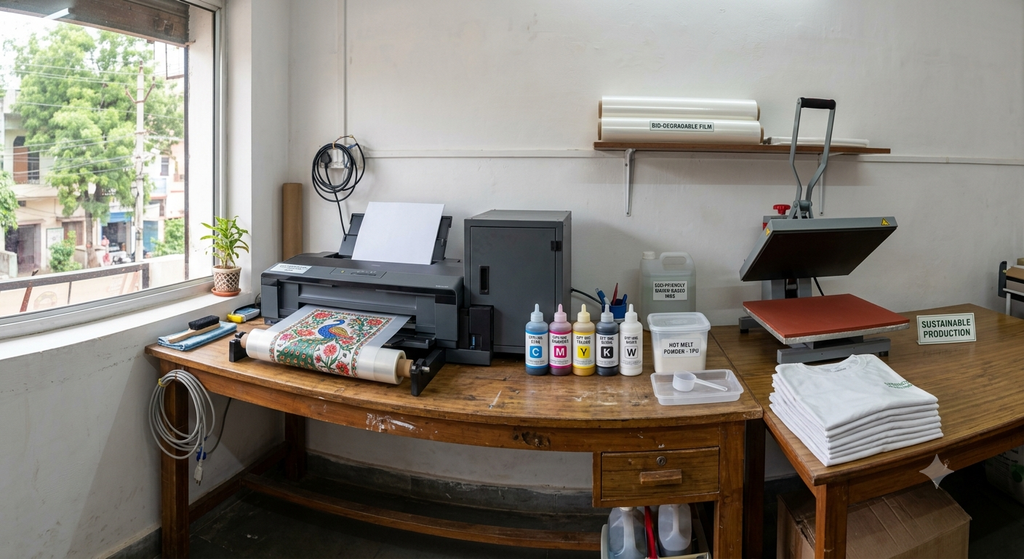
This is also where Eco-Friendly DTF Printing in India becomes an important discussion. Sustainable printing is not simply about buying an ink labelled “eco.” The complete workflow matters — ink, film, powder, energy use, waste, maintenance, and how efficiently material is used.
FESPA has also highlighted that DTF can support on-demand production, but the process still creates film and other waste. Better material usage and responsible waste collection can reduce the environmental impact.
For Indian printers, the practical goal is simple: get reliable transfers while reducing unnecessary waste.
Why Hot Melt Powder is Essential for DTF Transfers
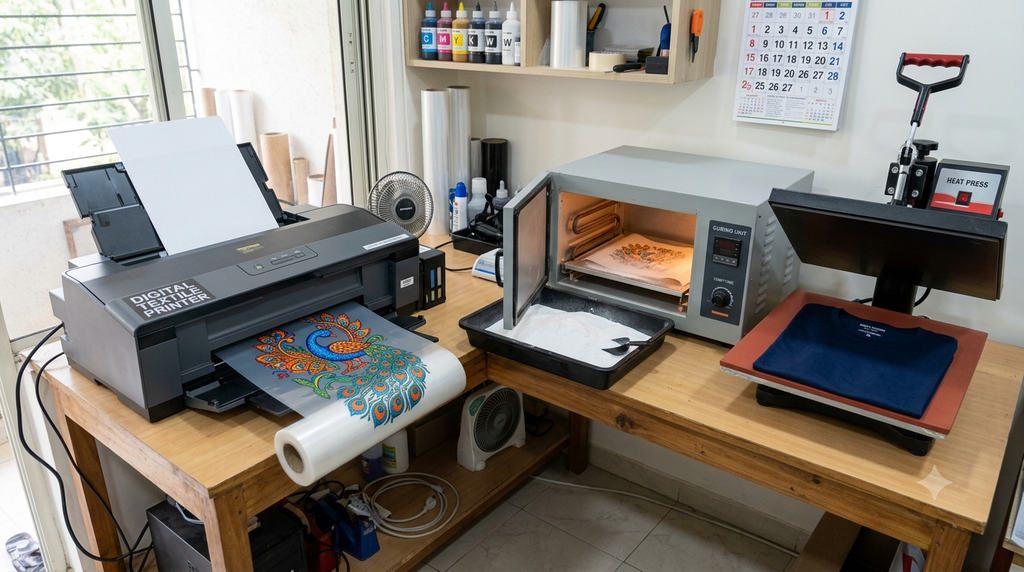
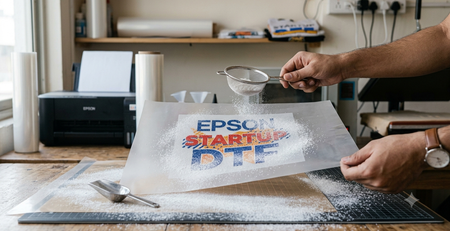
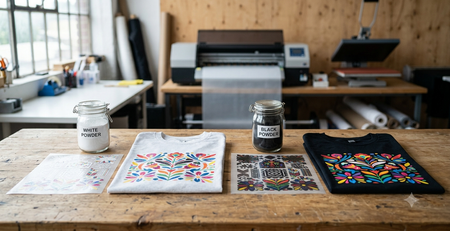
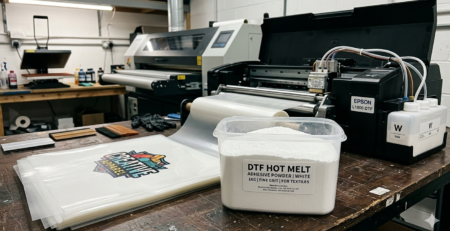
After the CMYK and white ink are printed onto DTF film, adhesive powder is applied to the wet print. The powder is then heated so that it melts and bonds with the printed layer.
During heat pressing, this adhesive helps the design attach to the fabric.
Without suitable powder, even a beautiful print can fail after transfer.
A good powder should provide:
- Reliable adhesion
- Even melting
- Good wash resistance
- A reasonably soft hand feel
- Consistent results between batches
- Compatibility with the selected film and ink
FESPA’s practical DTF workflow also describes applying adhesive powder evenly, removing excess powder and heating the adhesive before transferring the design to the garment.
For Eco-Friendly DTF Printing in India, avoiding failed transfers is important too. Every rejected T-shirt means wasted ink, film, powder, electricity and fabric.
Key Features to Look for in Quality DTF Adhesive Powder
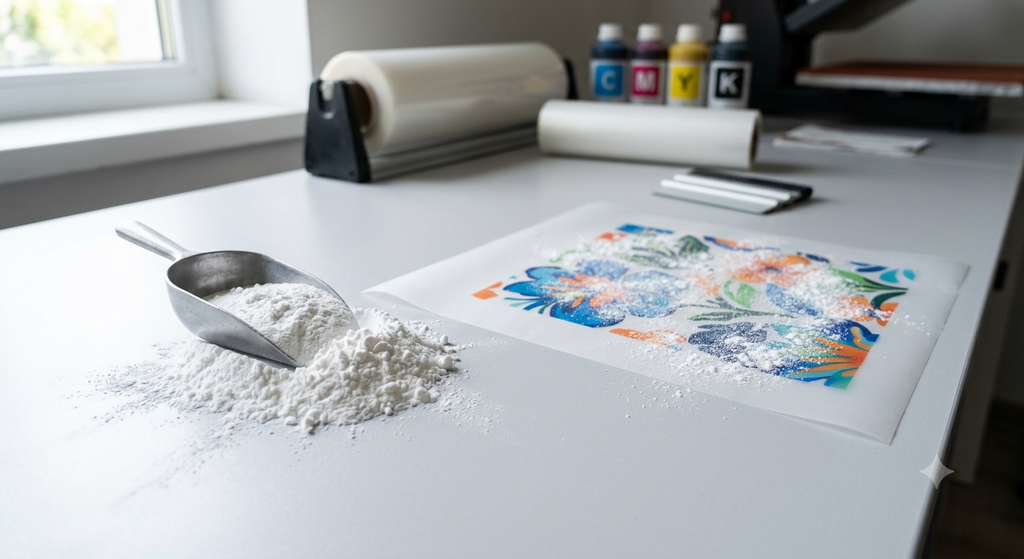
Not every white powder will behave the same way.
Before buying, check these points.
1. Particle size
Powder particle size affects how easily it covers the printed area. Fine and consistent particles can be useful for detailed designs, but the right specification depends on the application.
2. Melting behaviour
The powder should melt consistently during curing. Uneven melting can cause weak bonding or an unpleasant surface texture.
3. Wash resistance
Always test the finished transfer after normal washing. A powder that looks good immediately after pressing may not perform equally well after repeated washes.
4. Hand feel
For fashion T-shirts, customers usually prefer prints that do not feel excessively heavy or stiff.
5. Fabric compatibility
Cotton, polyester and blended fabrics can behave differently. Test your actual garments rather than relying only on a supplier’s general claim.
6. Packaging and storage
Moisture can affect powder handling. Keep the material sealed and stored in a clean, dry environment.
A simple test is often more useful than a long product specification sheet. Print the same design using two powders, press them under the same conditions, and compare adhesion and wash performance.
That is a sensible approach to Eco-Friendly DTF Printing in India because it reduces trial-and-error waste.
Top Hot Melt Adhesive Powder Brands Available in India
The Indian market has several suppliers worth comparing. The following names appear in current Indian DTF supply listings and industry comparisons. Actual performance can vary with the printer, ink, film, curing method and fabric.
Living Lion
Living Lion supplies DTF materials including PET film, DTF ink and hot-melt powder. Its listed TPU powder products include 1 kg packs, although some listings have minimum-order requirements for wholesale purchases.
For a commercial printer, the important point is to confirm the exact grade, particle size, minimum quantity and current quotation before ordering.
BhartiPrint (Bharti Creation)
BhartiPrint lists TPU hot melt powder for DTF printing. Its current product page lists the powder at ₹500/kg, while noting that pricing can vary with quantity and other factors.
This can make it an option for businesses comparing standard commercial powders. Still, a sample test is worthwhile before switching an entire production line.
Desmat Sublimation (Koncept)
Desmat Sublimation is another supplier to consider when comparing DTF consumables.
For this option, ask for the exact powder grade, particle specification, recommended curing conditions and pack size.
For Eco-Friendly DTF Printing in India, consistency is often more useful than simply selecting the lowest price.
3alps Digital Printers
3alps Digital Printers supplies DTF equipment and consumables. It can be worth considering if you prefer to source multiple parts of a DTF setup from one supplier.
Before ordering powder, confirm that its recommended specifications match your film, ink and curing setup.
Shagun Enterprise
Shagun Enterprise supplies DTF-related materials including hot-melt powder and PET film.
Current market listings show powder prices around the ₹799–₹800/kg level for some products, although prices and availability can change.
InksfyDTF (Etsy India)
InksfyDTF is an online marketplace option that may be more suitable for smaller purchases.
For marketplace buying, check the current listing, quantity, seller information, reviews, shipping cost and product specification before ordering.
Kamicraftsales (Etsy India)
Kamicraftsales is another marketplace option that can be considered by smaller DTF users.
For a home-based or low-volume operation, buying a smaller quantity first can be sensible. It lets you test the material before committing to bulk stock.
Price Range of DTF Hot Melt Powder in India (per kg)
Prices vary by grade, supplier, particle size, packaging and order quantity.
A practical current market range is roughly:
| Quality Level | Approximate Price |
|---|---|
| Economy | ₹450–₹700/kg |
| Standard | ₹700–₹1,100/kg |
| Premium | ₹1,100–₹1,800+/kg |
Individual listings can be lower or higher. For example, Living Lion currently lists certain products around ₹450/kg, while BhartiPrint lists its TPU powder at ₹500/kg.
Do not judge powder only by the price per kilogram.
Suppose a cheaper powder causes 5% of your transfers to fail. The apparent saving can disappear quickly when you add wasted film, ink, garments, labour and electricity.
Comparison of Indian Brands: Performance & Quality
There is no single powder that will be perfect for every DTF printer.
A useful comparison should include:
| Supplier | What to Check | Suitable For |
|---|---|---|
| Living Lion | Grade, consistency, MOQ | Bulk buyers |
| BhartiPrint | Price, wash resistance | Small/medium businesses |
| Desmat | Grade and curing requirements | Commercial printing |
| 3alps | Compatibility and supply | DTF equipment users |
| Shagun Enterprise | Grade and current quotation | Regular production |
| InksfyDTF | Listing and seller details | Small orders |
| Kamicraftsales | Reviews and specifications | Small/home setups |
These should be treated as comparison points rather than laboratory rankings. Current DTF guidance also notes that results can change according to film, ink, fabric, curing and operator settings.
Where to Buy Hot Melt Adhesive Powder in India (Online & Offline)
You can purchase DTF powder from specialist DTF suppliers, printing-equipment dealers and online marketplaces.
Online buying is convenient because you can compare pack sizes and prices. Local suppliers can be useful when you need faster delivery or technical support.
Before placing a large order, ask:
- What is the powder grade?
- What is the particle size?
- Which fabrics are recommended?
- What curing conditions are suggested?
- What is the minimum order quantity?
- Is a sample available?
- What is the current GST-inclusive price?
For Eco-Friendly DTF Printing in India, buying the right amount is also important. Overstocking consumables that are not used efficiently can increase waste.
Tips for Storing and Using DTF Hot Melt Powder
Store powder away from moisture and direct heat.
Keep the packaging properly closed when the material is not being used. Avoid leaving an open bag near the printer or heat-press area.
During production, apply the powder evenly. Remove excess powder instead of allowing loose material to remain around the workspace.
Also keep your work area clean. Loose powder can contaminate equipment and create unnecessary cleanup.
A good production routine is:
Print → Powder evenly → Remove excess → Cure → Transfer → Test
FESPA similarly recommends even powder application, removal of excess powder and controlled heating before garment transfer.
Sustainability is also about efficiency. Better nesting of designs on film, fewer failed prints and sensible material handling can reduce waste.
FESPA has noted that DTF’s sustainability depends partly on how users manage film and production waste, so simply calling a process “eco-friendly” is not enough.
Frequently Asked Questions (FAQs)
Is DTF printing eco-friendly?
DTF can support efficient, on-demand production, but it is not automatically sustainable. Film waste, ink, powder, energy consumption and disposal all matter. Better material planning can reduce unnecessary waste.
What makes DTF ink more sustainable?
Look for inks with credible environmental or chemical-safety certifications where available, and consider the complete printing process rather than the marketing label alone. FESPA has reported continued development of water-based and certified textile ink technologies.
Is hot melt powder necessary in DTF printing?
Yes. It acts as the adhesive layer that helps the printed design bond to the garment during heat transfer.
How much does DTF powder cost in India?
Common market listings currently range from roughly ₹450 to ₹1,800+ per kg depending on grade, supplier and quantity. Always check the latest quotation before purchasing.
Should beginners buy powder in bulk?
Usually, testing a smaller quantity first is safer. Once you confirm adhesion, feel and wash performance with your own printer and garments, you can move to larger quantities.
Which printer works well with DTF powder?
The powder is a consumable used with the DTF workflow rather than something selected by printer model alone. The printer, ink, film, powder and curing process should be treated as one system.
Can DTF printing be made more sustainable?
Yes, to an extent. Reduce failed prints, use film efficiently, choose appropriate ink and consumables, maintain the printer properly and collect production waste responsibly.
Conclusion: Best Brand Recommendation for Indian DTF Businesses
There is no universal “best” hot melt powder for every Indian DTF business.
For a new printer, the smartest approach is to test two or three suitable powders using the same artwork, film, ink, fabric and pressing conditions.
For example, compare adhesion immediately after transfer and then check the garment after normal washing. Also compare hand feel and the amount of wasted powder.
For Eco-Friendly DTF Printing in India, the best choice is ultimately the material that gives reliable production with fewer failed transfers and sensible material usage.
Businesses can also look at the wider DTF setup. Depending on production volume, options such as <span style=”color:blue”>🔵 ProlificGeeks DTF Printer L1800</span>, <span style=”color:blue”>🔵 XP600 DTF Printer</span>, and <span style=”color:blue”>🔵 i3200 DTF Printer</span> can be considered as part of a complete workflow. Current DTF printer comparisons generally position L1800-style machines toward entry-level work, XP600 toward growing businesses, and i3200 toward higher production requirements.
The main lesson is simple: don’t buy on price alone. Test the complete system first, then scale.
That is a more practical path toward Eco-Friendly DTF Printing in India — better consistency, less avoidable waste and a printing workflow that makes sense for your actual business.
Credit: Information references from Fespa, PrintIndustry, and other public sources.

LEAVE A COMMENT