
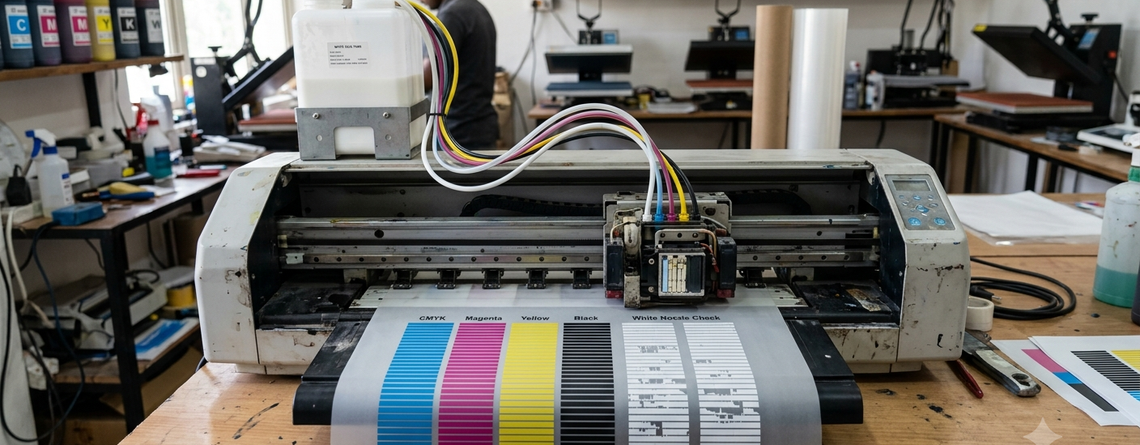
DTF Printer Clogging: Easy Solutions for Better Printing 2026
DTF printing looks simple: print the artwork on PET film, apply powder, cure it and heat press it onto the garment.
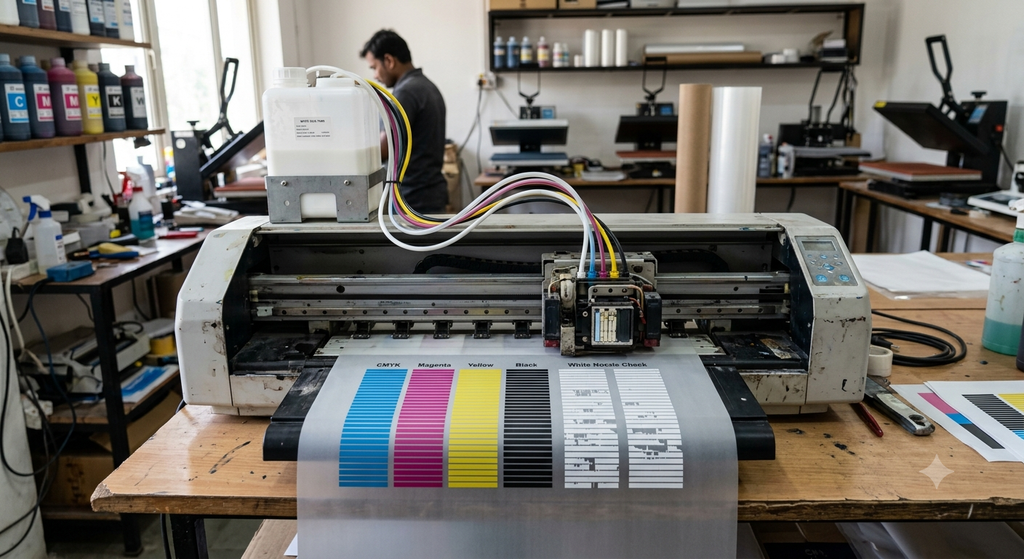
But anyone who runs a DTF printer knows that small maintenance problems can quickly become expensive. One of the most common is DTF printer clogging, especially when white ink is not handled correctly.
Chat with our team for printers, consumables, film, powder and business setup guidance.
Hot melt adhesive powder is not normally the direct cause of a printhead clog. The bigger problem is usually the ink system. However, loose powder, dust and poor cleaning around the printing area can make the overall machine dirtier and increase maintenance problems.
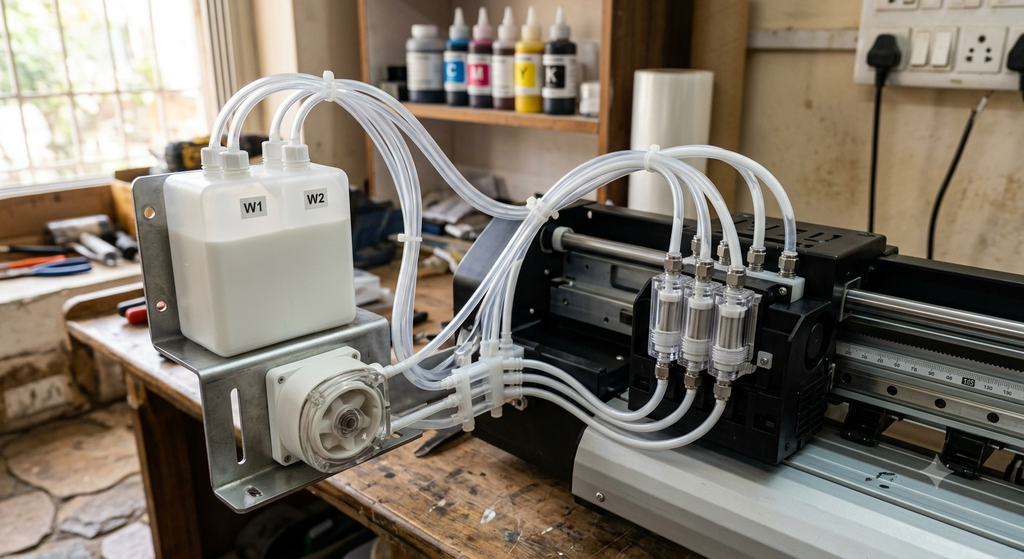
White DTF ink needs special attention because its pigment is heavier than ordinary CMYK ink. When the printer sits unused, pigment can settle inside the tank, ink lines, dampers and printhead.
That is why prevention is much better than waiting for a serious clog.
A good DTF workflow combines the right ink, regular nozzle checks, clean capping parts, proper white-ink circulation and careful handling of film and powder.
Why Hot Melt Powder is Essential for DTF Transfers
Hot melt adhesive powder creates the bonding layer between the printed DTF design and the garment.
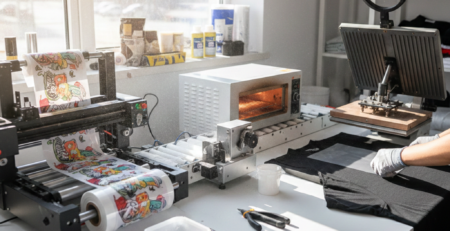
The basic process is:
- Print the design onto PET film.
- Print the white underbase.
- Apply adhesive powder while the ink is still suitable for powdering.
- Remove excess powder.
- Cure or melt the powder.
- Heat press the transfer onto the garment.
The powder itself does not solve DTF printer clogging. In fact, it should be kept away from the printer’s sensitive ink components.
This is important in a small workshop. If excess powder is allowed to spread around the printer, it can mix with dust and ink residue. A clean work area makes maintenance easier and helps the operator notice problems early.
FESPA’s DTF process guidance also describes evenly applying adhesive powder, removing excess powder and heating the adhesive before transferring the print.
Key Features to Look for in Quality DTF Adhesive Powder
Choosing powder is mainly about transfer quality, but it also affects how clean and predictable your overall workflow becomes.
Look at these points before buying:
Particle size
Different particle sizes suit different applications. A powder that spreads evenly is easier to control than one that forms lumps.
Adhesion
The powder should bond reliably with the fabrics you regularly print.
Wash resistance
Do not judge a powder only from a freshly pressed T-shirt. Test the finished garment after washing.
Softness
A transfer that is excessively thick or hard may not be comfortable to wear.
Melting behaviour
Always follow the powder supplier’s recommended curing conditions. Do not copy random settings from another powder.
Moisture resistance
Humidity can make powder clump. This matters even more in humid parts of India.
Most importantly, DTF printer clogging should not be blamed on powder before checking the ink system. If your nozzle check is failing, start with ink circulation, dampers, capping parts and printhead condition.
Top Hot Melt Adhesive Powder Brands Available in India
There are several powder suppliers available to Indian DTF businesses. The best option depends on your printer, ink, film, fabric and production volume.
Do not choose only by price.
A small sample test can tell you much more than a product description.
Living Lion
Living Lion is one option available in the Indian DTF consumables market.
Before buying, check the exact powder grade, particle size, pack size and recommended application conditions.
For a new DTF business, testing a smaller quantity first is sensible. If the powder performs well on your normal cotton, polyester and blended garments, you can then consider buying larger quantities.
BhartiPrint (Bharti Creation)
BhartiPrint is another Indian option for DTF consumables. Its published listing shows TPU hot melt powder around ₹500/kg at the time of checking.
Price is useful, but it should not be the only deciding factor.
Compare adhesion, softness, wash performance and powder coverage. A slightly more expensive powder may cost less overall if it reduces failed transfers.
Desmat Sublimation (Koncept)
Desmat Sublimation, associated with Koncept, is another supplier worth comparing.
A practical test is simple: print the same artwork using two powder options and compare the final transfers.
Check:
- Powder coverage
- Melt quality
- Softness
- Adhesion
- Wash performance
- Ease of application
This gives you a much better answer than simply comparing labels.
3alps Digital Printers
3alps Digital Printers is another supplier that appears in the Indian DTF market.
If you are considering its powder, confirm particle size, fabric suitability, curing requirements and pack size before ordering.
Also check whether the powder works well with your existing film and ink combination.
Shagun Enterprise
Shagun Enterprise offers DTF-related materials, including hot melt powder.
Published listings have shown powder products around the ₹799–₹800/kg range, although prices can change.
For regular production, ask about batch consistency and specifications before placing a large order.
InksfyDTF (Etsy India)
Marketplace sellers such as InksfyDTF can be useful when you want to compare smaller quantities.
The advantage is that smaller packs can let a new operator test the material without committing to a large purchase.
Always check the actual listing for weight, specifications, seller information and recent feedback.
Kamicraftsales (Etsy India)
Kamicraftsales is another marketplace option buyers may encounter.
Again, compare the actual material specifications rather than choosing only because the product photograph looks good.
A small trial batch is the safer approach when testing a new powder.
Price Range of DTF Hot Melt Powder in India (per kg)
The price of DTF hot melt powder varies according to grade, particle size, brand, packaging and order quantity.
A practical broad range is:
| Quality level | Approximate price/kg |
|---|---|
| Economy | ₹450–₹700 |
| Standard | ₹700–₹1,100 |
| Premium | ₹1,100–₹1,800 |
| Imported/specialty premium | ₹1,800–₹3,000 |
These are market comparison ranges, not fixed prices.
For example, DTFShop currently lists a 1 kg 80–200 micron A-grade soft adhesive powder at around ₹800, with a 5 kg option also available.
The cheapest powder is not always the cheapest choice.
If a ₹500 powder causes poor adhesion and forces you to redo 20 shirts, the apparent saving disappears quickly.
Comparison of Indian Brands: Performance & Quality
There is no universal winner.
A useful comparison should consider adhesion, softness, wash performance and value.
| Supplier/Brand | Adhesion | Softness | Wash Performance | Value |
|---|---|---|---|---|
| Living Lion | Good | Good | Good | Good |
| BhartiPrint | Good | Average–Good | Good | Very Good |
| Desmat Sublimation | Very Good | Good | Very Good | Good |
| 3alps | Good | Good | Good | Good |
| Shagun Enterprise | Average–Good | Average–Good | Good | Good |
| InksfyDTF | Good | Good | Good | Average |
| Kamicraftsales | Good | Good | Good | Average |
These should be treated as a practical buying framework rather than laboratory results.
Your actual result can change because of ink, film, printer, humidity, curing temperature, garment type and operator technique.
The same principle applies to DTF printer clogging. Two printers using the same ink can behave differently if one has better circulation and maintenance.
Where to Buy Hot Melt Adhesive Powder in India (Online & Offline)
DTF powder can be purchased through specialist DTF suppliers, printing-equipment dealers and online marketplaces.
Online buying makes it easier to compare pack sizes and specifications.
Offline suppliers can be useful when you need technical advice or want to discuss your particular printer setup.
Before buying, check:
- Powder weight
- Particle size
- Recommended fabric types
- Curing requirements
- Batch information
- GST invoice
- Shipping cost
- Return policy
For printer maintenance, also make sure your consumables are compatible with your machine.
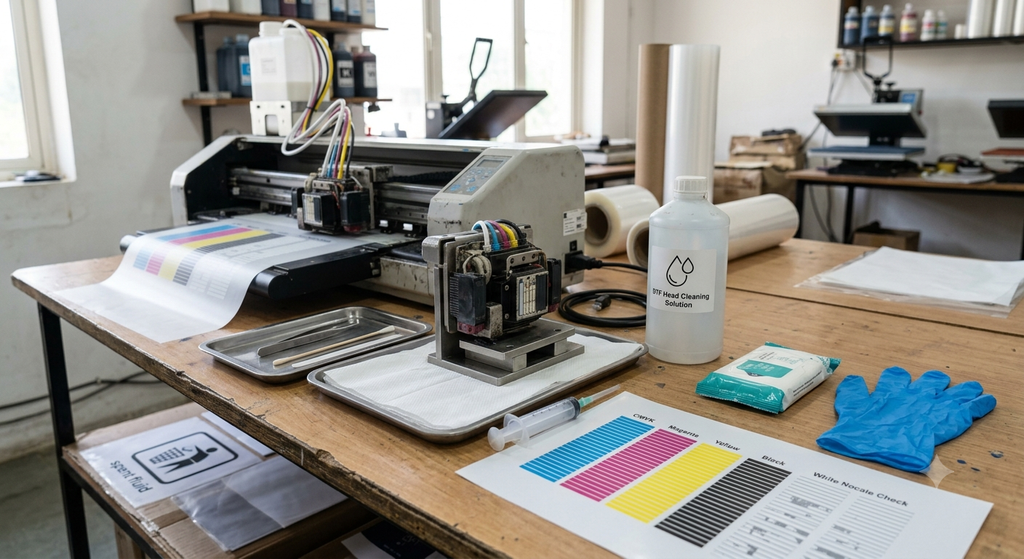
A common mistake is replacing the printhead immediately when DTF printer clogging appears. First check the nozzle pattern, ink flow, damper, capping station and white-ink circulation.
Tips for Storing and Using DTF Hot Melt Powder
Keep the powder sealed when not in use.
Humidity is one of the biggest enemies of loose adhesive powder. Moisture can cause clumps and uneven application.
A few simple habits help:
Keep powder dry
Close the package immediately after taking out the required amount.
Avoid clumps
If the powder has absorbed moisture and developed hard lumps, do not assume it will perform like fresh powder.
Keep powder away from the printer
Do not handle open powder directly above the printer or near exposed ink components.
Clean the workspace
Remove loose powder and dust regularly.
Test new materials
Whenever you change ink, film or powder, make a small test before starting a large order.
Record successful settings
Write down your film, ink, powder, curing method, heat-press settings and garment type.
This simple record can save a lot of troubleshooting later.
Frequently Asked Questions (FAQs)
What causes DTF printer clogging?
The most common causes include white ink pigment settling, long idle periods, dried ink around the capping station, poor ink circulation, dirty dampers, air in the ink line and poor maintenance.
Why does white ink clog more than CMYK?
White DTF ink contains a heavier pigment load. When it sits without enough movement, the pigment can settle and eventually interfere with ink flow.
Can cleaning liquid permanently fix a clogged printhead?
Not always.
Cleaning can help with light or moderate ink drying. A severely clogged, electrically damaged or physically damaged printhead may need replacement.
How can I prevent DTF printer clogging?
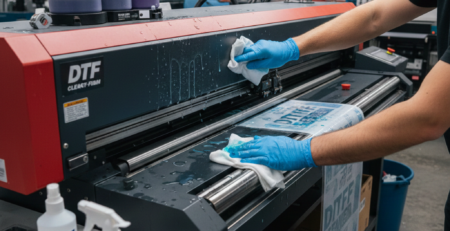
Use regular nozzle checks, keep white ink moving, maintain the capping station, clean the wiper and follow the printer manufacturer’s maintenance procedure.
Does hot melt powder cause printhead clogs?
Usually, powder is not the main cause of a printhead clog. Clogs are more commonly connected with ink flow, pigment settling, dried ink or poor maintenance. However, powder and dust should still be kept away from sensitive printer areas.
Should I replace the printhead immediately?
No.
First diagnose the problem. Check the nozzle pattern, ink supply, damper, capping station, wiper and circulation system.
A new printhead will not fix a blocked damper or poor ink supply.
Is expensive DTF powder always better?
No.
The best powder is the one that consistently works with your printer, film, ink, garment and curing process.
How often should a DTF printer be maintained?
Maintenance frequency depends on the machine and workload. High-use printers need regular daily checks, while machines that sit idle need special attention to prevent ink from drying.
Conclusion: Best Brand Recommendation for Indian DTF Businesses
There is no single powder or printer setup that is perfect for every business.
For adhesive powder, start by comparing Living Lion, BhartiPrint, Desmat, 3alps, Shagun Enterprise, InksfyDTF and Kamicraftsales based on your actual production needs.
For printer maintenance, focus less on finding a “magic” cleaning product and more on fixing the cause.
If your machine repeatedly develops DTF printer clogging, look at the complete ink path. Check white-ink circulation, dampers, capping parts, wiper condition, idle time and cleaning habits.
That is the closest thing to a permanent fix: not one aggressive cleaning session, but a routine that prevents the clog from coming back.
For a small DTF business, consistency matters more than chasing the cheapest consumable. Test materials, keep records and change only one variable at a time.
A clean machine, compatible consumables and regular maintenance will usually save more money than repeatedly replacing printheads after problems appear.
Product Suggestions — DTFshop.in
These are practical products to consider alongside the article. Current product details and compatibility should be checked before ordering:
- 🔵 ProlificGeeks DTF Printer L1800 / L1800-compatible setup — useful for converted Epson-based DTF workflows.
- 🔵 XP600 DTF Printhead — relevant when an XP600 printhead has actually been diagnosed as faulty.
- 🔵 i3200 DTF Printer — Audley 24-inch Dual Head — an industrial option for higher-volume production.
- 🔵 DTF Unclogging Kit — intended for printer maintenance and cleaning support.
- 🔵 DTF Hot Melt Powder 1KG, 80–200 Micron — an adhesive-powder option listed by DTFShop.
External References + Credits
- FESPA — Direct-to-Film printing process — useful reference for DTF workflow, ink preparation, adhesive-powder application and curing.
- ResearchGate — technical DTF research — useful for understanding the role of thermoactive adhesive powder and thermal fixation.
- DTFShop — DTF hot melt adhesive powder guide — used for the India-specific powder brands, price ranges and buying considerations.
- For the printer-clogging section, current technical troubleshooting references also consistently identify white-ink settling, drying, circulation and maintenance as major factors.
Credit: Information references from Fespa, PrintIndustry, and other public sources

LEAVE A COMMENT