
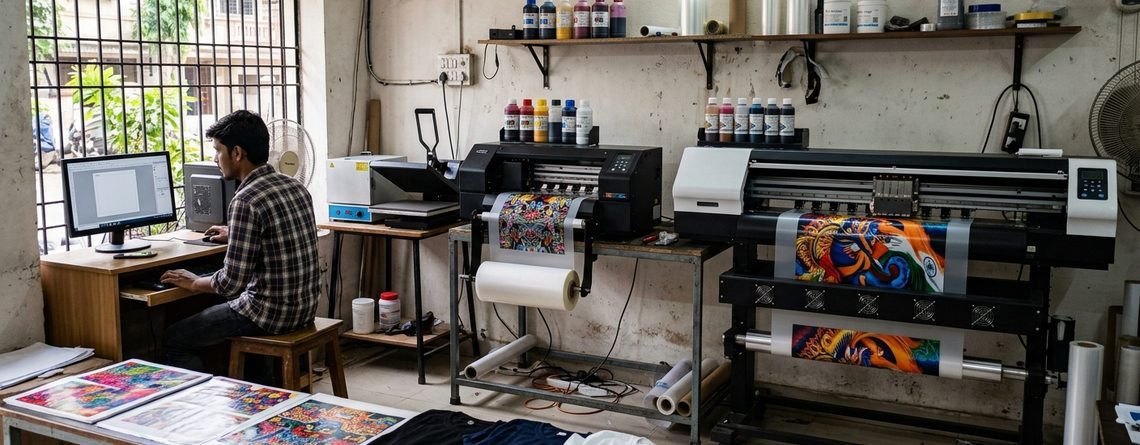
Best DTF Printer for Small Indian Print Shops: 4-Head vs 6-Head Compared
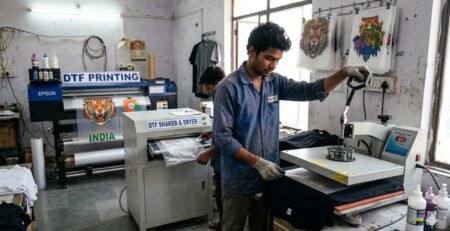
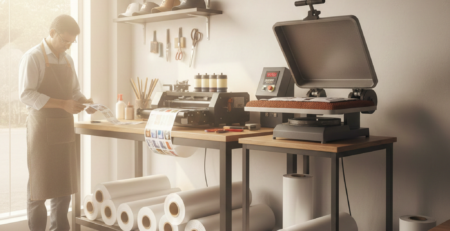
Starting a DTF printing business in India does not always mean buying the biggest printer available.
For a small print shop, the better question is simple: how much work do you actually need to complete every day?
Chat with our team for printers, consumables, film, powder and business setup guidance.
A 4-head DTF printer can make sense for a growing shop with regular T-shirt orders. A 6-head machine may be better when orders are higher and production speed matters more than the initial investment.
The Best DTF Printer for Small Indian Print Shops is therefore not automatically the machine with the most print heads. It is the machine that matches your order volume, budget, available space, maintenance ability and expected growth.
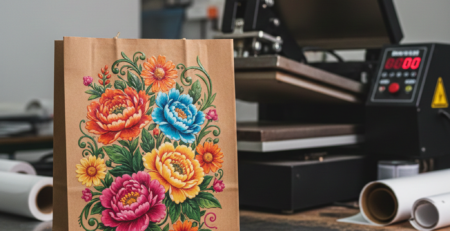
DTF is especially useful for custom T-shirts, uniforms, logos, hoodies, sportswear and small-batch apparel. FESPA also notes that DTF is well suited to small production runs and personalised products.
So, should a small Indian print shop choose 4 heads or 6 heads?
Let’s break it down.
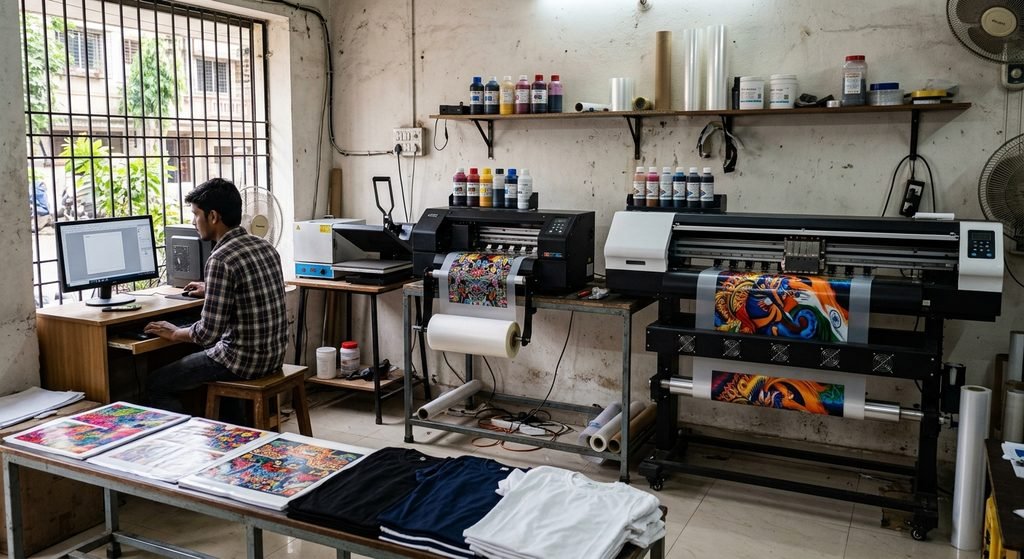
4-Head vs 6-Head DTF Printer: What Is the Difference?
The biggest difference is production capacity.
A 4-head configuration can provide a useful balance between investment and output. It may be suitable for shops that are receiving regular but moderate orders.
A 6-head configuration generally makes more sense when the shop has enough work to keep the machine busy for longer periods.
However, print-head count alone does not tell you the complete story.
You should also check:
- Actual printing speed
- Print width
- Print-head model
- White-ink circulation system
- RIP software
- Ink consumption
- Film consumption
- Maintenance requirements
- Local service availability
- Spare-part cost
- Warranty and technical support
For example, an XP600-based printer and an i3200-based printer can have very different production characteristics even though both are DTF machines.
For a small startup, a lower-cost machine may be more sensible. For a shop already receiving bulk orders, spending more on production capacity can reduce waiting time.
That is why choosing the Best DTF Printer for Small Indian Print Shops should begin with your actual daily workload.
Which Is Better: 4-Head or 6-Head?
Here is a simple comparison.
| Feature | 4-Head DTF Printer | 6-Head DTF Printer |
|---|---|---|
| Initial investment | Lower | Higher |
| Production capacity | Medium | Higher |
| Suitable for startups | Yes | Usually less necessary |
| Suitable for growing shops | Yes | Yes |
| Space requirement | Moderate | Higher |
| Maintenance cost | Generally lower | Generally higher |
| Best for | Regular small/medium orders | Higher-volume production |
| Upgrade reason | Budget and flexibility | Speed and production capacity |
The important point is that more heads do not automatically mean better business.
If your shop receives 10–30 garment orders a day, a very high-capacity machine may spend much of its time sitting idle.
On the other hand, if you regularly receive large uniform, corporate or reseller orders, a higher-capacity machine may save valuable production time.
Introduction to Hot Melt Adhesive Powder in DTF Printing
A DTF printer is only one part of the complete printing process.
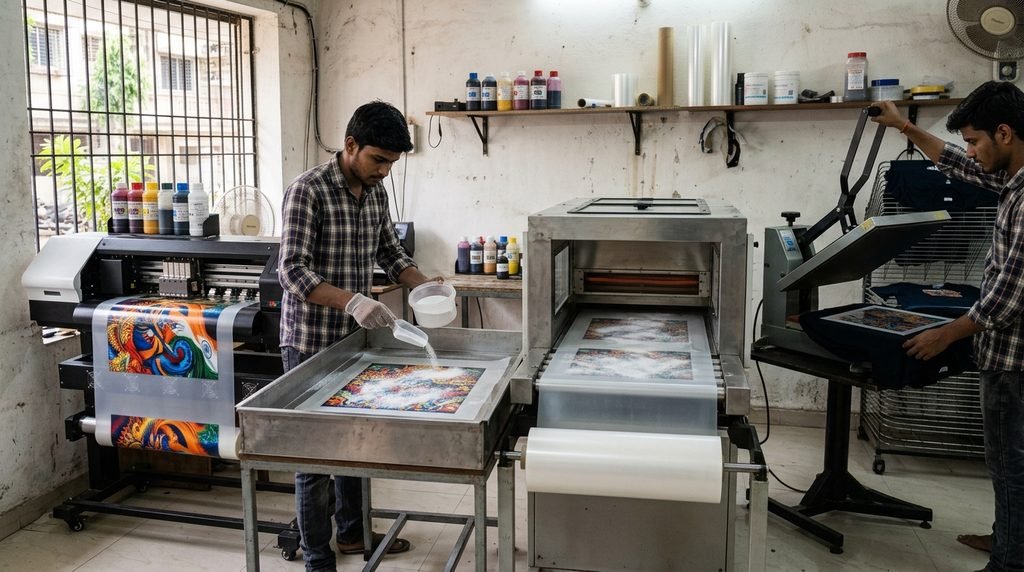
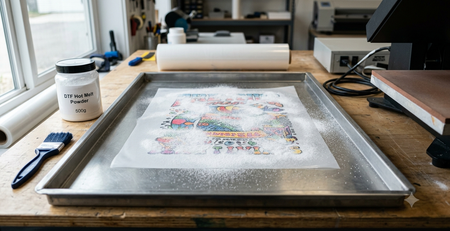
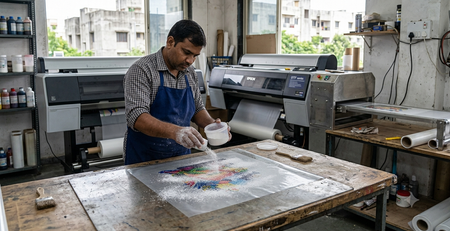
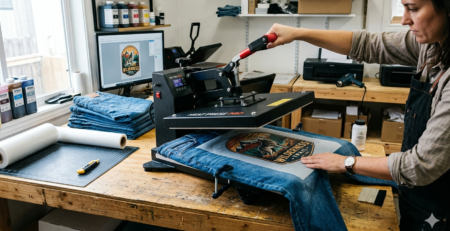
After the artwork is printed on DTF film, hot-melt adhesive powder is applied to the wet ink. The powder is then cured before the transfer is pressed onto the garment.
FESPA describes the process as printing onto film, applying adhesive powder, curing the powder and then transferring the design onto the garment.
Most DTF powders used for this purpose are based on thermoplastic adhesive materials. TPU is commonly used because it can melt during heating and form a bond after cooling.
Research into TPU powder adhesives also explains the basic principle: the powder is heated until it melts, wets the surface and develops bonding properties as it cools.
So even the Best DTF Printer for Small Indian Print Shops will not produce good transfers if the film, ink or adhesive powder is poor.
Why Hot Melt Powder is Essential for DTF Transfers
Think of the powder as the bonding layer between the printed design and the fabric.
Without proper adhesive, the printed ink will not transfer to the garment in the same way.
A good powder should:
- Melt evenly
- Bond properly with the printed ink
- Provide a comfortable print feel
- Work with the selected film
- Offer reasonable wash resistance
- Avoid excessive clumping
- Remain consistent during production
The exact result also depends on curing temperature, time, film, ink, fabric and heat-press settings.
This is why two shops using the same printer can get different results.
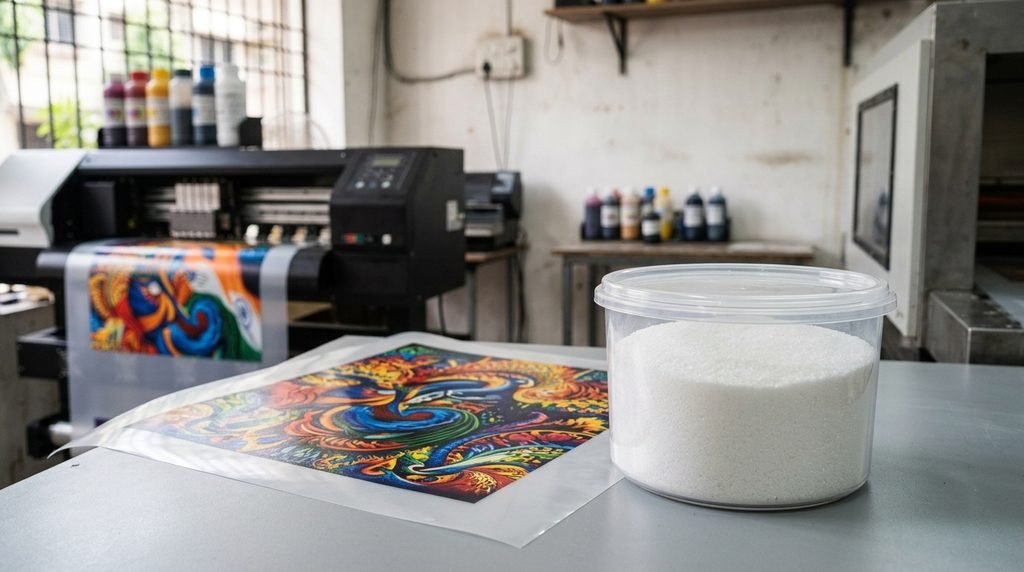
Key Features to Look for in Quality DTF Adhesive Powder
Do not choose powder only because it is cheap.
Check the following:
Particle Size
Powder particle size affects application and the final feel of the transfer.
Melting Behaviour
The powder needs to melt properly during curing. Uneven melting can lead to weak bonding or an unwanted surface texture.
Adhesion
Test the powder on the actual garments you sell.
Wash Resistance
A transfer that looks good on day one is not enough. Wash testing is important.
Storage Stability
Powder should be stored properly to reduce moisture-related clumping.
Compatibility
Always test the powder with your own combination of DTF ink, film and printer.
Top Hot Melt Adhesive Powder Brands Available in India
There are several Indian suppliers and marketplace sellers worth comparing. Pricing and specifications can change, so check the current product listing before ordering.
Living Lion
Living Lion is one Indian supplier offering TPU hot-melt powder for DTF printing. Its published listing includes 1 kg packaging and larger minimum-order quantities for some products.
For a small shop, check the minimum order before buying. If you are still testing your printer, purchasing a large quantity may not be necessary.
BhartiPrint (Bharti Creation)
BhartiPrint lists TPU hot-melt powder for DTF heat-transfer printing. Its current published listing shows ₹500/kg, with pricing subject to quantity and applicable GST.
This can be an option for businesses that want to compare locally available consumables.
Desmat Sublimation (Koncept)
Desmat Sublimation is another name Indian DTF buyers may come across.
When comparing this option with other suppliers, look beyond the brand name. Ask about particle size, recommended curing conditions, fabric compatibility and availability.
3alps Digital Printers
3alps Digital Printers supplies DTF-related equipment and consumables.
A supplier that can provide several parts of your workflow can be convenient, particularly when a shop is setting up a complete production system.
Shagun Enterprise
Shagun Enterprise is another supplier offering DTF consumables, including hot-melt powder.
Published market listings have shown prices around the ₹799–₹800/kg range, although prices and stock can change. Check the current listing before purchasing.
InksfyDTF (Etsy India)
InksfyDTF is a marketplace-style option that may be useful for buyers comparing smaller quantities.
With marketplace purchases, check the seller information, product weight, specifications, reviews and return terms carefully.
Kamicraftsales (Etsy India)
Kamicraftsales is another marketplace seller that buyers may encounter when comparing DTF supplies.
The same rule applies here: compare the actual specifications and total cost rather than choosing purely from the product image.
Price Range of DTF Hot Melt Powder in India (per kg)
There is no single fixed price.
Current published Indian listings show a broad range depending on grade, supplier, quantity and packaging.
As a rough practical guide:
| Quality/Buying Level | Approximate Price |
|---|---|
| Economy | ₹450–₹700/kg |
| Standard | ₹700–₹1,100/kg |
| Premium | ₹1,100–₹1,800+ /kg |
For example, Living Lion currently lists products around ₹450/kg, while BhartiPrint lists TPU powder at ₹500/kg. Other suppliers may be higher depending on grade and quantity.
Do not select powder only by price.
If cheaper powder causes failed transfers, the real cost can become higher because of wasted film, ink, garments and production time.
Comparison of Indian Brands: Performance & Quality
There is no universal winner because production conditions differ.
| Supplier | What to Compare |
|---|---|
| Living Lion | Price, consistency, MOQ |
| BhartiPrint | Price, wash performance, support |
| Desmat/Koncept | Compatibility and quality |
| 3alps | Supply and technical specifications |
| Shagun Enterprise | Price and local availability |
| InksfyDTF | Marketplace reviews and quantity |
| Kamicraftsales | Product specifications and total cost |
A practical test is better than guessing.
Print the same artwork using two powders. Use the same film, ink, curing process and garment.
Then compare:
- Adhesion
- Print feel
- Stretch
- Wash performance
- Fine-detail quality
This simple test can tell you more than a product description.
Where to Buy Hot Melt Adhesive Powder in India (Online & Offline)
Small print shops can purchase powder through specialist DTF suppliers, printing-equipment dealers and online sellers.
Before ordering, ask:
- Is the powder TPU?
- What is the particle size?
- What is the recommended curing range?
- What fabrics are recommended?
- Is a smaller test pack available?
- What is the MOQ?
- Is GST included?
- What is the delivery time?
For a new business, buying a small quantity for testing is often safer than immediately purchasing a large bulk shipment.
Tips for Storing and Using DTF Hot Melt Powder
Keep the powder dry.
Humidity can cause powder to clump, making application less consistent.
Use a sealed container after opening the original packet.
Also avoid mixing old and new powder without a reason. If your production environment is humid, pay extra attention to storage.
During production, remove excess powder from the film before curing. FESPA’s DTF process guidance also recommends applying the adhesive evenly and removing excess powder before curing.
Always follow the powder and film supplier’s recommended curing settings instead of copying a random temperature from another machine.
Choosing the Best DTF Printer for Small Indian Print Shops
Now we come back to the main question.
What is the Best DTF Printer for Small Indian Print Shops?
For a new or smaller shop, a 4-head machine can be a sensible middle ground when the expected order volume is moderate.
For example, a shop making custom T-shirts, school-event shirts and small business orders may not need the production capacity of a large 6-head machine.
But a reseller producing hundreds of transfers each week may benefit from moving to a higher-capacity setup.
For smaller budgets, shops can also investigate machines based around established print-head options.
Some commonly discussed choices include:
<span style=”color:blue”>🔵 ProlificGeeks DTF Printer L1800</span>
This type of setup can be considered by beginners who are more concerned with entry cost than maximum production speed.
<span style=”color:blue”>🔵 XP600 DTF Printer</span>
XP600-based machines are commonly considered when a growing shop needs more production capacity than a basic entry-level setup.
<span style=”color:blue”>🔵 i3200 DTF Printer</span>
i3200-based systems are better suited to businesses that are planning for higher production and want a more production-oriented setup.
The important thing is not to buy based on the name of the print head alone.
Check the complete machine.
That includes carriage design, white-ink circulation, software, electronics, maintenance access and after-sales support.
4-Head vs 6-Head: A Simple Real-Life Example
Imagine two Indian shops.
Shop A receives 15–25 T-shirt orders per day.
Most designs are small logos and simple graphics.
A 4-head setup may be enough. Spending heavily on extra capacity may not give the shop a useful return.
Shop B receives regular bulk orders from resellers and local businesses.
The shop needs to print continuously and complete large batches quickly.
Here, a 6-head machine becomes more interesting.
The extra investment can make sense when the printer is actually kept busy.
This is the key difference.
Buy capacity because you need it, not because the machine looks impressive.
Frequently Asked Questions (FAQs)
Is a 4-head DTF printer good for a small business?
Yes. A 4-head setup can be suitable when production requirements are moderate. Always compare actual speed, print-head model and machine design rather than relying only on head count.
Is a 6-head DTF printer better than a 4-head printer?
Not automatically. A 6-head machine can offer greater production capacity, but it usually costs more and may require more maintenance. The right choice depends on your workload.
What is the Best DTF Printer for Small Indian Print Shops?
For most small shops, the best choice is the machine that matches expected daily production, budget, service availability and growth plans. A 4-head printer can be a practical choice for moderate production, while 6 heads make more sense for higher-volume work.
Does hot-melt powder affect DTF print quality?
Yes. Adhesion, melting behaviour, particle size and wash performance can affect the finished transfer. Your printer, ink, film and curing process also matter.
Which DTF powder is best in India?
There is no single powder that is best for every setup. Living Lion, BhartiPrint, Desmat, 3alps, Shagun Enterprise and marketplace sellers such as InksfyDTF and Kamicraftsales can all be compared, but testing on your own workflow is the safest approach.
How much does DTF powder cost per kg in India?
Published listings vary. Common prices can range from roughly ₹450 to ₹1,800+ per kg depending on grade, seller, quantity and packaging.
Should I buy a 6-head printer when starting?
Usually, do not buy extra capacity unless you have a clear production requirement for it. Start with the workload you can realistically generate and consider future growth.
Conclusion: Best Brand Recommendation for Indian DTF Businesses
The Best DTF Printer for Small Indian Print Shops is not necessarily the fastest or most expensive machine.
For a new shop with moderate orders, a reliable 4-head configuration can offer a sensible balance between investment and production.
For a growing operation with regular bulk orders, a 6-head setup can become more attractive.
The same practical thinking applies to DTF powder.
Do not choose the cheapest product simply because it saves money upfront. Test adhesion, feel and wash performance with your own film, ink and garments.
If you are comparing printers, start by calculating your average daily orders. Then look at production speed, maintenance, service support and total operating cost.
A good DTF business is built around consistent output—not simply a bigger printer.
<span style=”color:blue”>🔵 ProlificGeeks DTF Printer L1800</span>, <span style=”color:blue”>🔵 XP600</span> and <span style=”color:blue”>🔵 i3200</span> can be useful products to compare at different stages of a DTF business, but the final choice should always match your actual production requirement.
Credit: Information references from Fespa, PrintIndustry, and other public sources.
Product Suggestions
For internal product linking on DTFShop.in, consider these naturally within the article:
- <span style=”color:blue”>🔵 ProlificGeeks DTF Printer L1800</span>
- <span style=”color:blue”>🔵 XP600 DTF Printer</span>
- <span style=”color:blue”>🔵 i3200 DTF Printer</span>
- <span style=”color:blue”>🔵 DTF Hot Melt Adhesive Powder</span>
- <span style=”color:blue”>🔵 DTF PET Transfer Film</span>
The DTFShop material currently positions L1800 as a lower-cost beginner option, XP600 as a faster option and i3200 as a higher-production option.
External References + Credits
- FESPA — DTF printing process and adhesive powder guidance
- FESPA — Personalised apparel and DTF market overview
- ResearchGate — TPU powder adhesive technical research
- DTFShop.in — Indian DTF powder and printer market information.
- BhartiPrint — TPU hot-melt powder product information.
- Living Lion — DTF TPU hot-melt powder listing.
Credit: Information references from Fespa, PrintIndustry, and other public sources.

LEAVE A COMMENT