
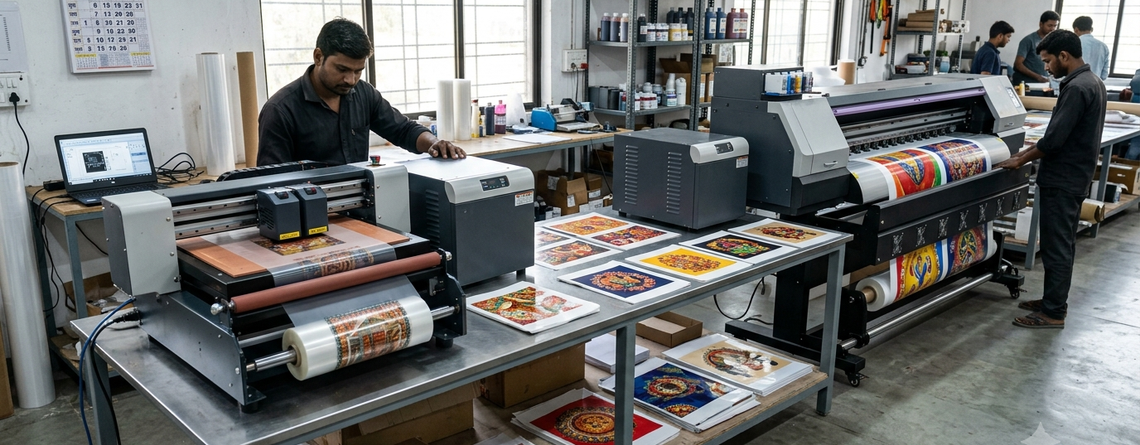
DTF Printer Printhead Comparison: Proven Epson i3200 vs XP600 Guide for India
Choosing a DTF printer in India is not only about checking the machine price.
The printhead matters a lot.
Chat with our team for printers, consumables, film, powder and business setup guidance.
For many buyers, the main choice comes down to the XP600 and Epson i3200. Both are used in DTF machines, but they suit different production requirements.
This DTF Printer Printhead Comparison looks at the practical differences between the two. We will cover print quality, production requirements, maintenance, replacement considerations and the type of business each setup can suit.
There is also another part of DTF printing that should not be ignored: adhesive powder. A good printhead can produce a beautiful transfer, but the finished garment can still fail if the powder, curing or heat-press process is poor.
So, after comparing the printheads, this guide also covers hot melt adhesive powder and popular powder suppliers available in India.
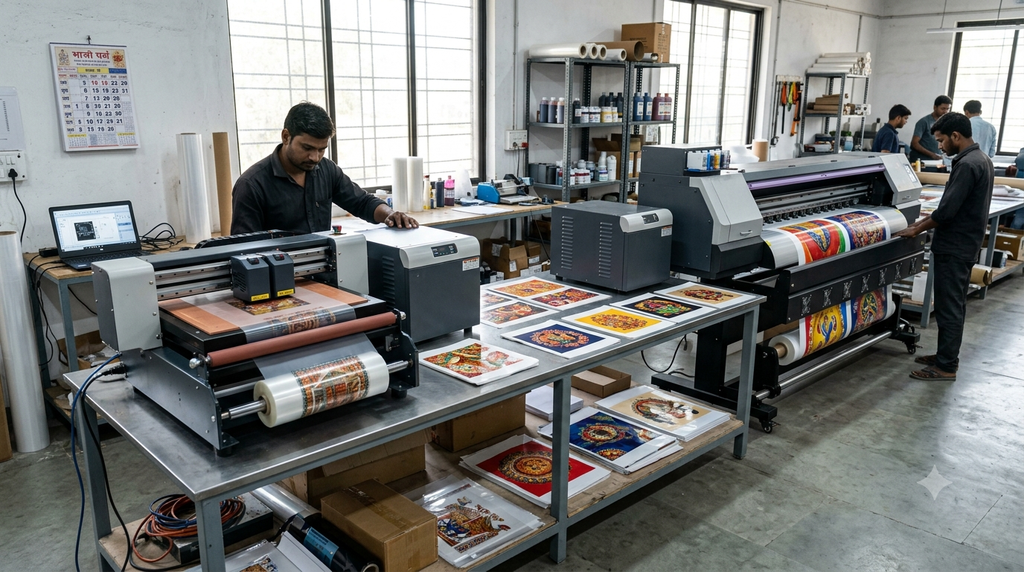
Epson i3200 vs XP600: The Basic Difference
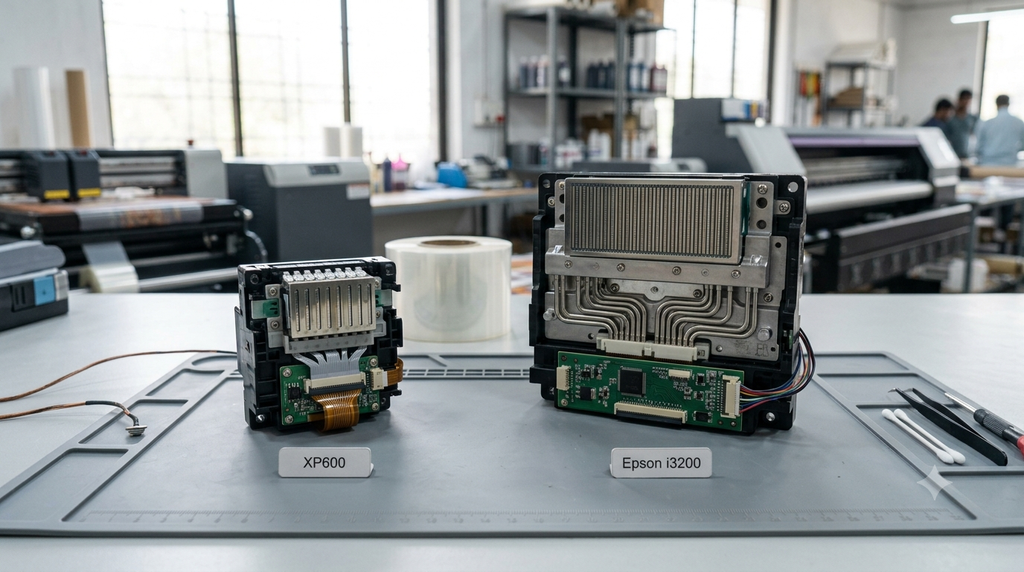
The XP600 is commonly found in compact and entry-level DTF printers. It is attractive to small businesses because machines using this head can have a lower entry cost.
The Epson i3200 is generally positioned for higher-production machines. It is used in wider and more production-oriented systems.
In simple terms:
| Feature | XP600 | Epson i3200 |
|---|---|---|
| Typical market position | Entry / small production | Commercial production |
| Machine size | Often compact | Often wider production machines |
| Initial machine cost | Usually lower | Usually higher |
| Production capability | Suitable for smaller workloads | Better suited to sustained production |
| Maintenance | Relatively simple | Requires disciplined maintenance |
| Replacement consideration | Lower-cost head category | Higher-cost industrial head category |
| Best fit | Startups and smaller shops | Growing and higher-volume businesses |
This does not mean that one head is automatically right for everyone.
A shop printing occasional T-shirts has different requirements from a business supplying hundreds of garments every week.
That is the most important point in any DTF Printer Printhead Comparison.
Print Quality: XP600 vs Epson i3200
Print quality depends on much more than the printhead.
Ink quality, RIP settings, film, white-ink management, print mode, humidity and maintenance all influence the final transfer.
The i3200 is generally selected when the business needs consistent production and detailed output. Its industrial positioning makes it attractive for businesses planning to increase production.
The XP600 can still produce good DTF transfers when correctly installed and maintained.
For example, imagine a small custom T-shirt shop producing 10–20 customer orders a day. An XP600 setup may provide enough capacity without requiring a larger production system.
Now consider a garment supplier handling regular bulk orders. The additional production capability of an i3200-based machine may become more useful.
So, when doing a DTF Printer Printhead Comparison, look at your actual workload rather than simply choosing the more expensive specification.
Speed and Production
Speed is one of the biggest reasons businesses compare XP600 and i3200 systems.
A small XP600 machine can work well for short runs and mixed orders. It is also easier to fit into a smaller workspace.
An i3200 machine makes more sense when the printer needs to work regularly for longer production periods.
However, advertised maximum speeds should not be treated as everyday production speeds.
Print shops normally reduce speed when they need:
- Better white coverage
- Stronger colour
- Cleaner small text
- More accurate gradients
- Better consistency
- Fewer printing defects
Therefore, ask the supplier for the real production speed at the print quality you intend to use.
That is more useful than looking only at a maximum speed number.
Maintenance and Printhead Care
DTF printers require regular attention.
White ink is especially important because pigment can settle when the system is not properly managed.
Daily checks can include:
- Nozzle check
- White-ink circulation
- Ink level inspection
- Wiper and capping-station cleaning
- Film alignment
- Powder application
- Proper curing
- Printhead parking
FESPA’s DTF workflow guidance also stresses nozzle checks, white-ink condition, correct film handling and controlled adhesive-powder application.
A common mistake is to compare only printhead prices.
The real cost also includes cleaning liquid, dampers, ink, film, powder, maintenance labour and downtime.
When Should You Choose XP600?
An XP600 setup can make sense when:
- You are starting a DTF business.
- Your daily production is relatively small.
- You need a compact printer.
- Your budget is limited.
- Most orders are short runs.
- You want a simpler entry into DTF printing.
For example, a home-based apparel business producing customised names, logos and small batches may not need a large industrial printer.
A compact XP600 machine can be easier to manage.
DTFShop currently lists XP600-based systems such as the 🔵 ProlificGeeks DTF Single Head XP600 Printer with Powder Shaker for Indian buyers. The current listing shows a ₹190,000 product price, although pricing and configuration can change.
When Should You Consider Epson i3200?
The i3200 becomes more interesting when your business has regular production requirements.
It can be considered when:
- Orders are increasing.
- You need longer production runs.
- You need wider-format equipment.
- Production consistency is important.
- Downtime has a significant business cost.
- You plan to scale a garment-printing operation.
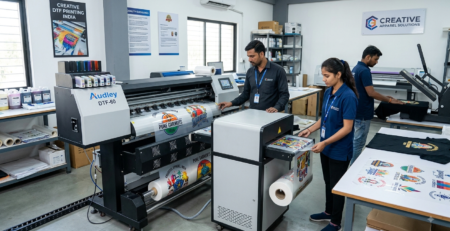
DTFShop currently lists i3200-based systems including the 🔵 Audley DTF 24 Inch 4 Head I3200 Printer with Powder Shaker. The current listed price is ₹920,000, showing how different an industrial multi-head configuration can be from an entry-level XP600 system.
The important point is not that a more expensive machine is automatically better.
It is about whether your workload can actually use the additional production capacity.
A Practical DTF Printer Printhead Comparison
Think about two businesses.
Business A:
A local T-shirt customisation shop receives 10–30 small orders each day.
Business B:
A garment supplier regularly produces large batches for brands, schools, events or uniform suppliers.
Business A may value lower entry cost, compact size and simpler maintenance.
Business B may place more value on production capacity, uptime and scalability.
That is why the DTF Printer Printhead Comparison should always be connected to monthly production, not just printer specifications.
Introduction to Hot Melt Adhesive Powder in DTF Printing
The printhead creates the printed image, but adhesive powder helps turn that image into a wearable transfer.
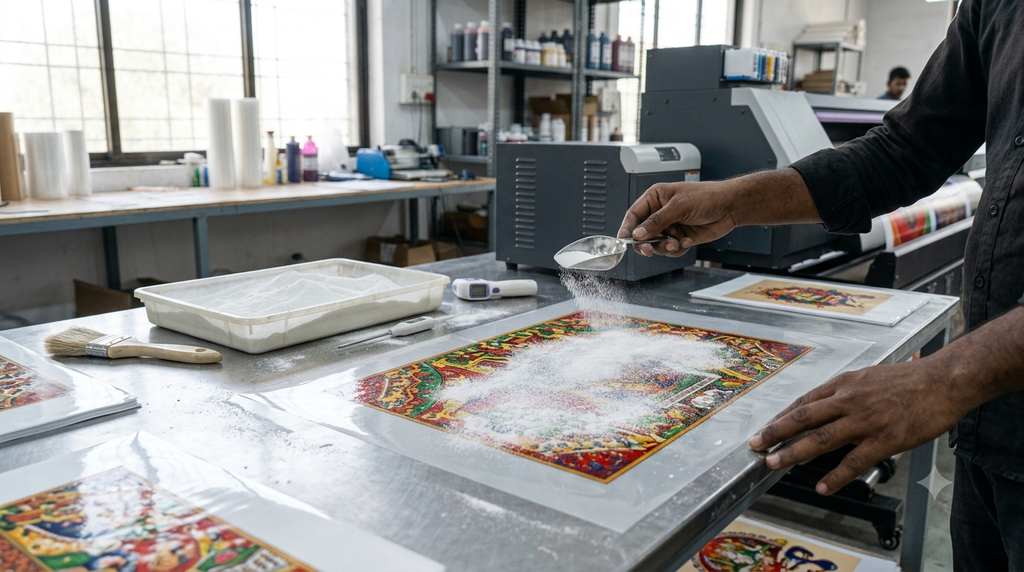
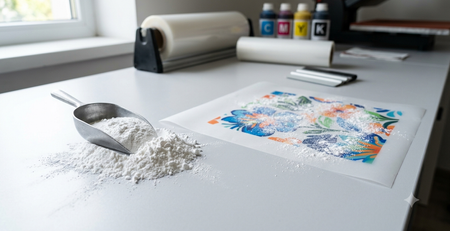
In DTF printing, the design is printed onto PET film. Adhesive powder is then applied to the printed area. The powder is heated so it melts and bonds with the printed layer.
After curing, the film can be transferred to the garment using a heat press.
FESPA describes the DTF workflow as printing onto film, applying adhesive powder, melting the powder and then transferring the design to the garment.
So, choosing the right powder is just as practical as choosing the right printer.
Why Hot Melt Powder is Essential for DTF Transfers
Without the adhesive layer, the printed design would not properly bond to the textile.
The powder provides the bonding layer between the transfer and garment.
A good powder should provide:
- Reliable adhesion
- Suitable melting behaviour
- Good wash resistance
- Reasonable stretch
- Even coverage
- Consistent curing
The powder must also be applied evenly.
Too little powder can cause weak adhesion.
Too much powder can make the print feel heavier and may affect the finish.
Key Features to Look for in Quality DTF Adhesive Powder
Do not choose powder only because it is cheap.
Check:
Particle size
Powder particle size affects how smoothly the powder covers the printed image.
Melting behaviour
The powder should work within the curing conditions recommended by the manufacturer.
Adhesion
The finished transfer should bond properly with the selected fabric.
Feel
A good DTF transfer should not feel unnecessarily thick or hard.
Wash resistance
Always test several washes before using a new powder for large customer orders.
Fabric compatibility
Cotton, polyester and blends can behave differently.
Research into hot-melt adhesives also shows that particle characteristics and adhesive composition can influence bonding and processing behaviour.
Top Hot Melt Adhesive Powder Brands Available in India
Living Lion
Living Lion is one of the names Indian DTF users may encounter when comparing adhesive powders.
Before buying, check the exact product grade, package size and recommended curing settings.
Do a small fabric test first.
BhartiPrint (Bharti Creation)
BhartiPrint is another Indian-market option.
For small businesses, the advantage of comparing local suppliers is that smaller quantities may be easier to purchase and test.
Desmat Sublimation (Koncept)
Desmat Sublimation, associated with Koncept, is another supplier to consider when researching DTF consumables.
Ask about the powder’s particle size, fabric suitability and curing recommendations.
3alps Digital Printers
3alps Digital Printers offers DTF-related equipment and consumables.
This type of supplier can be useful when a business wants to source multiple parts of its DTF workflow from one place.
Shagun Enterprise
Shagun Enterprise also lists DTF adhesive powder and related DTF materials.
Current listings should always be checked before placing a bulk order because prices and availability can change.
InksfyDTF (Etsy India)
Marketplace sellers such as InksfyDTF can be useful when a buyer wants smaller quantities.
However, check seller information, product specifications, reviews, package weight and return conditions before purchasing.
Kamicraftsales (Etsy India)
Kamicraftsales is another marketplace-style option that can be compared by hobby users and small DTF businesses.
For marketplace purchases, look beyond the product photograph. Check the actual material description and quantity.
Price Range of DTF Hot Melt Powder in India (per kg)
DTF powder prices vary according to grade, particle size, packaging and supplier.
A practical market range can be approximately ₹500–₹2,000+ per kg, with economy and standard grades commonly appearing toward the lower end and premium products higher. DTFShop’s current published guide gives an indicative range of roughly ₹450–₹800+ for commonly listed products, while its own premium powder listing has also been shown around ₹800/kg.
Do not compare two powders only by price per kilogram.
Instead, calculate:
Powder cost per transfer + wastage + reprint cost + production time.
If a cheaper powder creates frequent failed transfers, the apparent saving can disappear quickly.
Comparison of Indian Brands: Performance & Quality
There is no universal powder that performs exactly the same on every machine and fabric.
A useful comparison should consider:
| Factor | What to Check |
|---|---|
| Adhesion | Does the transfer bond properly? |
| Soft feel | Does the print remain comfortable? |
| Wash resistance | Does it survive repeated washing? |
| Powder flow | Does it spread evenly? |
| Curing | Does it melt consistently? |
| Wastage | How much excess powder is removed? |
| Fabric compatibility | Cotton, polyester or blends? |
| Price | Cost per usable transfer |
Published DTF powder comparisons also note that results can change according to temperature, fabric, humidity and curing conditions.
So treat brand comparisons as a starting point, not a guarantee.
Where to Buy Hot Melt Adhesive Powder in India (Online & Offline)
You can compare powder through:
- DTF equipment suppliers
- Printing-equipment dealers
- Textile-printing distributors
- Online DTF stores
- Marketplace sellers
For online buying, check the product weight carefully.
A ₹700 packet may look cheaper than a ₹900 product, but the package sizes may be different.
Also ask whether the seller can provide:
- Technical specification
- Recommended curing temperature
- Particle-size information
- Sample quantity
- GST invoice
- Bulk pricing
For DTF printer parts, DTFShop also lists consumables, printer parts and equipment online for Indian buyers.
Tips for Storing and Using DTF Hot Melt Powder
Keep powder dry.
Humidity can affect powder flow and handling.
Use a sealed container after opening the packet.
Do not leave an open bag near the powder shaker for the entire day.
Also avoid mixing different powders in the same container unless the manufacturers specifically recommend doing so.
Before changing powder, make a small test transfer.
Test it on the actual fabric your customer uses.
Check:
- Print appearance
- Powder coverage
- Curing
- Transfer pressure
- Peel behaviour
- Wash resistance
- Final hand feel
A ten-minute test can prevent a large batch of failed garments.
Frequently Asked Questions (FAQs)
Is XP600 good for a DTF printer?
Yes. XP600-based machines can be suitable for smaller DTF operations, short runs and businesses entering the market. The complete machine configuration and maintenance routine matter as much as the head itself.
Is Epson i3200 better than XP600?
They are designed for different production needs. The i3200 is generally associated with more production-oriented machines, while XP600 systems are common in compact and entry-level equipment.
What should I check before buying an i3200 DTF printer?
Check the complete machine, not only the printhead. Look at print width, number of heads, white-ink circulation, RIP software, powder shaker, service support, spare-part availability and actual production speed.
How much does DTF powder cost in India?
Prices vary widely. Economy products can be available around ₹500/kg, while premium grades can cost considerably more. Always compare the actual package weight and specifications.
Does expensive powder always produce better DTF transfers?
No. Your film, ink, fabric, curing temperature, powder coverage and heat-press settings all affect the final result.
How often should DTF powder be tested?
Test a new batch whenever you change supplier, grade or production conditions. It is especially important before a large customer order.
Can XP600 and i3200 use the same DTF powder?
The powder is not normally selected according to the printhead alone. Powder selection depends more on the DTF ink, film, fabric and curing/transfer process.
Conclusion: Best Brand Recommendation for Indian DTF Businesses
There is no single winner in a DTF Printer Printhead Comparison because the right printhead depends on the business.
For a smaller operation, an XP600-based machine can provide a practical starting point.
For a growing production business, an i3200-based configuration may make more sense when the additional capacity is actually required.
The same practical thinking applies to DTF powder.
Do not select powder only because it has the lowest price per kilogram. Test adhesion, curing, feel and wash performance on your actual garments.
When comparing printers, also consider the complete workflow. A reliable printer with good ink management, suitable PET film, consistent powder application and proper curing will usually be more useful than a machine selected only because its printhead sounds impressive.
That is the real lesson from a DTF Printer Printhead Comparison: match the equipment to your production, budget and working conditions.
And before committing to a bulk consumable purchase, test a small quantity first.
Product Suggestions
These are current DTFShop listings that fit naturally with the article:
- <span style=”color:blue”>🔵 ProlificGeeks DTF Single Head XP600 Printer with Powder Shaker (DFC30)</span> — current DTFShop listing. View product on DTFShop.in
- <span style=”color:blue”>🔵 DTF XP600 Printhead – ProlificGeeks / DTFShop</span> — useful when discussing XP600 replacement considerations. View product on DTFShop.in
- <span style=”color:blue”>🔵 Audley DTF Dual Head XP600 Printer</span> — a larger XP600 configuration. View product on DTFShop.in
- <span style=”color:blue”>🔵 DTF i3200 Printhead – ProlificGeeks</span> — for i3200 replacement/head discussions. View product on DTFShop.in
- <span style=”color:blue”>🔵 Audley DTF 24 Inch 4 Head i3200 Printer with Powder Shaker</span> — an industrial multi-head option. View product on DTFShop.in
External References + Credits
- FESPA — DTF workflow, film preparation, adhesive-powder application and curing. FESPA DTF Printing Guide
- ResearchGate — technical literature covering hot-melt adhesive behaviour and DTF thermofixation. ResearchGate technical reference
- DTFShop.in — Indian DTF powder and equipment market information used for indicative pricing and product references. DTFShop.in DTF Powder Guide
- PrintIndustry.com and InkJetInsights.com can also be used as supporting industry-reading sources when expanding the article’s reference section.
Credit: Information references from Fespa, PrintIndustry, and other public sources.

LEAVE A COMMENT