
DTF Adhesive Powder: Powerful Comparison of White vs Colored Powder for Different Fabrics 2026
Direct-to-Film, or DTF printing, has become a practical option for custom T-shirts, hoodies, sportswear, uniforms, bags, and other textile products.
But printing the artwork is only one part of the process. The adhesive powder used after printing plays a major role in how the transfer bonds with the fabric.
Chat with our team for printers, consumables, film, powder and business setup guidance.
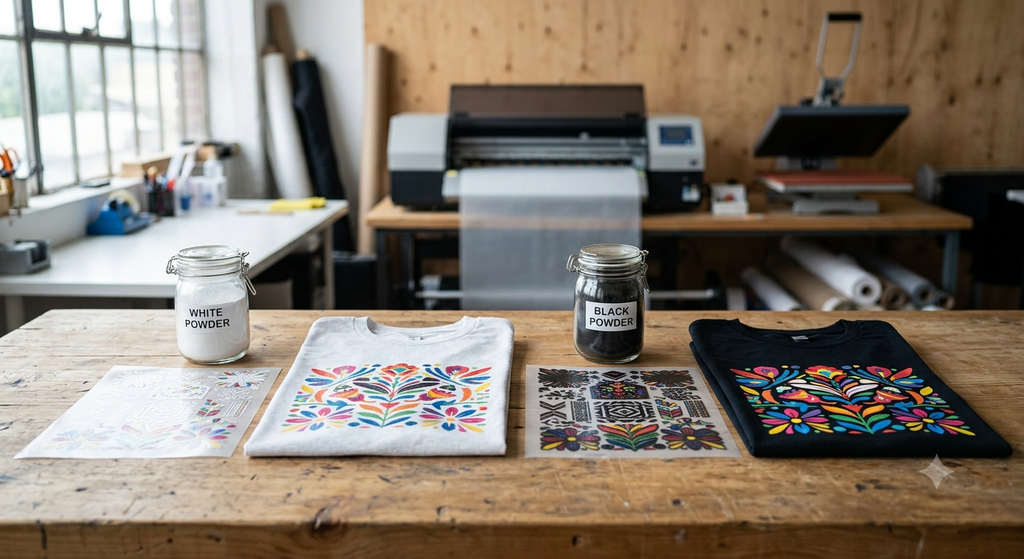
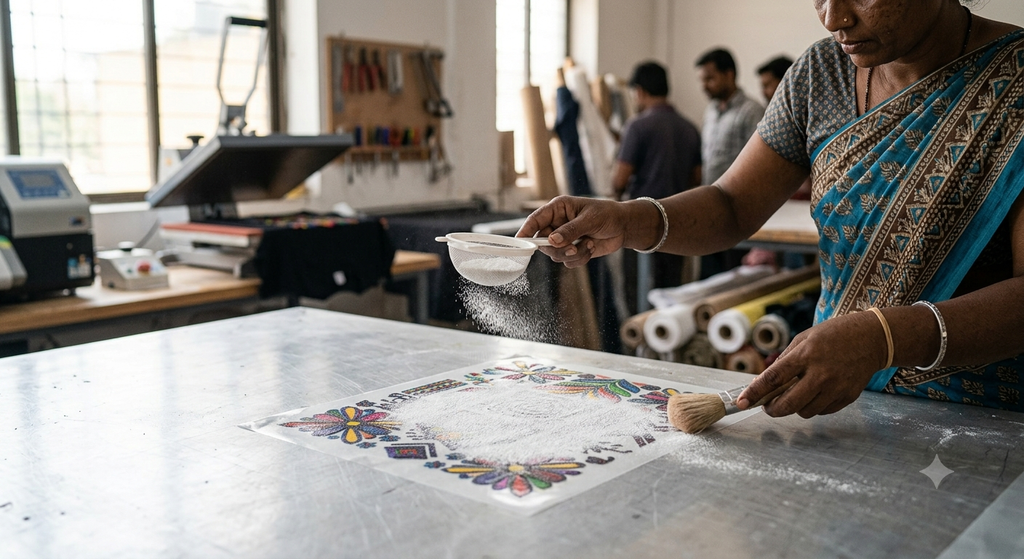
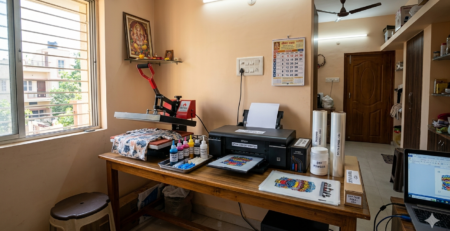
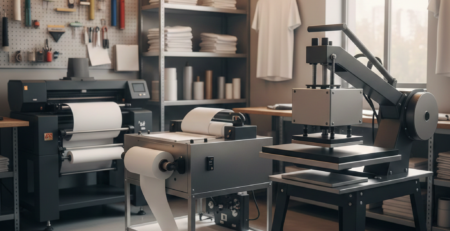
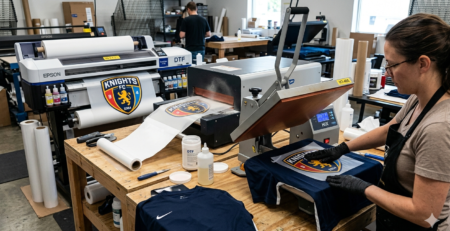
DTF Adhesive Powder is generally a thermoplastic hot-melt material. It is applied to the wet printed ink on the PET film. The powder is then cured so it melts and forms an adhesive layer. During heat pressing, this layer bonds the printed design to the garment. FESPA describes the DTF workflow as applying powder evenly, removing excess powder, curing it, and then transferring the print to the garment.
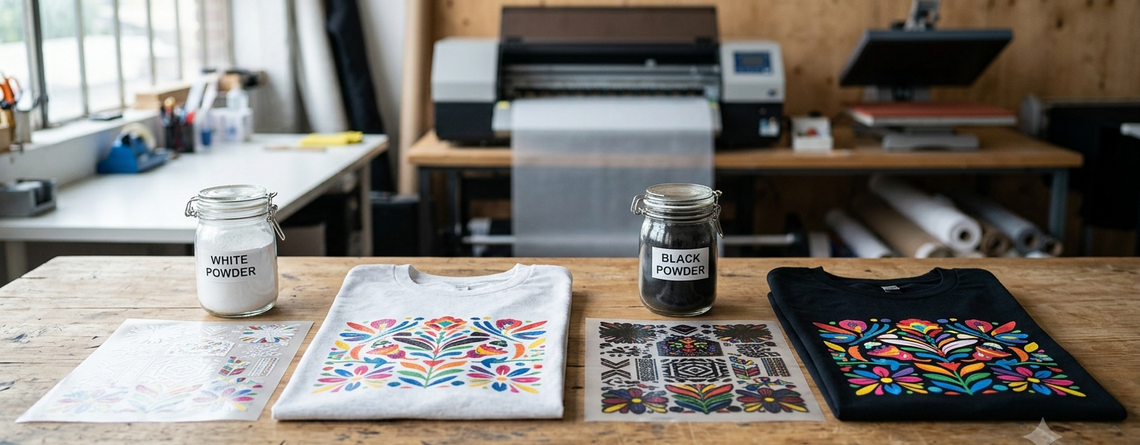
The most common option is white powder. However, colored powders, especially black powder, are also available for specific jobs.
The important point is simple: powder color should be selected according to the garment, artwork, and production requirements—not just price.
Why Hot Melt Powder is Essential for DTF Transfers
Without hot-melt powder, the printed ink has no proper adhesive layer to hold the transfer to the fabric.
A typical DTF workflow looks like this:
- Print the artwork onto DTF PET film.
- Apply DTF Adhesive Powder while the ink is still suitable for powder application.
- Remove excess powder.
- Cure the powder.
- Place the transfer on the garment.
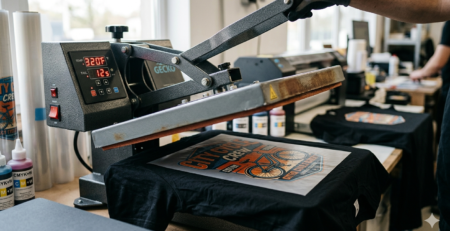
- Heat press according to the film, powder, and garment manufacturer’s recommended settings.
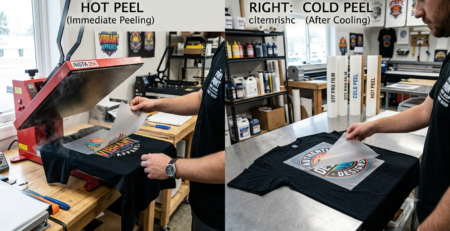
- Peel the film according to the film specification.
Research into heat-sealable powder adhesives shows why these materials are useful in textile applications: hot-melt powders create an adhesive layer that activates under heat and bonds with the substrate.
For a small T-shirt shop, this may sound straightforward. In production, however, powder quality matters.
If the powder is uneven, damp, poorly cured, or incompatible with the application, you may see peeling, weak edges, rough texture, or inconsistent wash performance.
Key Features to Look for in Quality DTF Adhesive Powder
When buying DTF Adhesive Powder, do not look only at the price per kilogram.
Check these points first:
1. Polymer Type
TPU-based hot-melt powder is widely used in garment DTF applications. The exact formulation can differ between suppliers.
2. Particle Size
Particle size affects how easily the powder covers the wet ink and how much detail the transfer can retain.
A powder that is too coarse may not be suitable for very fine artwork. A powder that is too fine can require more careful handling and application.
3. Melting and Curing Range
Every powder should be tested according to its manufacturer’s specifications. Do not assume that every brand has exactly the same curing requirement.
4. Adhesion
The powder should create a reliable bond between the printed transfer and the fabric.
5. Flexibility
For T-shirts and sportswear, the adhesive layer should handle normal fabric movement without becoming excessively brittle.
6. Wash Performance
A good transfer should maintain its bond when the garment is washed according to recommended care instructions.
7. Moisture Resistance During Storage
Humidity is one of the biggest practical problems with powder. Keep bags sealed and avoid leaving working powder exposed for long periods.
Top Hot Melt Adhesive Powder Brands Available in India
The Indian DTF market has several suppliers and distributors. Availability, pack sizes, specifications, and prices can change, so buyers should request a current specification sheet and sample before placing a large order.
Living Lion
Living Lion lists white TPU hot-melt powder for DTF printing. Its published listing shows a 1 kg pack at an indicated price of ₹450/kg, although the listing also shows minimum-order conditions that can differ by product. The supplier describes the powder as suitable for DTF PET films and gives application-related specifications such as softening point and particle size.
For wholesale buyers, the main advantage is the ability to discuss larger quantities rather than buying only small retail packs.
BhartiPrint (Bharti Creation)
Bharti Creation lists TPU Hot Melt Powder for DTF heat-transfer printing at an indicated ₹500/kg. Its product information describes the powder as a soft-peel DTF powder and highlights wash resistance and use across different textile media. The company also notes that GST and quantity/customization can affect the final price.
For a small printing business, it makes sense to test this type of powder on the actual fabrics you use most often before moving to bulk purchase.
Desmat Sublimation (Koncept)
Desmat Sublimation and Koncept are names buyers may encounter while comparing textile-printing consumables in India.
For this type of supplier, check the actual powder specification rather than relying only on the brand name. Ask about TPU grade, particle size, recommended curing conditions, packaging, and whether the powder is intended for light garments, dark garments, polyester, cotton, or blends.
A sample test is more useful than simply comparing the lowest quoted price.
3alps Digital Printers
3ALPS Digital Printers, based in Bhiwandi, Maharashtra, lists DTF equipment, DTF inks, heat-transfer film, and hot-melt powder among its product categories.
This can be useful for businesses that prefer to source several parts of their DTF workflow from one supplier.
Again, confirm the powder specification before ordering because “DTF powder” can refer to different grades and particle sizes.
Shagun Enterprise
Shagun Enterprise in Surat lists hot-melt adhesive powder as part of its digital textile printing product range.
Its published DTF information also references hot-melt powder and PET film specifications, showing that powder is treated as part of the complete DTF production workflow rather than an isolated consumable.
For businesses buying machines and consumables together, asking the supplier to test the powder with the actual printer and film combination can be useful.
InksfyDTF (Etsy India)
InksfyDTF may appear in marketplace searches for DTF consumables and specialty products.
Marketplace sellers can be useful when you need smaller quantities or want to try a product before committing to wholesale quantities. However, check seller reviews, current specifications, packaging date, and storage conditions.
Kamicraftsales (Etsy India)
Kamicraftsales is another marketplace-style source buyers may encounter when searching for craft and transfer-printing materials.
The same rule applies: compare specifications rather than choosing only by the listing photograph or price.
For regular commercial production, a supplier that can provide consistent batches and technical support may be more useful than a cheaper one-off marketplace listing.
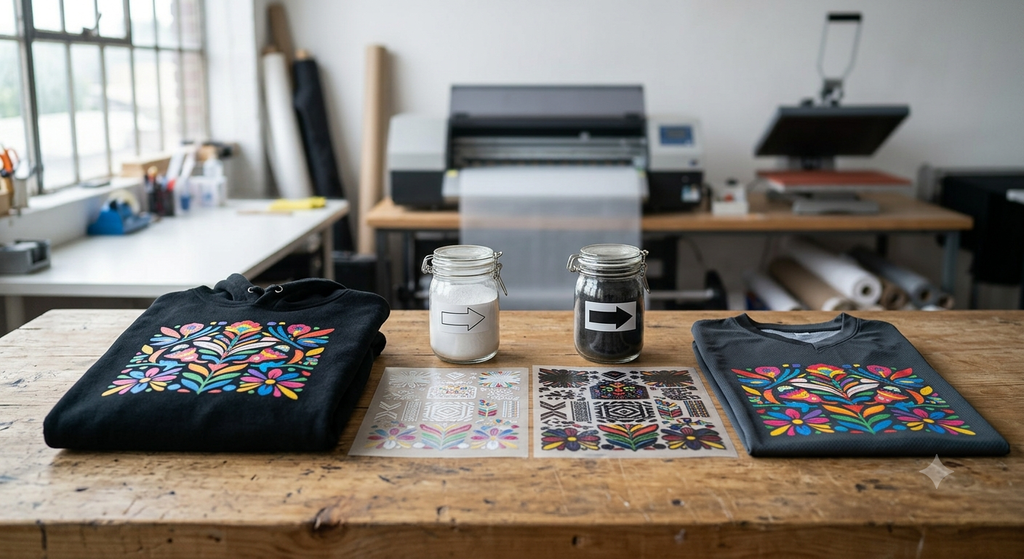
DTF Adhesive Powder comparison on black and dark polyester fabric
Price Range of DTF Hot Melt Powder in India (per kg)
There is no single fixed Indian market price because the price depends on powder grade, particle size, brand, quantity, packaging, GST, and shipping.
As current published examples, Living Lion lists one white TPU DTF powder at ₹450/kg, while Bharti Creation lists TPU hot-melt powder at ₹500/kg before applicable GST.
A practical buying range for comparison is therefore roughly:
| Powder Type | Indicative Price Position |
|---|---|
| Standard white DTF powder | Around ₹450–₹500/kg in the cited listings |
| Premium/specialty powder | Can be higher |
| Colored/black powder | Often varies by supplier and formulation |
| Bulk industrial purchase | Usually requires a separate quotation |
Do not treat these figures as fixed market rates. Always request a current quote.
Comparison of Indian Brands: Performance & Quality
Instead of asking “Which brand is the best?”, ask “Which powder works best for my production?”
For example:
White cotton T-shirts:
Standard white DTF Adhesive Powder is usually the sensible starting point.
White polyester:
White powder may work well, but test the complete ink, film, powder, and pressing combination.
Black cotton T-shirts:
White powder can work, but excess powder around open design areas may become visible. A black or colored adhesive may produce a cleaner edge for certain designs.
Dark polyester sportswear:
This deserves extra testing because polyester dye migration can affect the appearance of the print. Specialty black/anti-sublimation powders are available for such applications, but they should be tested before production.
The color of the powder is not automatically a measure of strength. White and black powders can use similar thermoplastic adhesive bases, while their pigments and formulations differ. The important factors remain adhesion, particle size, curing, fabric, and the complete transfer process.
Where to Buy Hot Melt Adhesive Powder in India (Online & Offline)
You can source DTF Adhesive Powder through online DTF suppliers, textile-printing dealers, marketplaces, and local printing-equipment distributors.
Online buying is convenient because you can compare pack sizes and prices quickly.
Offline buying has one major advantage: you can sometimes ask for a sample print.
Before ordering, ask:
- What is the powder particle size?
- Is it TPU?
- What fabrics is it recommended for?
- What are the curing recommendations?
- Is it suitable for dark polyester?
- What is the minimum order quantity?
- Is a sample available?
- What storage conditions are recommended?
DTFShop.in currently lists DTF powder alongside printers, inks, PET films, heat presses, and printer parts, making it one option for comparing the wider DTF workflow.
Tips for Storing and Using DTF Hot Melt Powder
Good storage can make a surprisingly large difference.
Keep the bag tightly sealed
Do not leave powder open beside the printer or curing unit.
Protect it from humidity
Moisture can cause clumping. Clumped powder is harder to distribute evenly.
Do not mix different powders casually
If you change from one brand or grade to another, clean the working area and test the new powder separately.
Shake off excess powder properly
Too much powder can make the transfer feel thicker and can create unwanted edges.
Test before bulk production
Make one transfer first. Press it on the actual garment. Stretch it. Wash-test it when possible.
Record your settings
Keep a simple production sheet showing:
- Film brand
- Powder brand
- Fabric type
- Curing setting
- Press temperature
- Press time
- Pressure
- Peel type
This makes troubleshooting much easier.
FESPA also recommends following the transfer-film manufacturer’s time and temperature instructions during curing and heat pressing.
Frequently Asked Questions (FAQs)
Is white DTF powder better than black DTF powder?
Not automatically. White is the normal choice for most DTF jobs. Black powder is a specialty option for certain dark garments and designs where a visible white adhesive edge or dye-migration problem needs to be controlled.
Can white DTF powder be used on black T-shirts?
Yes, but the result depends on the artwork and powder application. If excess white powder remains around open areas of the design, a light halo can sometimes be visible on dark fabric.
What is colored DTF powder used for?
Colored powders, especially black, are mainly used for specific fabric and design situations. Black adhesive can blend better with dark garments and can be useful in applications involving dark polyester.
Does powder color decide print durability?
No. Durability depends on the complete process, including powder quality, curing, film, ink, fabric, heat, pressure, and time.
Which powder should a beginner buy?
For a beginner printing mostly cotton T-shirts, hoodies, and light or mixed-color garments, good-quality white powder is usually the simplest starting point.
Should I buy powder only based on price?
No. A cheaper powder is not necessarily cheaper after failed transfers, reprints, wastage, and customer complaints are included.
How do I know if a powder suits my fabric?
Run a small test. Check adhesion, stretch, appearance, hand feel, and wash performance. This is especially important for polyester, blends, sportswear, and dark fabrics.
Conclusion: Best Brand Recommendation for Indian DTF Businesses
There is no single best DTF Adhesive Powder for every Indian printing business.
If your work is mainly standard cotton T-shirts, hoodies, light garments, and general custom apparel, start with a reliable white TPU powder.
If you regularly print black or dark garments, consider keeping a specialty black or colored powder available. It can help with visible adhesive edges in suitable designs.
For polyester sportswear, do not make the decision from color alone. Dye migration, curing temperature, ink, film, and fabric all need to be considered.
For Indian buyers, Living Lion and Bharti Creation currently provide publicly listed price examples that can help establish a basic purchasing benchmark, while suppliers such as 3ALPS and Shagun Enterprise can be considered when looking for broader DTF-printing support.
The safest approach is simple: buy a small quantity, test it on your real garments, record the settings, and only then move to bulk purchasing.
That approach usually saves more money than choosing a powder only because it has the lowest price per kilogram.
Product Suggestions (Blue Products)
For the wider DTF setup, these products from DTFShop.in can be considered:
<span style=”color:blue”>🔵 ProlificGeeks DTF Printer L1800</span> — suitable for smaller or entry-level production.
<span style=”color:blue”>🔵 ProlificGeeks XP600 DTF Printer</span> — a practical option for businesses looking for more production speed.
<span style=”color:blue”>🔵 ProlificGeeks i3200 DTF Printer</span> — aimed at higher-volume production.
<span style=”color:blue”>🔵 ProlificGeeks Premium PET Film</span> — the film should be considered together with the powder because transfer performance depends on the complete system.
<span style=”color:blue”>🔵 ProlificGeeks Hot Melt Powder</span> — a relevant consumable to compare when building a DTF supply setup.
DTFShop.in currently lists DTF printers, DTF powder, PET film, inks, printer parts, and related equipment. Its published buying guides also compare L1800, XP600, and i3200 options for different production levels.
External References + Credits
For technical background and industry context, useful references include:
- FESPA — DTF workflow, textile applications, adhesive powder application, curing, and garment-transfer processes.
- ResearchGate — technical background on heat-sealable powder adhesives and their use with fabrics.
- DTFShop.in — Indian DTF equipment and consumable information, including printer and powder categories.
Credit: Information references from Fespa, PrintIndustry, and other public sources.

LEAVE A COMMENT