
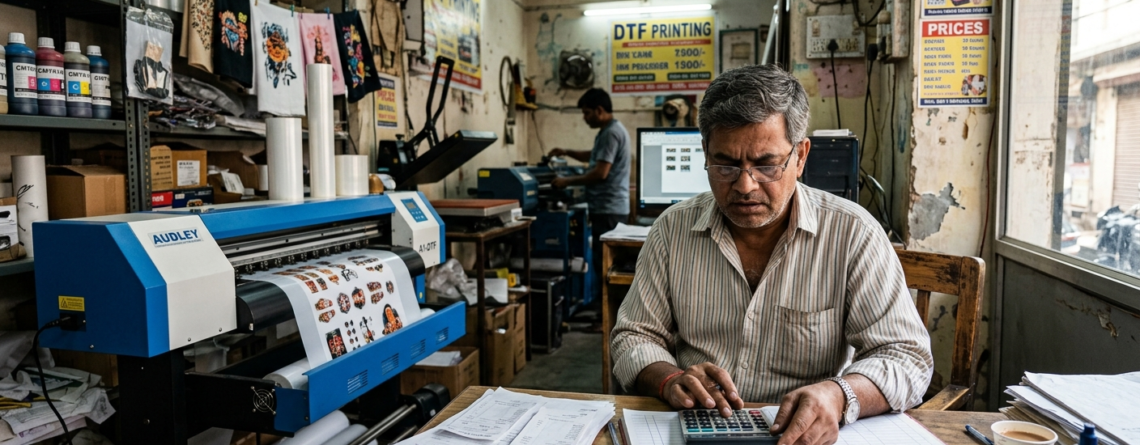
DTF Printer Investment Crush: Full Workflow & Profit Reality for Indian Print Shops 2026
Here’s the blunt truth:
Most people don’t fail because DTF doesn’t work.
They fail because they don’t understand how money moves inside the workflow.
Chat with our team for printers, consumables, film, powder and business setup guidance.
You don’t recover a DTF Printer Investment by buying a machine.
You recover it by controlling cost at every step—from design to final press.
This guide breaks that down. No theory. Only numbers and decisions.
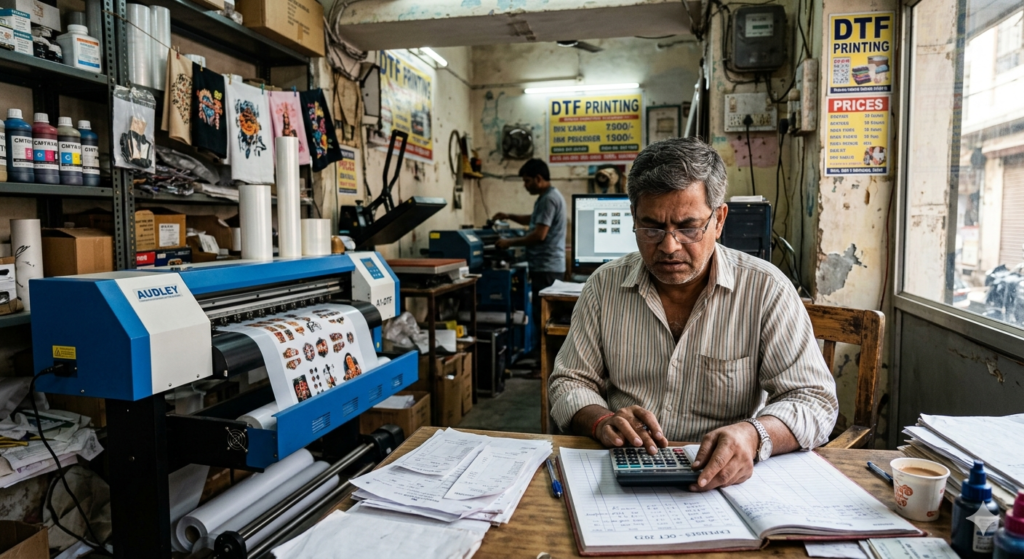
Step-by-Step: How DTF Printing Actually Works (And Where Money Is Made or Lost)
1. Design Stage (Zero Cost? Wrong.)
- Software (CorelDRAW/Photoshop): ₹2,000–₹3,000/month (if licensed)
- Designer cost: ₹10–₹30 per design (or ₹15k–₹25k salary)
Reality:
Bad design = reprints = wasted film + ink.
👉 Loss point starts here.
2. Printing Stage (Where Your Investment Bleeds or Scales)
Machines you’ll typically consider:
- XP600 DTF Printer (entry-mid level)
- i3200 DTF Printer (production level)
Typical consumable cost per A3 print:
- Ink: ₹8–₹12
- Film: ₹10–₹15
- Total: ₹20–₹27 per print
If calibration is off → double prints → cost becomes ₹40+ instantly.
3. Powder Application
- DTF Powder cost: ₹400–₹600/kg
- Per print: ₹5–₹7
Manual process = inconsistency
Automatic shaker = upfront cost but saves rework
4. Curing Stage
- Electricity + time cost: ₹2–₹4 per print
- Improper curing = peeling complaints = refund loss
5. Heat Press Stage
- Electricity + labor: ₹5–₹10 per print
Final product cost (average):
👉 ₹35–₹50 per print
Selling price in Indian market:
👉 ₹120–₹250 per print
Your margin depends on volume—not price.
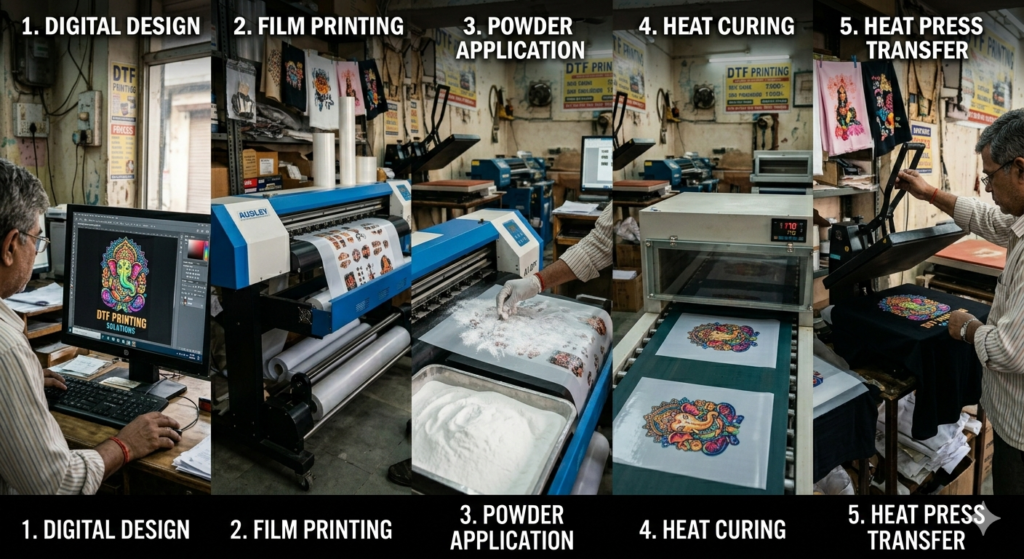
Real DTF Printer Investment in India (2026 Reality)
| Setup Type | Investment | Suitable For |
|---|---|---|
| Basic XP600 Setup | ₹3–₹4.5 lakh | Small shops, beginners |
| i3200 Setup | ₹5–₹7 lakh | Scaling businesses |
Includes:
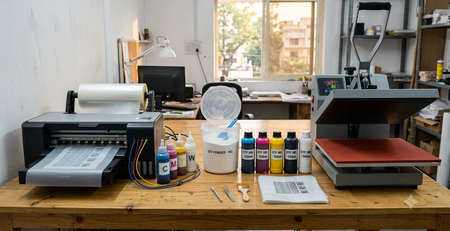
- Printer
- Heat press
- Initial stock (DTF Ink 100ML, DTF PET Film Roll, DTF Powder)
Available through ProlificGeeks at dtfshop.in
Profit Scenarios (This Is What Actually Matters)
Scenario 1: Low Volume (Starter Mistake Zone)
- Prints/day: 30
- Revenue/print: ₹150
- Monthly revenue: ₹1.35 lakh
Costs:
- Consumables: ₹40,000
- Rent + electricity: ₹20,000
- Misc: ₹10,000
👉 Profit: ₹65,000/month
Break-even:
👉 5–7 months (best case)
Reality: Most people stay stuck here.
Scenario 2: Medium Volume (Stable Business)
- Prints/day: 80
- Monthly revenue: ₹3.6 lakh
Costs:
- Consumables: ₹1.2 lakh
- Overheads: ₹50,000
👉 Profit: ₹1.9 lakh/month
Break-even:
👉 3–4 months
Scenario 3: High Volume (Serious Operators Only)
- Prints/day: 150+
- Monthly revenue: ₹6–₹8 lakh
Costs:
- Consumables: ₹2.5–₹3 lakh
- Overheads: ₹80k–₹1 lakh
👉 Profit: ₹3–₹4 lakh/month
Break-even:
👉 2–3 months
Mini Case: Surat Shop Owner (Real Pattern)
- Started with XP600
- First 3 months: low volume, barely breaking even
- Shifted to bulk B2B orders (uniform suppliers)
Now:
👉 ₹2.5–₹3 lakh monthly profit
👉 Upgraded to i3200 within 6 months
Lesson:
👉 Volume + consistency > machine alone
XP600 vs i3200: Which One Recovers Investment Faster?
| Factor | XP600 | i3200 |
| Cost | ₹3–4.5L | ₹5–7L |
| Speed | Medium | High |
| Maintenance | Moderate | Lower (if used right) |
| Ideal Volume | 30–80 prints/day | 100+ prints/day |
| ROI Speed | Slower | Faster (if volume exists) |
Decision Rule:
- No confirmed orders → XP600
- Bulk orders ready → i3200
Hidden Costs Nobody Talks About
This is where most ROI calculations fail.
1. Printhead Damage
- Cost: ₹15k–₹40k
- Happens due to poor maintenance
2. Idle Machine Loss
- No orders = no recovery
- EMI still running
3. Wastage
- Misprints
- Film rejection
- Color mismatch
👉 Can eat 10–20% of revenue
4. Power Issues (India Reality)
- Voltage fluctuation damages boards
5. Downtime
- 2–5 days repair = ₹20k–₹50k lost opportunity
Pros and Cons (No Sugarcoating)
Pros
- High margin product
- Customization demand is real
- Fast turnaround
- Works for B2B + B2C
Cons
- Requires daily discipline
- Not “plug and play”
- Market is getting competitive
- Bad operator = guaranteed loss
Who Should NOT Buy This
Don’t invest if:
- You don’t have minimum ₹50k working capital/month
- You don’t understand printing basics
- You expect passive income
- You don’t have sales channels
DTF is not a “buy machine → earn money” model.
Common Mistakes That Destroy ROI
- Buying i3200 without orders
- Ignoring maintenance
- Underpricing prints
- No B2B clients
- No daily production target
Step-by-Step Investment Recovery Plan
Step 1: Start With Real Numbers
- Target: 50 prints/day minimum
- Fix selling price before buying machine
Step 2: Lock B2B Clients First
- Local t-shirt shops
- Uniform suppliers
- Small brands
Step 3: Control Costs
- Track per print cost daily
- Reduce wastage below 10%
Step 4: Scale Gradually
- XP600 → i3200 upgrade
- Add staff only after demand
Step 5: Maintain Machine Like an Asset
- Daily cleaning
- Proper shutdown
- Use quality consumables (DTF Ink 100ML, DTF PET Film Roll, DTF Powder)
Decision Framework (Simple and Brutal)
Choose XP600 if:
- You’re testing market
- Budget under ₹4.5L
- Volume uncertain
Choose i3200 if:
- You already have orders
- You want faster ROI
- You can push 100+ prints/day
Final Decision Summary
DTF works. But only if:
- You hit volume early
- You control wastage
- You plan ROI before buying
A DTF Printer Investment is not risky.
A blind investment is.
What You Should Do Next
If you’re serious:
- Calculate your daily print capacity
- Estimate your local demand
- Decide your machine based on volume—not budget
You can explore reliable machines from ProlificGeeks at:
👉 https://dtfshop.in
👉 Or WhatsApp directly: +918123524574
Ask for numbers. Not brochures.
Credit: Industry insights referenced from Fespa, PrintIndustry, and public textile printing reports.

LEAVE A COMMENT