
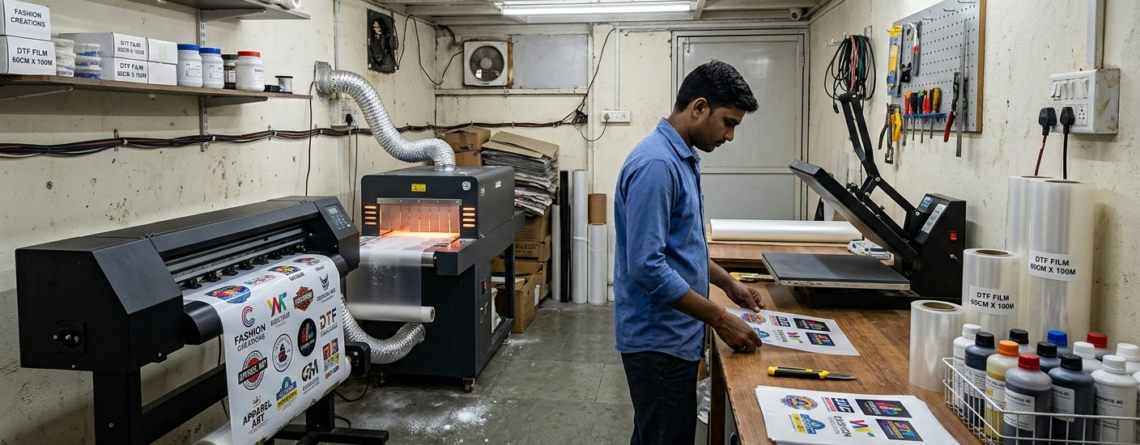
DTF Printer Investment: The Brutal Truth About Recovery Time in India
If your DTF Printer Investment is ₹4–7 lakhs and you don’t recover it in 8–12 months, the problem is not the machine.
It’s your numbers.
I’ve seen Indian print shop owners recover capital in 4–6 months. I’ve also seen people stuck for 2 years blaming “market slowdown.”
This article is not motivation.
It’s math.
If you’re serious about starting or scaling a DTF unit, read this like you’re about to sign a ₹5 lakh cheque.
What Is the Real DTF Printer Investment in India?
Let’s talk actual numbers for 2026 India.
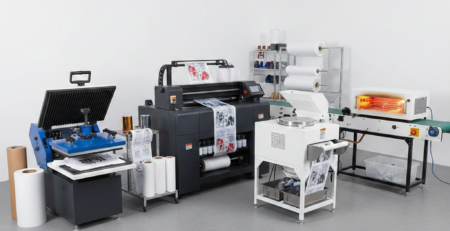
Entry-Level Commercial Setup (Not Hobby Machine)
| Component | Approx Cost (₹) |
|---|---|
| 24-inch DTF Printer (Commercial Grade) | 3,20,000 – 4,20,000 |
| Powder Shaker + Dryer | 80,000 – 1,50,000 |
| Heat Press | 35,000 – 60,000 |
| Initial Ink + Film + Powder Stock | 60,000 – 90,000 |
| Electrical + Table Setup | 40,000 – 70,000 |
| Working Capital (2 Months) | 1,00,000 – 1,50,000 |
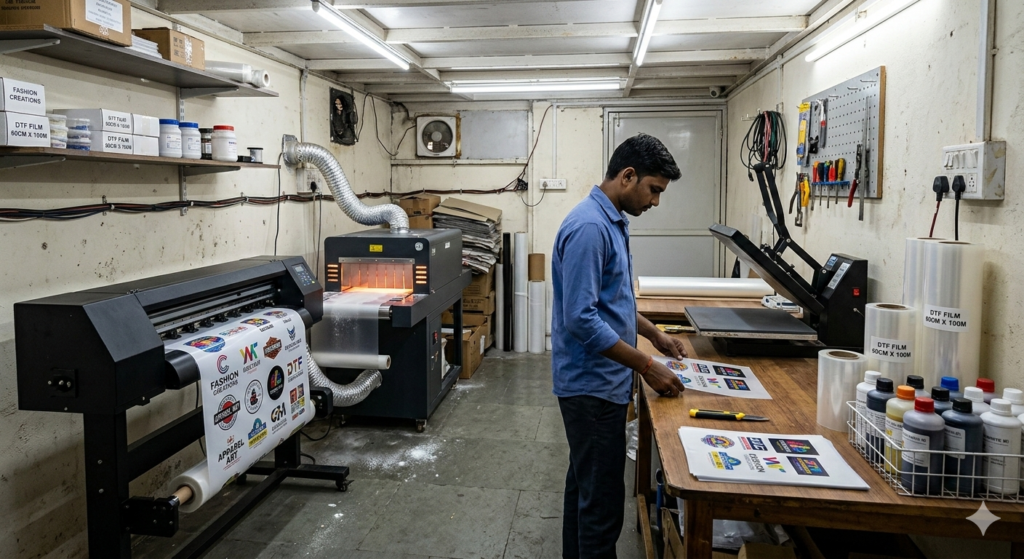
Total Realistic DTF Printer Investment:
₹5.5 lakhs to ₹7 lakhs
If someone told you ₹3 lakh total — you’re either underestimating or under-building.
Machines like ProlificGeeks DTF printers, available at dtfshop.in, fall in the commercial reliability category. That matters when we talk about downtime and ROI.
Monthly Running Cost – The Real Cash Burn
Let’s assume moderate production.
| Expense | Monthly (₹) |
|---|---|
| Ink | 45,000 – 70,000 |
| Film | 60,000 – 1,00,000 |
| Powder | 20,000 – 35,000 |
| Labour (1 operator) | 15,000 – 20,000 |
| Electricity | 8,000 – 15,000 |
| Rent (small unit) | 15,000 – 25,000 |
| Maintenance + Cleaning | 5,000 – 10,000 |
Total Monthly Cost:
₹1.7 lakh – ₹2.5 lakh
If your revenue is below ₹3 lakh per month, recovery will be slow.
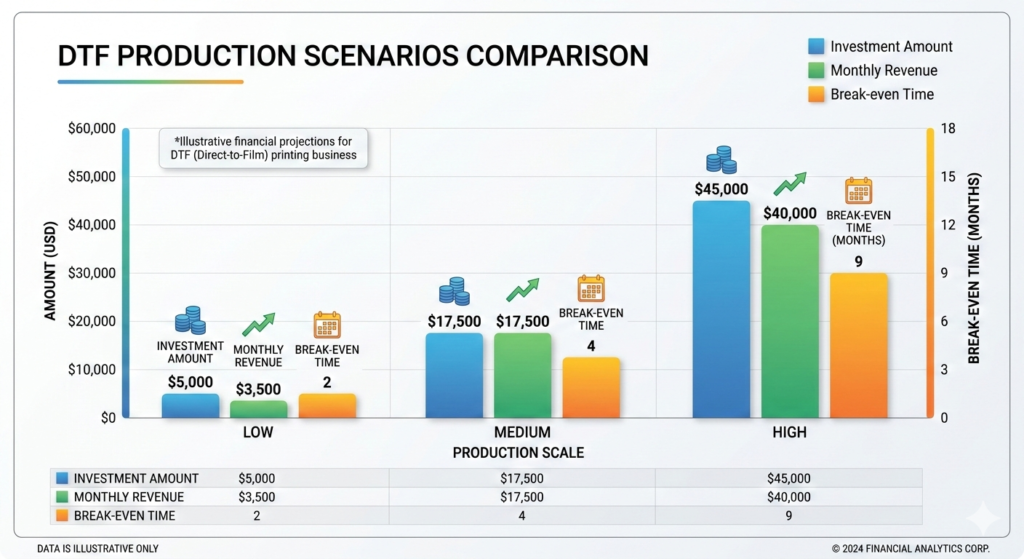
Real Revenue Scenarios (Low / Medium / High Production)
Let’s break this down properly.
Assumption:
Average DTF transfer selling price = ₹40–₹60 per A3 equivalent.
Scenario 1: Low Production (Beginner Struggle Mode)
- 70 prints/day
- 25 working days
- 1,750 prints/month
- Avg selling ₹45
Revenue: ₹78,750
This is loss territory if you have staff and rent.
Recovery time?
Not happening.
This is why many small operators fail.
Scenario 2: Medium Production (Serious Business Mode)
- 200 prints/day
- 25 working days
- 5,000 prints/month
- Avg selling ₹50
Revenue: ₹2,50,000
After monthly cost (~₹2 lakh average):
Net Profit ≈ ₹50,000
Break-even on ₹6 lakh investment:
12 months
Now we are talking business.
Scenario 3: High Production (Wholesale / Reseller Focus)
- 400 prints/day
- 25 working days
- 10,000 prints/month
- Avg selling ₹50
Revenue: ₹5,00,000
Monthly cost increases to around ₹3 lakh (more material + 2 staff).
Net Profit ≈ ₹2 lakh
Break-even:
3–4 months
Yes, possible.
But only with consistent bulk orders.
Mini Case Example – Surat Unit (Anonymized)
A client in Surat invested ₹6.2 lakh in a commercial setup.
First 3 months:
Low sales. ₹1.5 lakh monthly revenue.
They focused only on small retail jobs.
Month 4:
Shifted to wholesaling transfers to 6 local t-shirt printers.
Production increased to 8,000 prints/month.
Monthly revenue: ₹4 lakh
Net profit: ₹1.4 lakh
Investment recovered in 7 months.
Lesson:
Volume > fancy designs.
Break-Even Formula (Simple and Clear)
Break-even months =
Total DTF Printer Investment ÷ Monthly Net Profit
Example:
₹6,00,000 ÷ ₹1,00,000 = 6 months
If your profit is ₹40,000 per month:
Recovery = 15 months
The machine is not the issue.
Production capacity utilisation is.
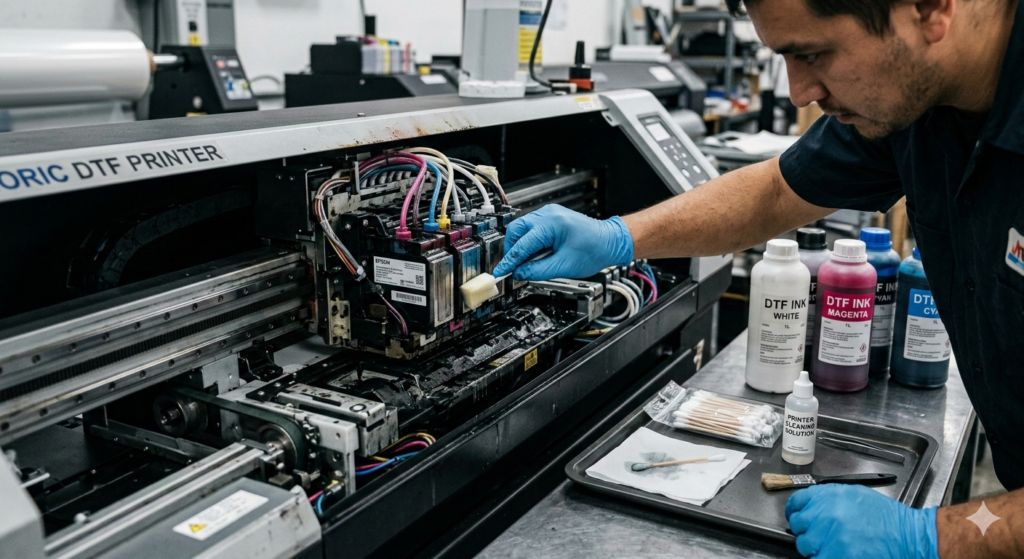
Hidden Costs Nobody Talks About
- Printhead Replacement
₹18,000 – ₹35,000 depending on model
Poor maintenance kills heads in 6–8 months. - Downtime Loss
3 days machine idle = lost revenue
No income but rent + salary continues. - Ink Wastage During Cleaning
Heavy in monsoon. - Power Backup (Inverter/UPS)
Voltage fluctuation damages boards. - Market Credit Cycle
Many B2B buyers pay after 30 days.
Working capital matters.
Industry discussions at events like FESPA regularly highlight maintenance discipline as the biggest profitability factor in small-format textile printing.
Who Should NOT Buy This
Do NOT invest if:
- You don’t have B2B buyers lined up.
- You plan to print only your own clothing brand (low volume).
- You can’t manage daily maintenance.
- You don’t have ₹1.5 lakh buffer cash.
- You expect passive income.
DTF is a daily operational business.
Comparison: Low vs Medium vs High Scale ROI
| Factor | Low Scale | Medium Scale | High Scale |
|---|---|---|---|
| Investment | ₹5.5L | ₹6L | ₹7L |
| Monthly Revenue | ₹80k | ₹2.5L | ₹5L |
| Monthly Profit | Negative | ₹50k | ₹2L |
| Break-even | No recovery | 12 months | 3–4 months |
| Risk Level | High | Moderate | Operational |
Scalability Reality in India
India is price sensitive.
Margins shrink fast if:
- Too many local competitors
- You compete only on rate
- No niche focus (sports, corporate, schools)
According to textile printing data published in industry summaries by PrintIndustry, small-format digital print businesses grow sustainably only when 60%+ revenue comes from repeat buyers.
One-time Instagram orders won’t scale you.
Common Mistakes That Destroy ROI
- Buying cheapest machine available.
- Ignoring humidity control.
- No AMC or technical support backup.
- Selling below cost to gain market.
- No production planning.
- Mixing incompatible ink brands.
- Delaying cleaning cycles.
Most failed DTF Printer Investment stories are operational failures, not market failures.
Step-by-Step Investment Recovery Plan
Step 1: Pre-Sell Before Buying
Secure at least 3 bulk buyers before installation.
Step 2: Start With B2B
Retail comes later.
Step 3: Daily Production Target
Minimum 250 prints/day from month 2.
Step 4: Strict Maintenance SOP
No skipped cleaning.
Step 5: Weekly Cost Tracking
Know cost per print exactly.
Step 6: Upsell Add-ons
Gang sheets, urgent printing, design support.
Decision Framework – What Should You Choose?
If You Have:
- Existing print shop
- Screen printing clients
- T-shirt wholesalers
→ Go medium-to-high scale immediately.
If You Are:
- New entrepreneur
- No buyer network
- Limited buffer capital
→ Partner with someone before investing.
Machines like ProlificGeeks DTF printers, available to buy DTF online at dtfshop.in, make sense only when your business model is ready.
WhatsApp support availability helps during breakdowns — but support cannot fix a weak sales plan.
Honest Pros and Cons
Pros
- Fast turnaround
- No color limit
- High-margin bulk transfer model
- Low space requirement
- Expanding customization market
Cons
- Maintenance sensitive
- Competitive pricing pressure
- Requires daily discipline
- Ink cost fluctuation
- Power stability issues in smaller cities
So… How Fast Can You Recover DTF Printer Investment?
Best case (serious volume): 4–6 months
Practical case (disciplined operator): 8–12 months
Poor planning case: 18+ months or never
Your recovery speed depends on:
- Volume
- Buyer quality
- Cost control
- Downtime management
- Cash flow discipline
Not luck.
Final Decision Summary
If you can consistently push 6,000–8,000 transfers per month, your DTF Printer Investment makes financial sense.
If you’re guessing demand, don’t invest yet.
DTF is profitable in India — but only when run like a production business, not a hobby.
If you’re evaluating machines, compare reliability, parts availability, and service backup.
Commercial-grade systems like ProlificGeeks models are structured for sustained production — which is what ROI depends on.
If you want realistic guidance before investing ₹5–7 lakhs, talk to professionals who deal with serious buyers daily. Support is available via WhatsApp at dtfshop.in.
Make the decision based on numbers.
Not YouTube hype.
Credit: Industry insights referenced from Fespa, PrintIndustry, and public textile printing reports.


LEAVE A COMMENT