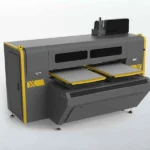
DTG Printer is an HJD single-platen hybrid DTG printer. A single platen holds one garment position for the supported direct-garment workflow.
DTG Printer is an HJD single-platen hybrid DTG printer. A single platen holds one garment position for the supported direct-garment workflow. Any additional film-transfer mode depends on the supplied machine configuration and software.
What you receive for the listed price
The named machine or conversion configuration selected on this product page.
Unlisted accessories, starter-consumable quantities, installation services and warranty terms are not included by implication; these package details still require a written itemisation.
Applicable taxes and shipping, where relevant, are shown at checkout. Gallery guides and demonstration equipment explain use; they are not additional supplied items.
Smart Online SavingsYour order cost, explained
Compare automated website ordering—including COD, card/digital payments, rewards and coupons—with a manual/offline order.
Order on DTFShop.inRecommended
Product value₹580,000.00
Prepaid discountNot applicable above ₹10,000
Website shippingCalculated by weight at checkout
GST (18%)+₹104,400.00
Estimated platform fee (2.36% of total)+₹16,542.24
Estimated prepaid subtotal₹700,942.24
Weight-based shipping will be added at checkout
Online purchase rewardsEarn and use eligible rewards
Purchase + email couponsGet eligible coupon offers and free promotional coupons by email
✓ Order online anytime, from anywhere✓ Choose COD where available✓ Pay securely by credit card or available digital payment methods✓ Immediate digital payment proof and automatic order confirmation✓ GST invoice available without manual follow-up✓ Automatic tracking and WhatsApp order updates✓ Earn rewards on eligible completed online purchases✓ Receive eligible purchase coupons and free promotional coupons by email
Manual / Offline Order
Product value₹580,000.00
Manual / offline shippingCalculated by actual weight and location
GST (18%)+₹104,400.00
Prepaid website discount₹0
Website rewards / coupon₹0
Estimated manual order subtotal₹684,400.00
Actual weight/location-based courier charge is extra
• Payment coordinated manually through WhatsApp/bank transfer• Confirmation and invoice may require manual processing• Courier charged on the actual/manual booking basis• Shipment timing and updates are coordinated manually
How this estimate works:
Website example uses the 7.5% prepaid discount only when the eligible value is ₹10,000 or below, plus GST 18% and an estimated non-EMI platform fee equal to 2.36% of the subtotal including that fee. Shipping, coupons and final taxes are confirmed at checkout.
Website and manual/offline shipping are excluded from these subtotals because courier charges are calculated from actual weight, dimensions and delivery location.
Final checkout or confirmed manual quotation is authoritative and can change with shipping, coupon, rewards, variation and payment method.
Frequently bought together
Complete your setup
Useful add-ons commonly paired with this product. Choose only what you need.
DTG Printer is an HJD single-platen hybrid DTG printer. A single platen holds one garment position for the supported direct-garment workflow. Any additional film-transfer mode depends on the supplied machine configuration and software.
What you receive for the listed price
The named machine or conversion configuration selected on this product page.
Unlisted accessories, starter-consumable quantities, installation services and warranty terms are not included by implication; these package details still require a written itemisation.
Applicable taxes and shipping, where relevant, are shown at checkout. Gallery guides and demonstration equipment explain use; they are not additional supplied items.
Hybrid Single Platen Product view HJD India for garment printing.
Production quality is a complete workflow
Assess a machine with representative artwork and the materials used for the intended jobs. Media transport, ink condition, software settings and the downstream process affect usable output. Head count or nominal media width alone does not establish a guaranteed production speed.
Daily use and practical checks
When working with DTG Printer, prepare the garment as part of the print process. Loading flat, controlling pretreatment and using the correct white/colour setup are as important as the artwork file.
Specifications and available options
Brand
HJD
Machine Type
Hybrid DTG + DTF machine
Printhead
Dual I3200
Platen Type
Single platen
Maximum Print Size
16 x 24 inch
Ink Configuration
CMYK + WWWW
RIP / Software
Maintop / Elephant RIP
Power Requirement
Approx. 3000W
DTG Fabric Support
Cotton fabric with pretreatment
DTF Fabric Support
Any fabric through DTF transfer workflow, subject to transfer suitability
Pretreatment Required
Yes, for cotton DTG printing
DTF Printing Support
Yes
Installation
Included
Warranty
1 year dedicated warranty
Warranty Exclusion
No warranty on printhead and ink-related parts
Printhead Warranty
No printhead warranty
Spare Parts Support
Available
Delivery
Pan-India delivery available
Operating the equipment consistently
For DTG Printer, keep the supplied maintenance schedule, service access and work area in the daily routine. Record stable settings for each material combination. Use the machine documentation for electrical requirements, ventilation and installation rather than transferring values from a different model.
Building the production workflow around the machine
A printer or processing unit delivers its best practical value when the stages around it are planned together. Artwork preparation, material loading, printing, curing or transfer, and finished-output inspection each take time. The configuration described above establishes the role of this machine in that sequence. Nominal width, head count or platen arrangement are useful specifications, but they do not alone describe completed daily output.
Build the workflow around the actual jobs being produced, including the size of the designs, material changes and the time needed for setup and routine care between batches.
Illustrated guide: building the production workflow around . Educational illustration, not a product photograph.
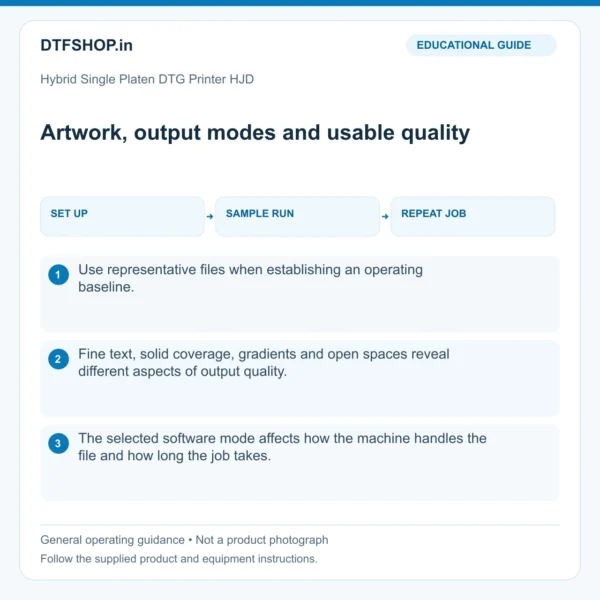
Artwork, output modes and usable quality
Use representative files when establishing an operating baseline. Fine text, solid coverage, gradients and open spaces reveal different aspects of output quality. The selected software mode affects how the machine handles the file and how long the job takes. Save the preset once an acceptable result has been established and retain the approved sample alongside it.
A demonstration file with sparse artwork is not a complete reference for a dense production design. For repeat work, keep the artwork version and intended finished dimensions clear so a later software or layout change does not become an unnoticed production difference.
Illustrated guide: artwork output modes and usable quality. Educational illustration, not a product photograph.
Media handling and the working area
Material should enter the working zone in the position and condition required by the machine. Roll-fed equipment needs a supported path with consistent alignment, while a platen arrangement needs flat loading and suitable clearance around the item. Keep the operator's loading area, output area and maintenance access practical.
A machine that is awkward to load or clean can lose useful production time even when its printing stage is fast. Plan where consumables and finished work will be held so they remain protected from dust, accidental contact and unnecessary movement through the workshop.
Illustrated guide: media handling and the working area. Educational illustration, not a product photograph.
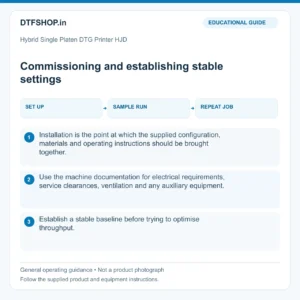
Commissioning and establishing stable settings
Installation is the point at which the supplied configuration, materials and operating instructions should be brought together. Use the machine documentation for electrical requirements, service clearances, ventilation and any auxiliary equipment. Establish a stable baseline before trying to optimise throughput. Confirm the relevant checks for the machine, such as media tracking, nozzle condition, alignment, temperature control or consistent contact.
Record those results along with the working recipe. If a setting is later changed, retain the previous value and sample so the effect can be evaluated rather than relying on memory of how a job looked before the adjustment.
Illustrated guide: commissioning and establishing stable se. Educational illustration, not a product photograph.
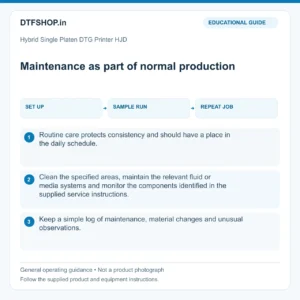
Maintenance as part of normal production
Routine care protects consistency and should have a place in the daily schedule. Clean the specified areas, maintain the relevant fluid or media systems and monitor the components identified in the supplied service instructions. Keep a simple log of maintenance, material changes and unusual observations. A recurring defect is easier to investigate when its timing can be compared with an ink change, cleaning event or new media batch.
Use the correct service method and consumables for the installed technology. Procedures intended for an aqueous garment-transfer printer, a sublimation machine and a UV system should remain distinct.
Illustrated guide: maintenance as part of normal production. Educational illustration, not a product photograph.
Assessing capacity with meaningful evidence
The useful capacity measure is accepted finished work in the quality mode required by the business. Include setup, handling, maintenance and the downstream process when estimating that capacity. Compare samples using the same artwork dimensions and acceptance standard. Record rejected output as well as successful output so a faster setting is not mistaken for a better production result.
When the workflow is stable, keep the configuration and approved process documented for other operators. This creates a realistic basis for repeat orders, material planning and support, while avoiding unsupported promises about output speed, unattended operation or compatibility with every application.
Illustrated guide: assessing capacity with meaningful evide. Educational illustration, not a product photograph.
Recommended Add-ons from DTFShop
If you are buying the HJD DTG DTF Hybrid Machine, you may also need compatible DTG/DTF consumables and workflow accessories depending on your production requirement.
These external references are educational only. Always follow your actual machine installation requirement, electrical setup, garment printing workflow and DTFShop guidance before preparing your workspace.
Reference videos explain a method or related model. They do not certify your supplied machine, consumable batch or print results. Follow the exact product manual and recommended settings.
Practical questions
What is a useful production demonstration?
Use artwork and materials similar to the jobs you intend to sell. Inspect finished output, setup time and the downstream processing stage. Head count or nominal width alone does not establish usable production speed at your required quality.
What should the operator save for repeat jobs?
Keep the artwork version, print preset, material identity and approved finished sample together. Record routine maintenance and any setup changes. A known reference job helps distinguish a file change from a transport, ink or calibration problem.
Additional information
Weight
300 kg
Dimensions
180 × 80 × 90 cm
Reviews
There are no reviews yet.
Be the first to review “Hybrid Single Platen DTG Printer HJD – Direct to Garment Printing Machine India” Cancel reply
Continue on WhatsAppPlease share your details so our team can help you faster.
Hybrid Single Platen DTG Printer HJD – Direct to Garment Printing Machine India₹620,000.00Original price was: ₹620,000.00.₹580,000.00Current price is: ₹580,000.00.













Reviews
There are no reviews yet.