DTFShop benefitSave up to 22.1%
Includes eligible prepaid saving before GST/fees
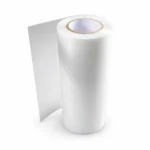
DTF PET film roll A4 India is an A4 PET-film roll for a compatible DTF transfer setup. A narrow roll can suit compact production where small logos, labels and individual garment designs are common.
DTF PET film roll A4 India is an A4 PET-film roll for a compatible DTF transfer setup. A narrow roll can suit compact production where small logos, labels and individual garment designs are common. The coating carries the printed image through the adhesive and transfer stages.
What you receive for the listed price
One A4-format PET film roll, 100 metres long.
Ink, adhesive powder and printing equipment are separate.
Applicable taxes and shipping, where relevant, are shown at checkout. Gallery guides and demonstration equipment explain use; they are not additional supplied items.
Availability: Unavailable — contact us for an alternativeSKU: PG-DTF-FILM-A4R01Category: DTF Pet FIlms
UnavailableThis product cannot be purchased online
Please choose an alternative or contact us for the nearest available model.
Smart Online SavingsYour order cost, explained
Compare automated website ordering—including COD, card/digital payments, rewards and coupons—with a manual/offline order.
Order on DTFShop.inRecommended
Product value₹1,600.00
Prepaid discount (7.5%)−₹120.00
Website shippingCalculated by weight at checkout
GST (18%)+₹266.40
Estimated platform fee (2.36% of total)+₹42.21
Estimated prepaid subtotal₹1,788.61
Weight-based shipping will be added at checkout
Online purchase rewardsEarn and use eligible rewards
Purchase + email couponsGet eligible coupon offers and free promotional coupons by email
✓ Order online anytime, from anywhere✓ Choose COD where available✓ Pay securely by credit card or available digital payment methods✓ Immediate digital payment proof and automatic order confirmation✓ GST invoice available without manual follow-up✓ Automatic tracking and WhatsApp order updates✓ Earn rewards on eligible completed online purchases✓ Receive eligible purchase coupons and free promotional coupons by email
Manual / Offline Order
Product value₹1,600.00
Manual / offline shippingCalculated by actual weight and location
GST (18%)+₹288.00
Prepaid website discount₹0
Website rewards / coupon₹0
Estimated manual order subtotal₹1,888.00
Actual weight/location-based courier charge is extra
• Payment coordinated manually through WhatsApp/bank transfer• Confirmation and invoice may require manual processing• Courier charged on the actual/manual booking basis• Shipment timing and updates are coordinated manually
Estimated saving by ordering prepaid on DTFShop.in₹99.39
before weight-based shipping and any additional eligible rewards or coupon saving
How this estimate works:
Website example uses the 7.5% prepaid discount only when the eligible value is ₹10,000 or below, plus GST 18% and an estimated non-EMI platform fee equal to 2.36% of the subtotal including that fee. Shipping, coupons and final taxes are confirmed at checkout.
Website and manual/offline shipping are excluded from these subtotals because courier charges are calculated from actual weight, dimensions and delivery location.
Final checkout or confirmed manual quotation is authoritative and can change with shipping, coupon, rewards, variation and payment method.
Frequently bought together
Complete your setup
Useful add-ons commonly paired with this product. Choose only what you need.
DTF PET film roll A4 India — Overview and practical use
DTF PET film roll A4 India is an A4 PET-film roll for a compatible DTF transfer setup. A narrow roll can suit compact production where small logos, labels and individual garment designs are common. The coating carries the printed image through the adhesive and transfer stages.
What you receive for the listed price
One A4-format PET film roll, 100 metres long.
Ink, adhesive powder and printing equipment are separate.
Applicable taxes and shipping, where relevant, are shown at checkout. Gallery guides and demonstration equipment explain use; they are not additional supplied items.
Product view for professional garment transfer printing.
Coating, feeding and transfer release
The film coating receives the image and carries it through the adhesive and curing stages. Print-face orientation, media flatness and release behaviour are distinct properties. Do not infer a hot-, warm- or cold-peel instruction from the surface finish alone.
Product view.
Daily use and practical checks
When working with DTF PET film roll A4 India, use consistent roll support and avoid letting printed film touch dusty surfaces. Clean handling protects the image before the transfer has been fully cured.
Working with a repeatable transfer recipe
For DTF PET film roll A4 India, keep the film protected from dust and moisture, and handle the print face as little as possible. Use the film and powder instructions for curing and pressing; a small finished-transfer test is more informative than judging the wet image alone.
Product view.
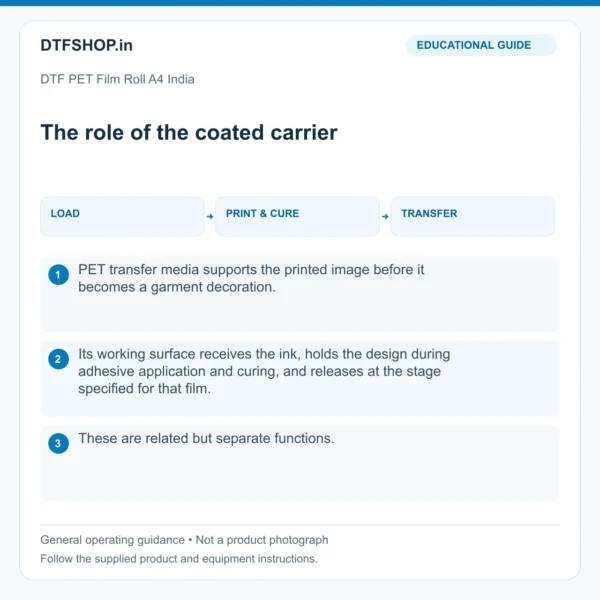
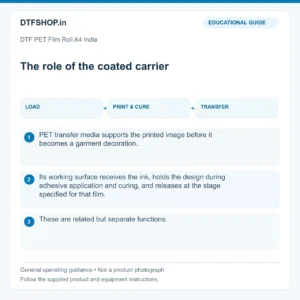
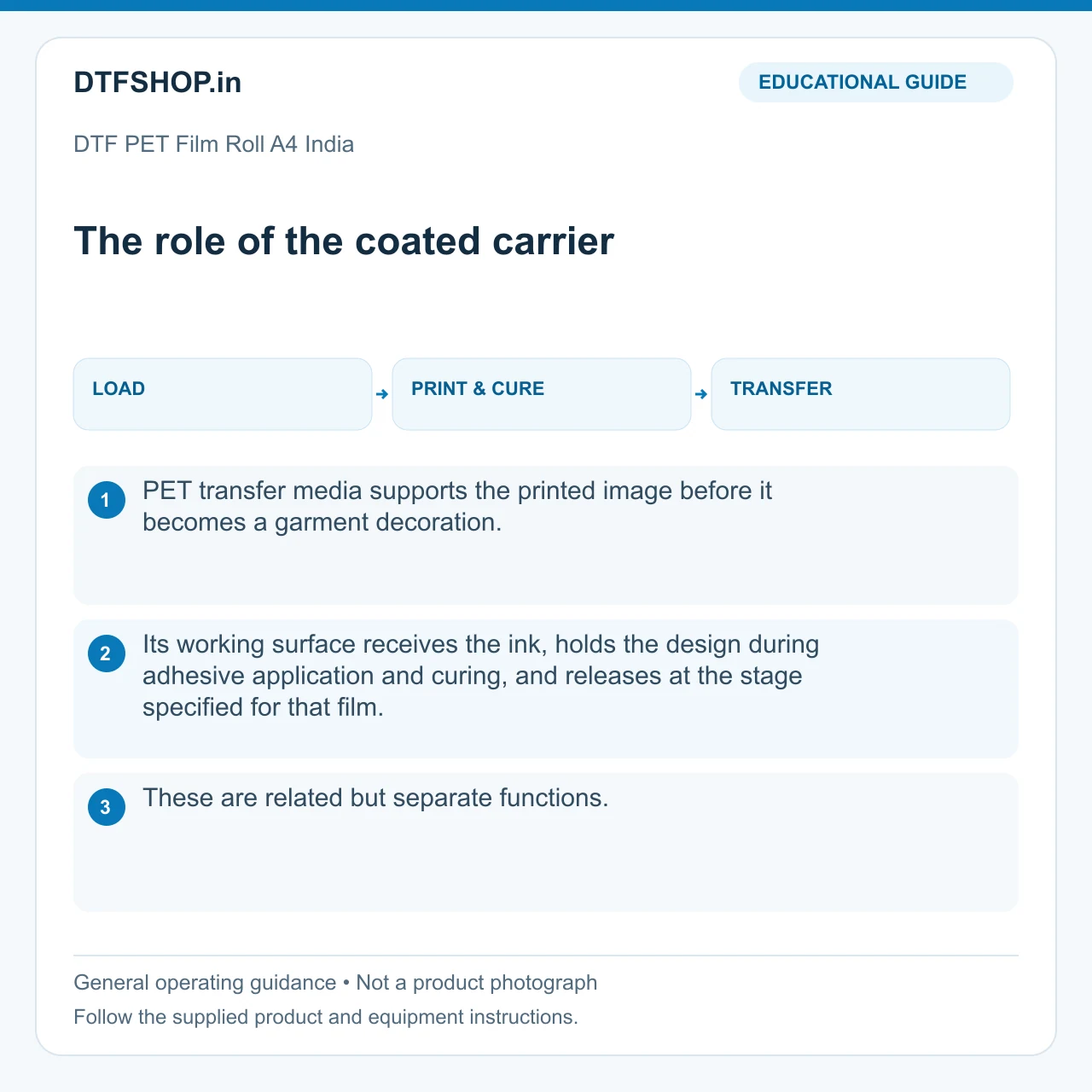
The role of the coated carrier
PET transfer media supports the printed image before it becomes a garment decoration. Its working surface receives the ink, holds the design during adhesive application and curing, and releases at the stage specified for that film. These are related but separate functions. A film that feeds neatly still needs the correct print-face orientation and transfer process.
Similarly, a decorative surface description does not establish a universal peel instruction. Think of the carrier as an active part of the printing recipe rather than a disposable sheet that can be exchanged without affecting the settings or the final appearance.
Illustrated guide: the role of the coated carrier. Educational illustration, not a product photograph.
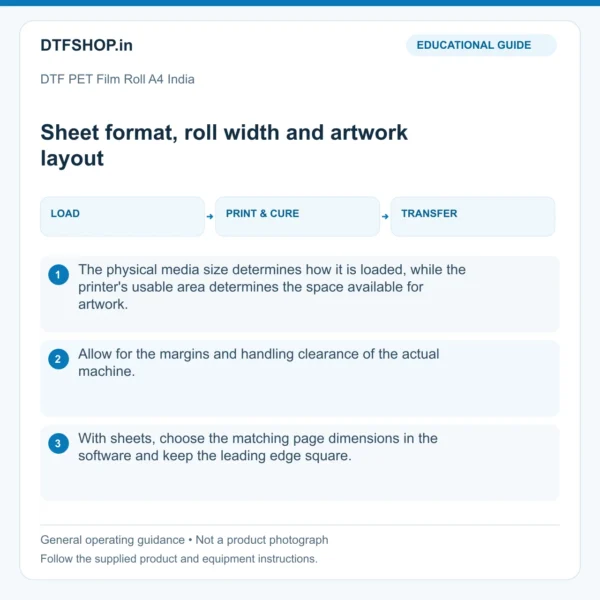
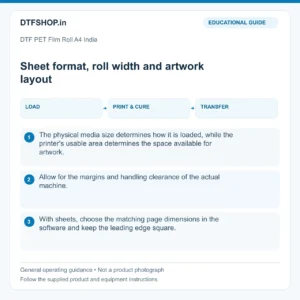
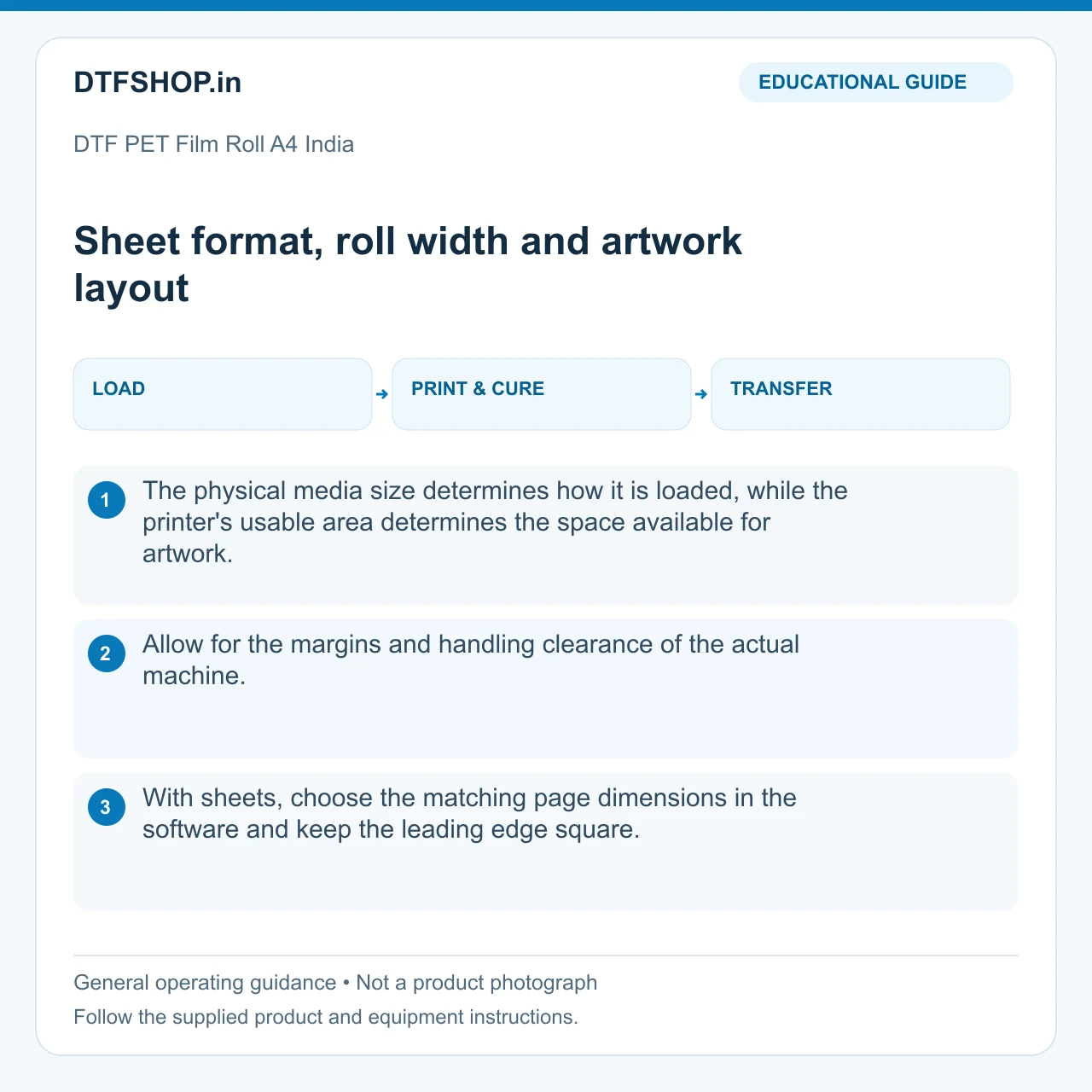
Sheet format, roll width and artwork layout
The physical media size determines how it is loaded, while the printer's usable area determines the space available for artwork. Allow for the margins and handling clearance of the actual machine. With sheets, choose the matching page dimensions in the software and keep the leading edge square.
With rolls, support the unwind path and avoid sideways pull as the roll turns. Gang-sheet planning can place several smaller designs within the available area, but adequate spacing still helps powder removal and handling. A clean, repeatable layout is more useful than squeezing artwork into every visible corner of the carrier.
Illustrated guide: sheet format roll width and artwork layo. Educational illustration, not a product photograph.
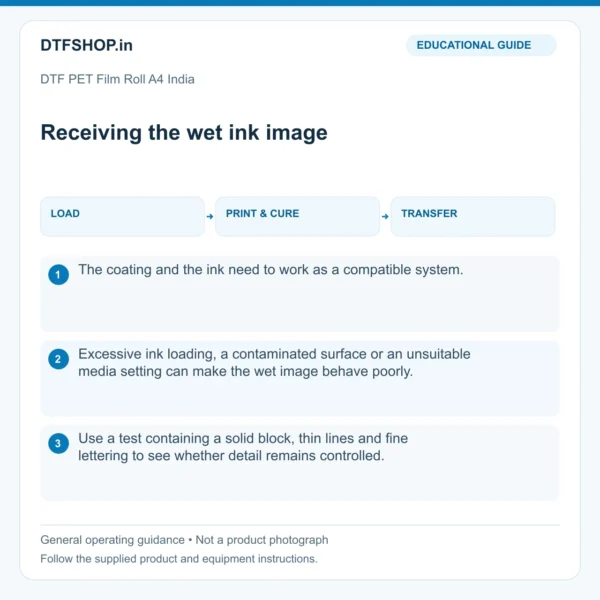
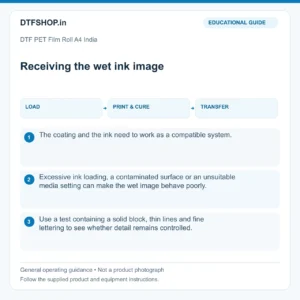
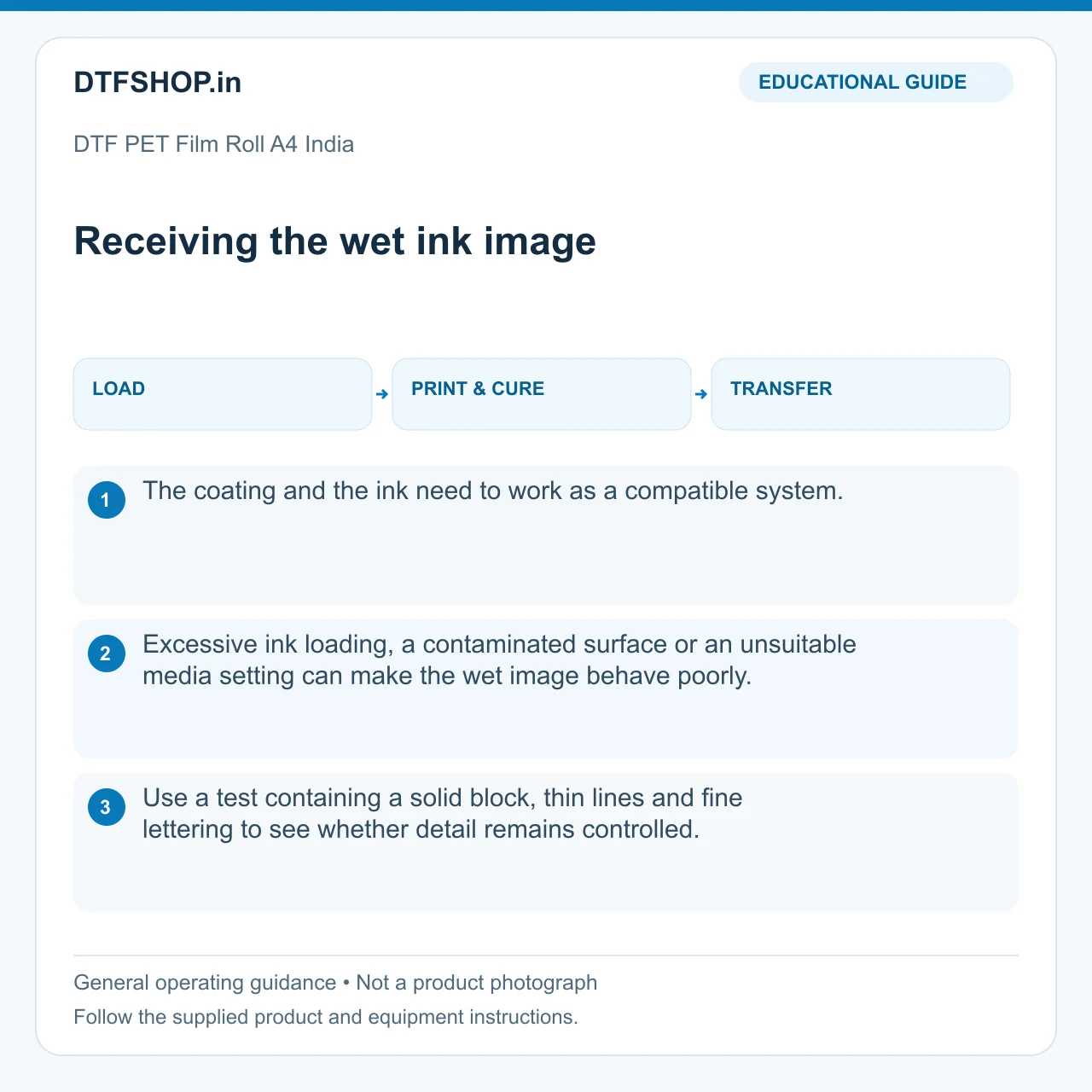
Receiving the wet ink image
The coating and the ink need to work as a compatible system. Excessive ink loading, a contaminated surface or an unsuitable media setting can make the wet image behave poorly. Use a test containing a solid block, thin lines and fine lettering to see whether detail remains controlled.
Handle the edges where practical and keep fingerprints away from the print face. If the result changes between rolls or variants, record that change before adjusting the whole workflow. A useful test changes one factor at a time and compares the completed transfer, rather than relying only on how glossy or dense the wet image looks.
Illustrated guide: receiving the wet ink image. Educational illustration, not a product photograph.
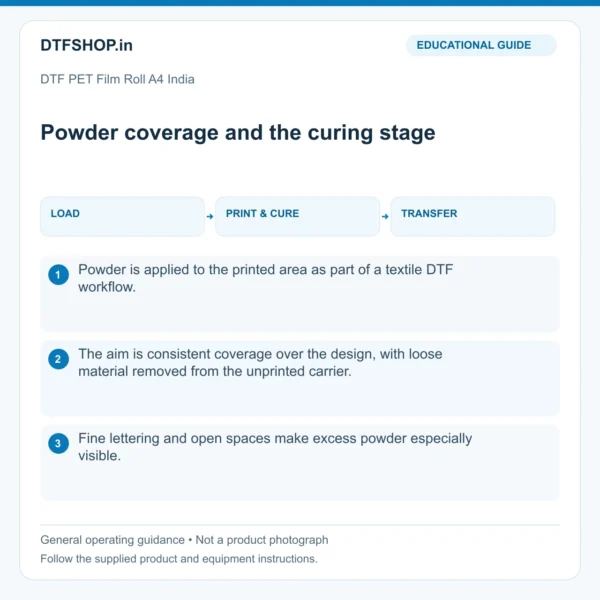
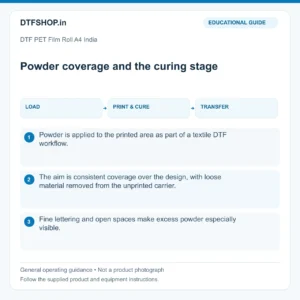
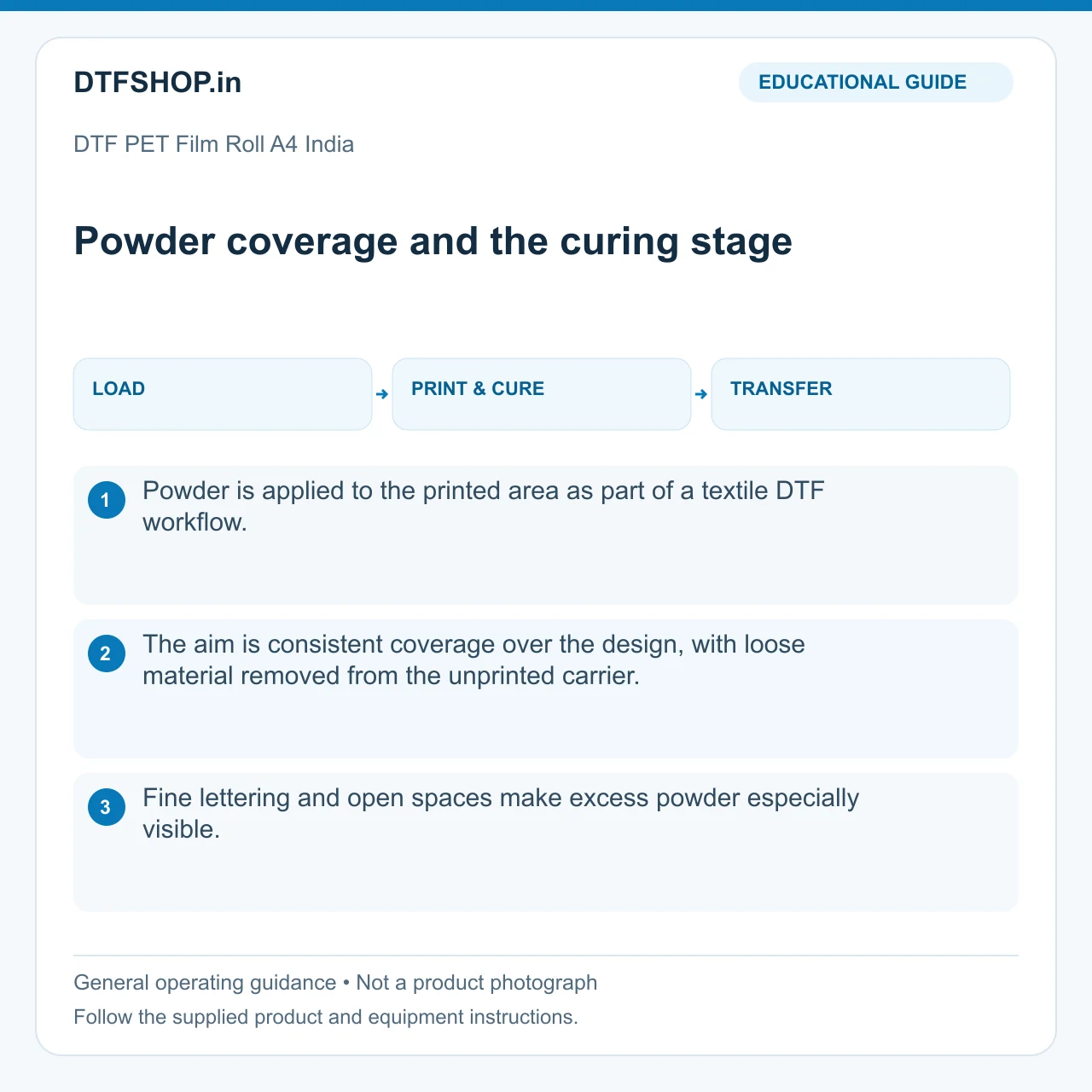
Powder coverage and the curing stage
Powder is applied to the printed area as part of a textile DTF workflow. The aim is consistent coverage over the design, with loose material removed from the unprinted carrier. Fine lettering and open spaces make excess powder especially visible. Curing prepares the adhesive layer for transfer, but the correct process comes from the film and powder combination and the equipment used.
Avoid borrowing one temperature or conveyor setting from an unrelated material. Keep the carrier flat during processing and use a representative sample to establish that the printed design, adhesive layer and release behaviour work together.
Illustrated guide: powder coverage and the curing stage. Educational illustration, not a product photograph.
Release behaviour and finished appearance
Peeling is a controlled part of transfer application. Follow the supplied instruction for the required release stage and handling sequence. Pulling the carrier too soon, too late or at an unsuitable angle can complicate an otherwise stable transfer. Matte, gloss and decorative effects should be judged on the garment under normal viewing conditions.
A special finish may be more obvious in a large solid area than in a small outline. Include both in the sample artwork. Where a protective sheet or finishing press is part of the material procedure, use the specified method consistently instead of improvising a different surface treatment on each job.
Keeping media results repeatable
Store unused media in its protective packaging, away from workshop contamination and conditions outside the supplier's guidance. Keep opened sheets flat and protect roll edges from knocks or creases. Label the size, finish and working side in the production area so similar-looking variants remain distinguishable. For repeat orders, retain a finished sample together with the film identity, powder and press settings.
A short production record makes a coating change, handling mark or release difference easier to identify. Evaluate a new batch through the complete transfer process before using it for a long run of customer garments.
Recommended Add-ons from DTFShop
To complete the workflow, you may also check these related DTFShop products when they match your machine or printing process:
Reference videos explain a method or related model. They do not certify your supplied machine, consumable batch or print results. Follow the exact product manual and recommended settings.
Practical questions
Does a glossy or matte face identify the peel method?
No. Coating appearance and release behaviour are different properties. Use the confirmed instructions for this supplied film and evaluate a sample transfer. A setting from a different film or adhesive is not automatically suitable.
Where should I judge the result?
Inspect the finished transfer on a representative garment. Check fine lettering, image edges, coverage and the surrounding fabric for loose adhesive marks. A clean-looking wet image on film is only an intermediate check.
What is included with DTF PET film roll A4 India?
The package-contents section above lists the supplied item and quantity. Choose the stated option when alternatives are available; a gallery showing several examples does not turn one selected option into a combined set.
Additional information
Weight
2.4 kg
Dimensions
35 × 20 × 20 cm
3 reviews for DTF PET Film Roll A4 India – Premium Transfer Printing Media
5 out of 5
Nisha Patel–
Great value for money. Setup is incredibly easy if you follow standard industrial printing parameters. Static handling is excellent and peel properties remain crisp.
5 out of 5
Manish Tiwari–
Perfect compatibility with our converted machines. Flow rates are smooth and packaging arrived safely. Static handling is excellent and peel properties remain crisp.
4 out of 5
Manish Tiwari–
Very reliable over long production runs. Colors are accurate and consistency remains solid throughout the week. Static handling is excellent and peel properties remain crisp.







Nisha Patel –
Great value for money. Setup is incredibly easy if you follow standard industrial printing parameters. Static handling is excellent and peel properties remain crisp.
Manish Tiwari –
Perfect compatibility with our converted machines. Flow rates are smooth and packaging arrived safely. Static handling is excellent and peel properties remain crisp.
Manish Tiwari –
Very reliable over long production runs. Colors are accurate and consistency remains solid throughout the week. Static handling is excellent and peel properties remain crisp.