UV DTF PET Film 24-Inch A+B Film is a 24-inch A+B film for UV DTF transfer work. The wider format supports appropriately sized roll-to-roll sticker production.
UV DTF PET Film 24-Inch A+B Film is a 24-inch A+B film for UV DTF transfer work. The wider format supports appropriately sized roll-to-roll sticker production. The image is transferred from the film system to a suitable surface after printing and the specified lamination stage.
What you receive for the listed price
One 24-inch A-film roll, 100 metres long, plus one matching B-film roll, 100 metres long.
Both A and B rolls are included. Ink is not included; the printer and application tools are separate.
Applicable taxes and shipping, where relevant, are shown at checkout. Gallery guides and demonstration equipment explain use; they are not additional supplied items.
Availability: Special Order — estimated dispatch/availability in 20–20 daysSKU: PG-UV-FILM-24IN-ABCategory: UVDTF Printer Consumables
Special OrderAvailable to order — expected in 20–20 days
Full online payment is required. COD is unavailable. This order is non-cancellable once paid.
GST invoice available / Shipping calculated at checkout / Product support
Smart Online SavingsYour order cost, explained
Compare automated website ordering—including COD, card/digital payments, rewards and coupons—with a manual/offline order.
Order on DTFShop.inRecommended
Product value₹13,000.00
Prepaid discountNot applicable above ₹10,000
Website shippingCalculated by weight at checkout
GST (18%)+₹2,340.00
Estimated platform fee (2.36% of total)+₹370.77
Estimated prepaid subtotal₹15,710.77
Weight-based shipping will be added at checkout
Online purchase rewardsEarn and use eligible rewards
Purchase + email couponsGet eligible coupon offers and free promotional coupons by email
✓ Order online anytime, from anywhere✓ Choose COD where available✓ Pay securely by credit card or available digital payment methods✓ Immediate digital payment proof and automatic order confirmation✓ GST invoice available without manual follow-up✓ Automatic tracking and WhatsApp order updates✓ Earn rewards on eligible completed online purchases✓ Receive eligible purchase coupons and free promotional coupons by email
Manual / Offline Order
Product value₹13,000.00
Manual / offline shippingCalculated by actual weight and location
GST (18%)+₹2,340.00
Prepaid website discount₹0
Website rewards / coupon₹0
Estimated manual order subtotal₹15,340.00
Actual weight/location-based courier charge is extra
• Payment coordinated manually through WhatsApp/bank transfer• Confirmation and invoice may require manual processing• Courier charged on the actual/manual booking basis• Shipment timing and updates are coordinated manually
How this estimate works:
Website example uses the 7.5% prepaid discount only when the eligible value is ₹10,000 or below, plus GST 18% and an estimated non-EMI platform fee equal to 2.36% of the subtotal including that fee. Shipping, coupons and final taxes are confirmed at checkout.
Website and manual/offline shipping are excluded from these subtotals because courier charges are calculated from actual weight, dimensions and delivery location.
Final checkout or confirmed manual quotation is authoritative and can change with shipping, coupon, rewards, variation and payment method.
Frequently bought together
Complete your setup
Useful add-ons commonly paired with this product. Choose only what you need.
UV DTF PET Film 24-Inch A+B Film — Overview and practical use
UV DTF PET Film 24-Inch A+B Film is a 24-inch A+B film for UV DTF transfer work. The wider format supports appropriately sized roll-to-roll sticker production. The image is transferred from the film system to a suitable surface after printing and the specified lamination stage.
What you receive for the listed price
One 24-inch A-film roll, 100 metres long, plus one matching B-film roll, 100 metres long.
Both A and B rolls are included. Ink is not included; the printer and application tools are separate.
Applicable taxes and shipping, where relevant, are shown at checkout. Gallery guides and demonstration equipment explain use; they are not additional supplied items.
Product view.
How the UV DTF film system works
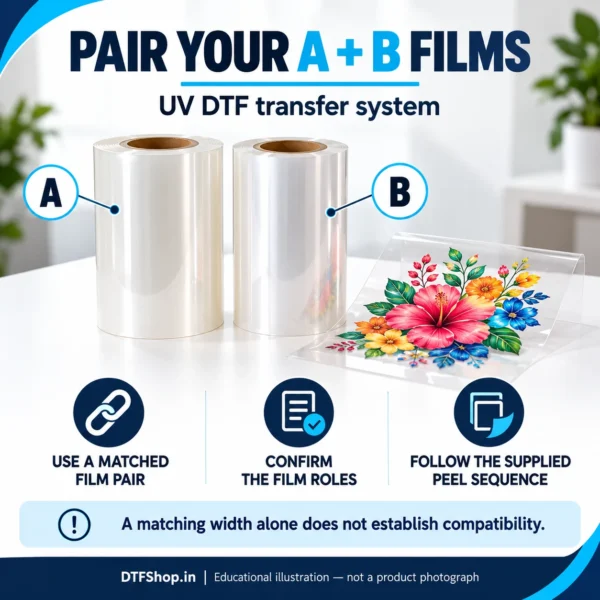
UV DTF creates a transferable decoration on compatible adhesive film. In a matched A/B film system, the printed design is laminated with its transfer layer, positioned on the prepared object and transferred using the specified peel sequence. This workflow is separate from textile DTF powder-and-heat transfer.
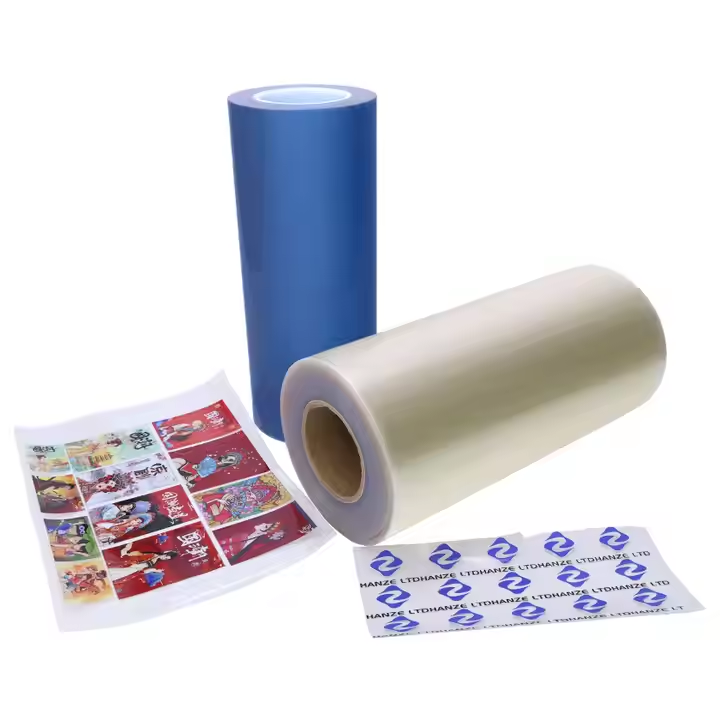
Product view.
Daily use and practical checks
When working with UV DTF PET Film 24-Inch A+B Film, surface preparation and transfer contact determine the result on the final object. Curves, texture and coatings need to be considered rather than treating every object as an identical flat substrate.
Clean handling and surface contact
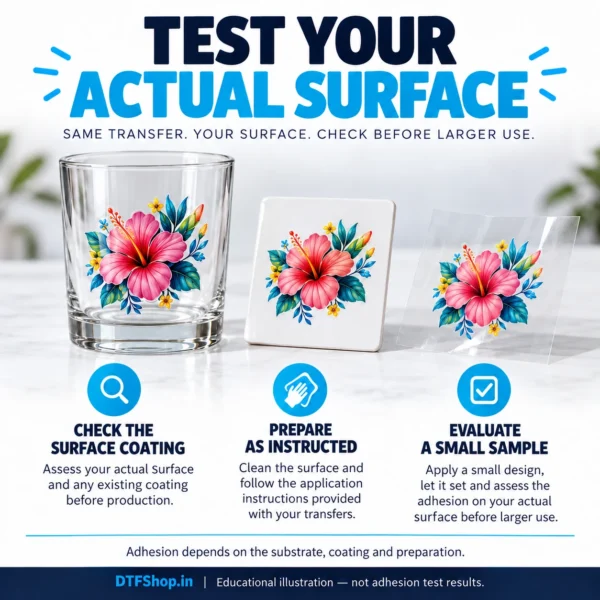
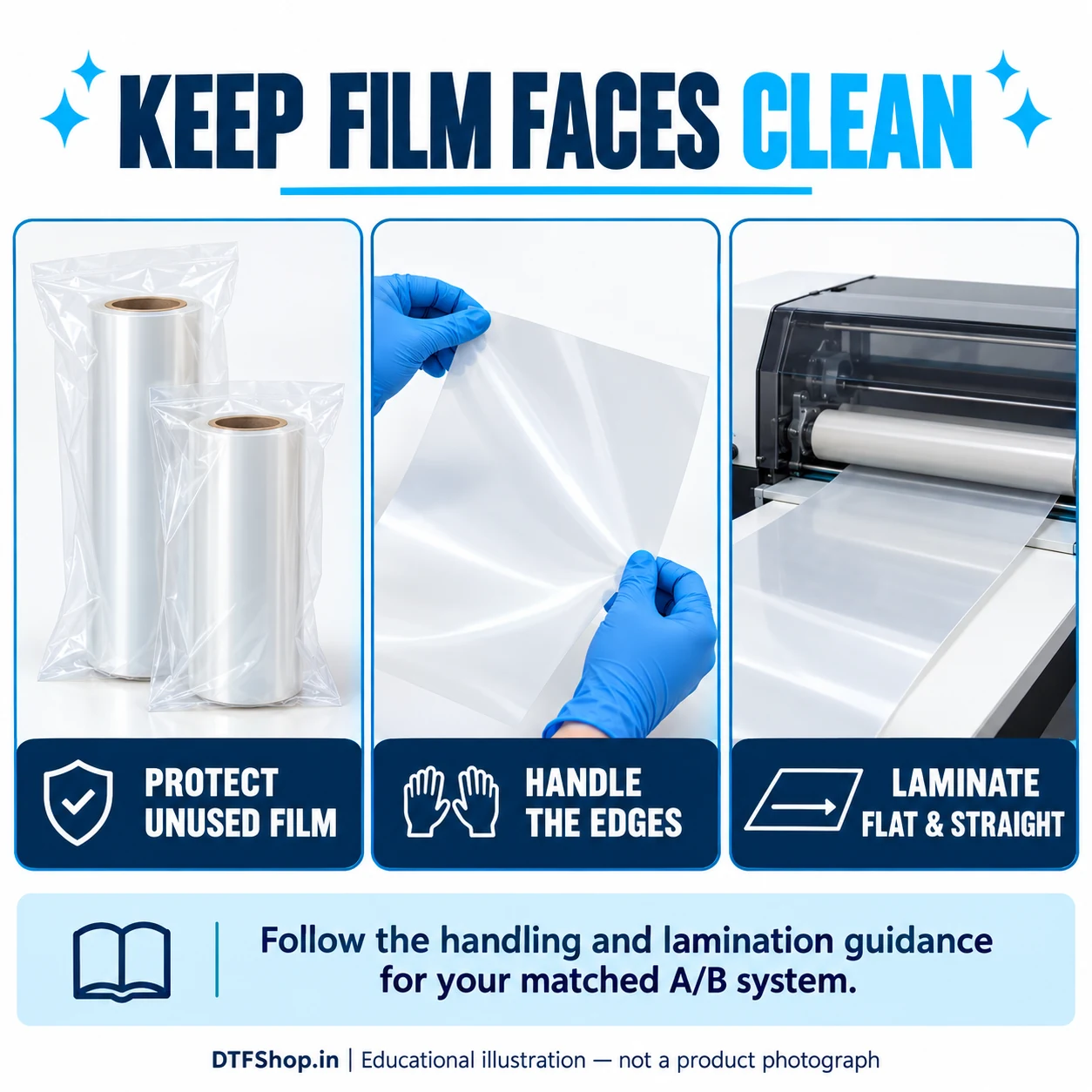
For UV DTF PET Film 24-Inch A+B Film, keep the working film faces free of dust, fingerprints and creases. Smooth contact helps prevent trapped air around the design. Evaluate adhesion on the actual surface, including any coating or texture, and follow the film system instructions for lamination and application.
Product view.
Understanding the UV printing workflow
UV printing uses a compatible ink and curing arrangement to form the image on the intended media. Direct printing onto a flat object and printing a transferable decoration on UV DTF film use different media paths. The role described above identifies which part of that workflow this item serves.
Ink, film, cleaner and equipment should be selected as one supported system. A common colour name or similar printer width does not establish that two systems use the same materials. Keeping the workflow clearly identified helps the operator make sensible choices about setup, handling and finished-output evaluation.
Direct printing and film transfer applications
In a flatbed workflow, the object or sheet is positioned within the machine's supported working area. Surface preparation, object height and stable positioning affect the result. In a UV DTF workflow, a matched adhesive-film arrangement carries the decoration to the object through the specified application sequence.
These methods can serve different shapes and production needs. Choose the method around the actual job rather than assuming that every UV system handles every substrate in the same way. The final application must be assessed on its real surface, including coatings, texture, curvature and the way the object will be handled.
Product view.
Curing, adhesion and surface behaviour
The ink system and curing arrangement need to be compatible with each other and the intended application. A surface that looks dry is only one observation; adhesion and finished behaviour also matter. Hard, soft and hybrid ink descriptions refer to intended formulation behaviour, rather than a universal ranking from good to better.
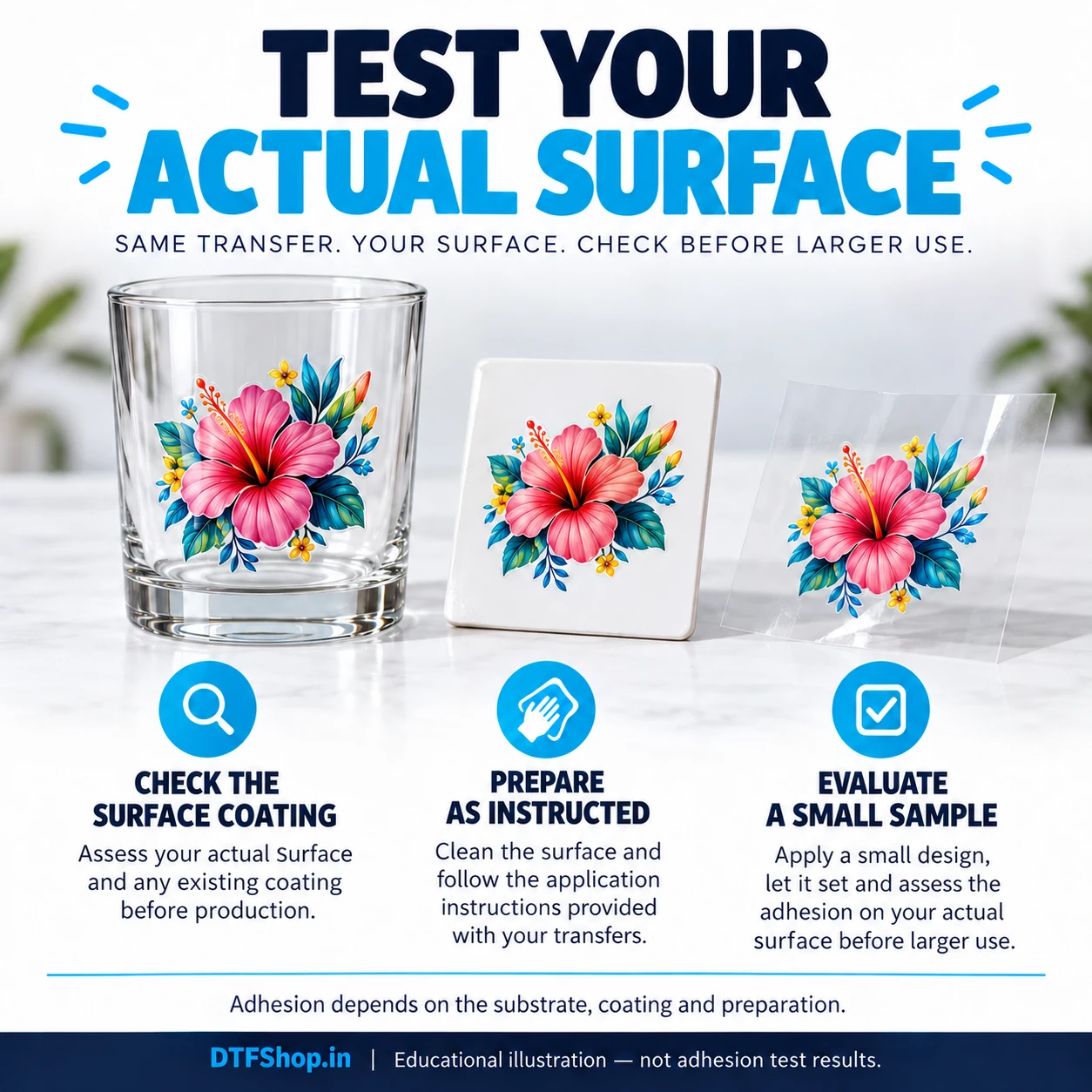
Use the supplied material guidance when evaluating a formulation. Keep surface preparation and application conditions consistent during a test. Avoid extending an ordinary adhesion sample into claims about food contact, dishwashing, outdoor life or chemical resistance unless the specific materials and process have supporting evidence for those claims.
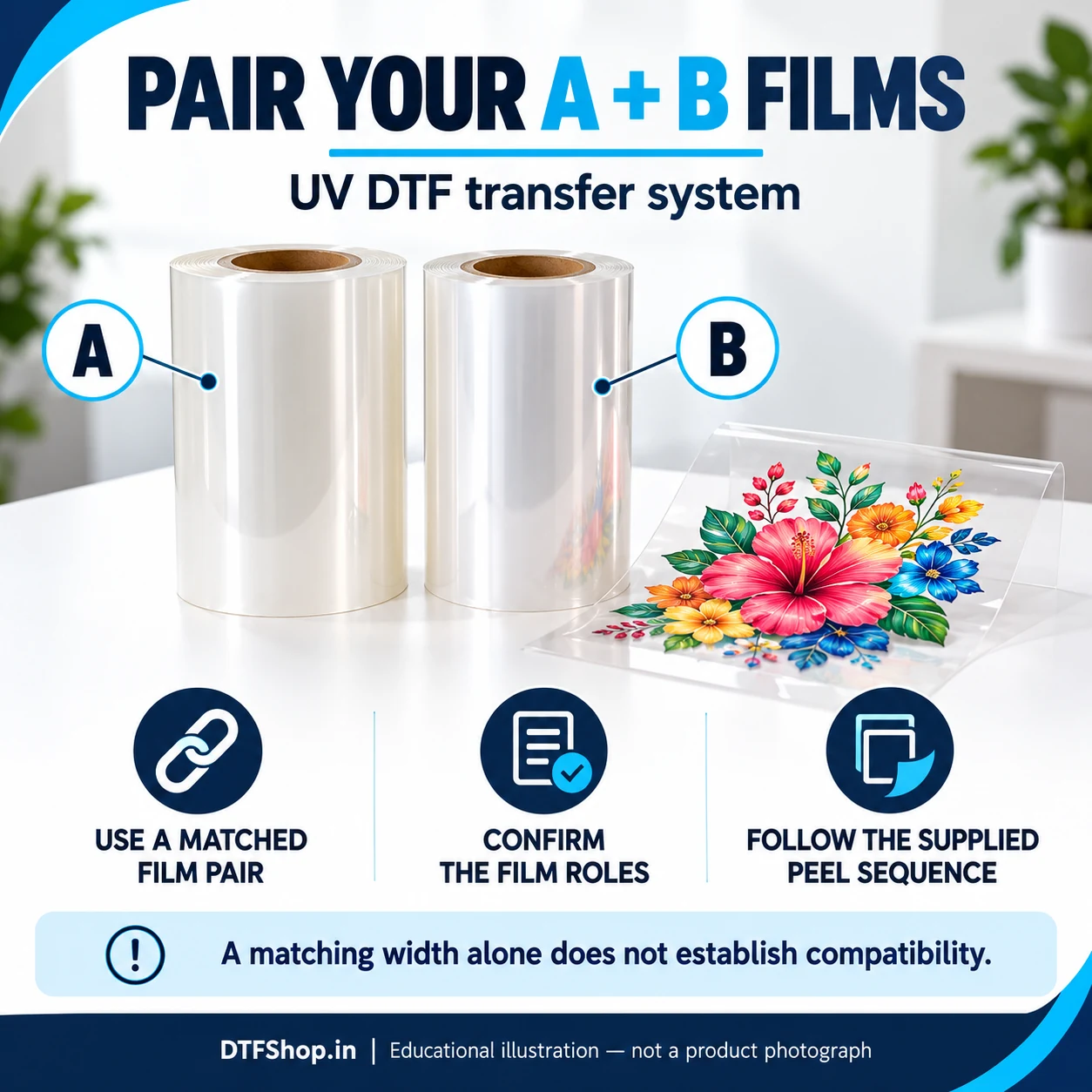
Illustrated guide to product use, handling or workflow. Educational illustration, not a product photograph.
Handling film and printed decorations
Where UV DTF film is used, follow the matched film system's lamination, positioning and release instructions. Keep the working surfaces free of dust, fingerprints and creases. Smooth application helps avoid trapped air and local contact differences around the artwork. Test a design with fine features and larger solid areas so the transfer behaviour can be seen across different shapes.
A textured or strongly curved object may need a different application approach from a flat smooth surface. Record the material and preparation method used for an accepted sample so a repeat job starts from an established procedure.
Keeping the materials and machine organised
Protect UV ink and related fluids from unintended light exposure and follow their supplied storage information. Keep maintenance products separate from printing consumables and labelled for the installed system. Use the equipment documentation for cleaning, curing-unit service and safe access to the working area. Head height, media positioning and clearances are machine settings rather than properties of the artwork file.
For roll workflows, track alignment through printing and lamination; for flatbed work, keep jigs and objects stable. The purpose is consistent control of the whole image path, without borrowing an aqueous garment-transfer routine for a different chemistry.
Illustrated guide to product use, handling or workflow. Educational illustration, not a product photograph.
A useful finished-output evaluation
Retain an accepted sample and note the ink, film or substrate, preparation and working settings. Inspect small text, image edges, colour and surface contact under consistent lighting. Judge the result after the handling stage specified by the materials, using a test appropriate to the intended item.
If a defect appears, compare one process change at a time rather than changing ink, film, curing and application together. A repeatable sample provides a clearer production reference than a general claim of universal adhesion. It also helps distinguish material compatibility, machine setup and application technique when technical support is needed.
Recommended Add-ons from DTFShop
To complete the workflow, you may also check these related DTFShop products when they match your machine or printing process:
Reference videos explain a method or related model. They do not certify your supplied machine, consumable batch or print results. Follow the exact product manual and recommended settings.
Practical questions
Is UV DTF the same as garment DTF?
No. UV DTF uses compatible UV-curable ink and an A/B transfer-film system for suitable objects. Garment DTF uses a different ink, adhesive-powder and heat-transfer process. Keep the two systems and their maintenance fluids separate.
Does the material name guarantee adhesion?
No. Surface coating, cleanliness, shape and the intended use matter alongside the material. Evaluate a representative sample with the supplied ink and film system before committing a production run. No universal outdoor-life or dishwasher claim is made here.
What is included with UV DTF PET Film 24-Inch A+B Film?
The package-contents section above lists the supplied item and quantity. Choose the stated option when alternatives are available; a gallery showing several examples does not turn one selected option into a combined set.
Additional information
Weight
15 kg
Dimensions
35 × 20 × 20 cm
3 reviews for UV DTF PET Film 24-Inch A+B Film – Premium Heat Transfer Film for Glass, Leather & Wood Printing | ProlificGeeks / DTFShop.in
4 out of 5
Arjun Reddy–
Great format width for high volume commercial UV DTF setups. Laminates smoothly without wrinkles. Static handling is excellent and peel properties remain crisp.
5 out of 5
Neha Gupta–
Excellent material thickness and release coat. Transferred labels onto uneven wood and leather products with perfect clarity. Static handling is excellent and peel properties remain crisp.
5 out of 5
Rajesh Nair–
Outstanding durability of the transfers. Have run multiple items through dishwashers and the bond remains intact. Static handling is excellent and peel properties remain crisp.
Continue on WhatsAppPlease share your details so our team can help you faster.
UV DTF PET Film 24-Inch A+B Film – Premium Heat Transfer Film for Glass, Leather & Wood Printing | ProlificGeeks / DTFShop.in₹16,000.00Original price was: ₹16,000.00.₹13,000.00Current price is: ₹13,000.00.









Arjun Reddy –
Great format width for high volume commercial UV DTF setups. Laminates smoothly without wrinkles. Static handling is excellent and peel properties remain crisp.
Neha Gupta –
Excellent material thickness and release coat. Transferred labels onto uneven wood and leather products with perfect clarity. Static handling is excellent and peel properties remain crisp.
Rajesh Nair –
Outstanding durability of the transfers. Have run multiple items through dishwashers and the bond remains intact. Static handling is excellent and peel properties remain crisp.