AvailabilityBackorder available
Dispatch after confirmation
DTFShop benefitSave up to 13.7%
Includes eligible prepaid saving before GST/fees
UV DTF Cleaner is a maintenance-fluid for a compatible UV ink system. UV-maintenance liquid must suit the installed ink chemistry and the parts being serviced.
UV DTF Cleaner is a maintenance-fluid for a compatible UV ink system. UV-maintenance liquid must suit the installed ink chemistry and the parts being serviced. It is not interchangeable with an aqueous DTF or sublimation cleaner simply because both products are sold as printhead fluids.
What you receive for the listed price
The named consumable in its stated or selected pack.
An exact pack quantity has not yet been confirmed where it is absent from the product options. Production equipment and unrelated consumables are separate.
Applicable taxes and shipping, where relevant, are shown at checkout. Gallery guides and demonstration equipment explain use; they are not additional supplied items.
Smart Online SavingsYour order cost, explained
Compare automated website ordering—including COD, card/digital payments, rewards and coupons—with a manual/offline order.
Order on DTFShop.inRecommended
Product value₹2,800.00
Prepaid discount (7.5%)−₹210.00
Website shippingCalculated by weight at checkout
GST (18%)+₹466.20
Estimated platform fee (2.36% of total)+₹73.87
Estimated prepaid subtotal₹3,130.07
Weight-based shipping will be added at checkout
Online purchase rewardsEarn and use eligible rewards
Purchase + email couponsGet eligible coupon offers and free promotional coupons by email
✓ Order online anytime, from anywhere✓ Choose COD where available✓ Pay securely by credit card or available digital payment methods✓ Immediate digital payment proof and automatic order confirmation✓ GST invoice available without manual follow-up✓ Automatic tracking and WhatsApp order updates✓ Earn rewards on eligible completed online purchases✓ Receive eligible purchase coupons and free promotional coupons by email
Manual / Offline Order
Product value₹2,800.00
Manual / offline shippingCalculated by actual weight and location
GST (18%)+₹504.00
Prepaid website discount₹0
Website rewards / coupon₹0
Estimated manual order subtotal₹3,304.00
Actual weight/location-based courier charge is extra
• Payment coordinated manually through WhatsApp/bank transfer• Confirmation and invoice may require manual processing• Courier charged on the actual/manual booking basis• Shipment timing and updates are coordinated manually
Estimated saving by ordering prepaid on DTFShop.in₹173.93
before weight-based shipping and any additional eligible rewards or coupon saving
How this estimate works:
Website example uses the 7.5% prepaid discount only when the eligible value is ₹10,000 or below, plus GST 18% and an estimated non-EMI platform fee equal to 2.36% of the subtotal including that fee. Shipping, coupons and final taxes are confirmed at checkout.
Website and manual/offline shipping are excluded from these subtotals because courier charges are calculated from actual weight, dimensions and delivery location.
Final checkout or confirmed manual quotation is authoritative and can change with shipping, coupon, rewards, variation and payment method.
Frequently bought together
Complete your setup
Useful add-ons commonly paired with this product. Choose only what you need.
UV DTF Cleaner is a maintenance-fluid for a compatible UV ink system. UV-maintenance liquid must suit the installed ink chemistry and the parts being serviced. It is not interchangeable with an aqueous DTF or sublimation cleaner simply because both products are sold as printhead fluids.
What you receive for the listed price
The named consumable in its stated or selected pack.
An exact pack quantity has not yet been confirmed where it is absent from the product options. Production equipment and unrelated consumables are separate.
Applicable taxes and shipping, where relevant, are shown at checkout. Gallery guides and demonstration equipment explain use; they are not additional supplied items.
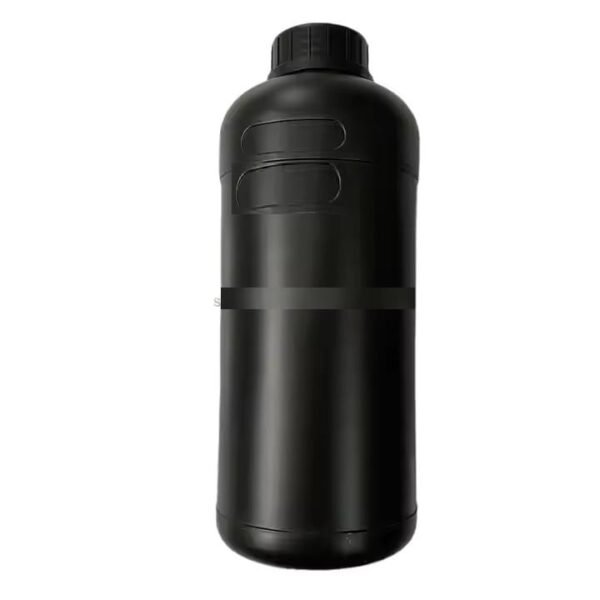
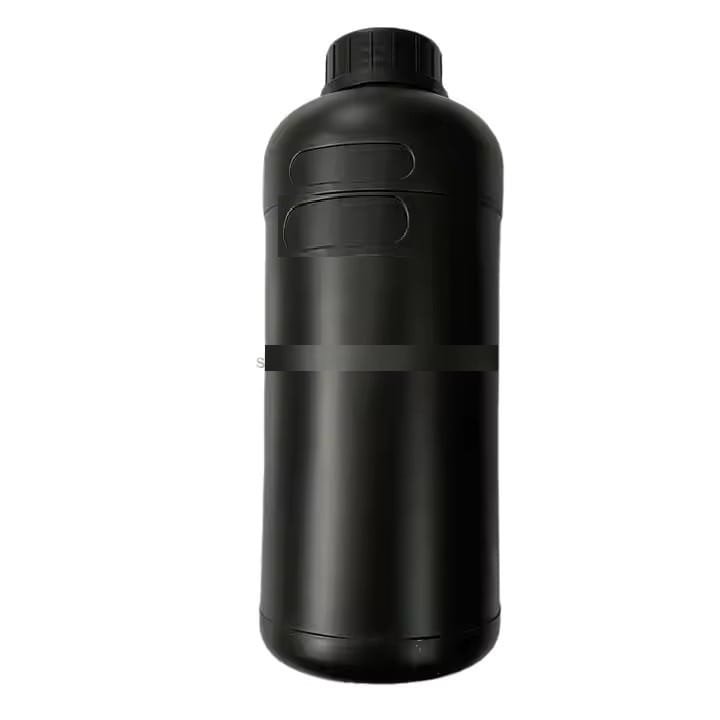
Product view 1 L.
Curing and the intended application
UV printing uses an ink system and curing arrangement designed to work together. Direct flatbed printing and UV DTF film transfer have different media paths. Adhesion and surface preparation must be evaluated for the actual object rather than assumed from its material name alone.
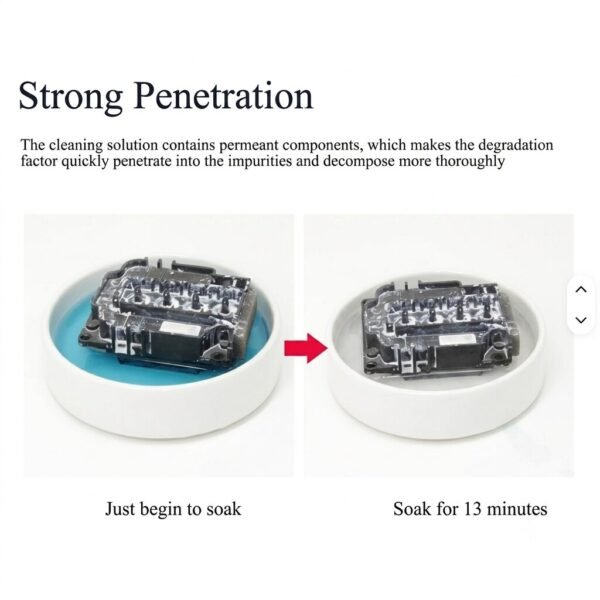
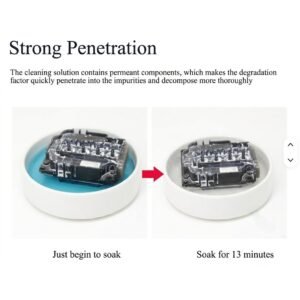
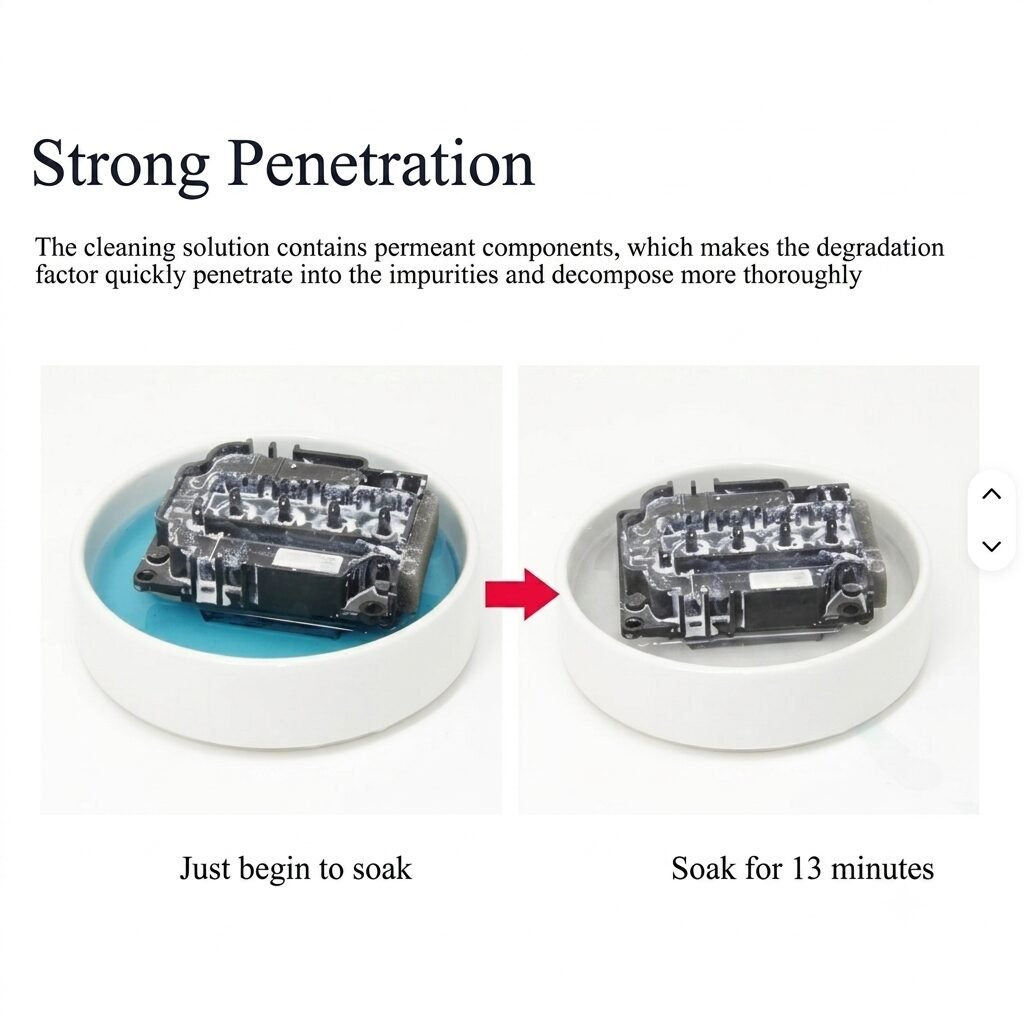
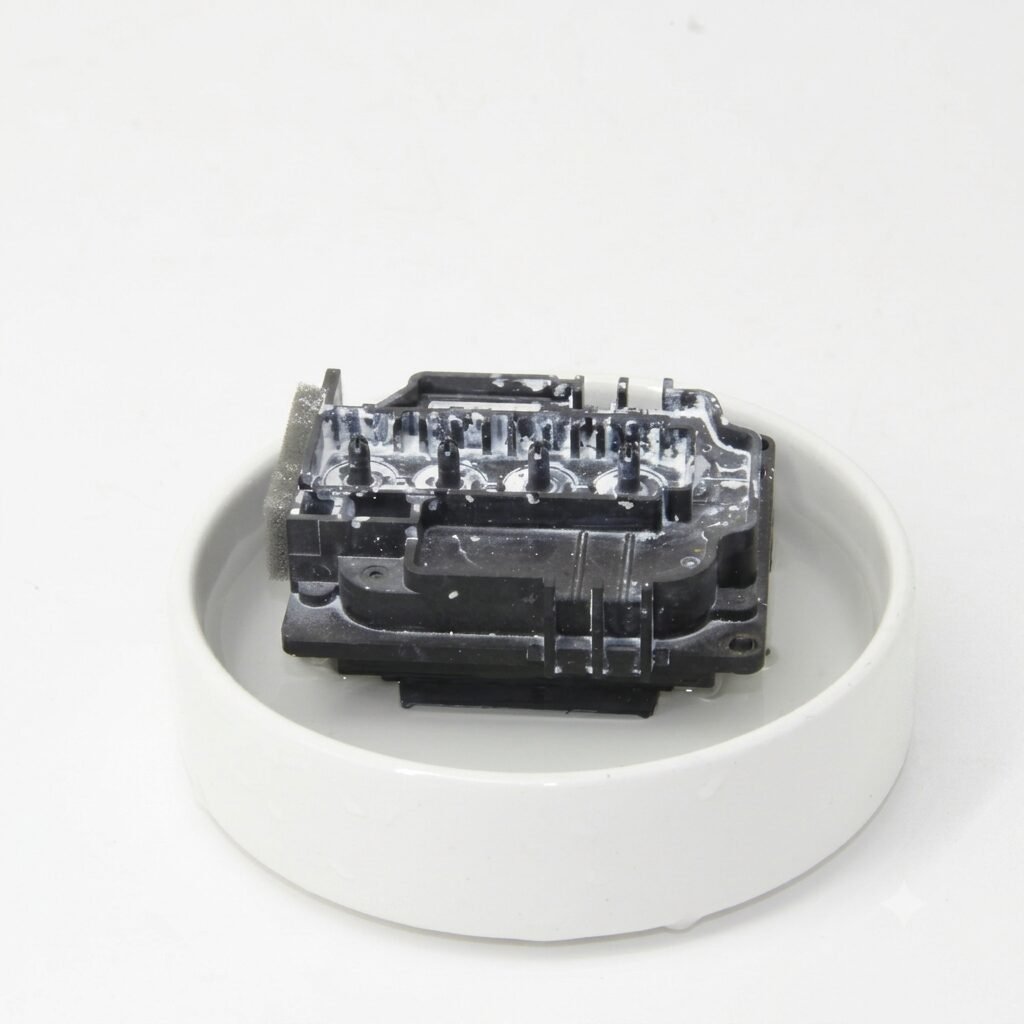
Demonstration of DTF cleaning solution breaking down ink residue on a printhead after soaking for 13 minutes.
Daily use and practical checks
When working with UV DTF Cleaner, keep cleaning tools and waste paths separate from water-based ink systems. Follow the fluid safety data and avoid unnecessary skin or eye exposure.
Material consistency in production
For UV DTF Cleaner, protect UV inks and related fluids from unintended light exposure and use compatible materials. Keep film, ink and cleaning products identified by system. Follow the supplied safety and handling instructions rather than borrowing procedures from an aqueous garment-DTF line.
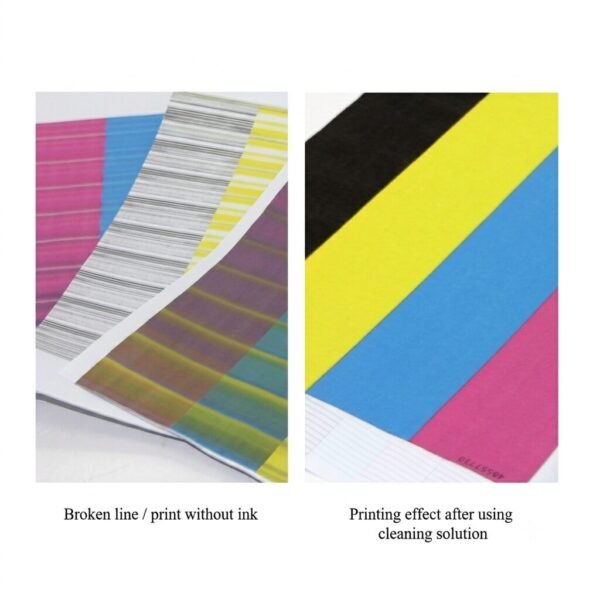
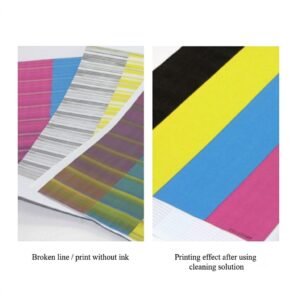
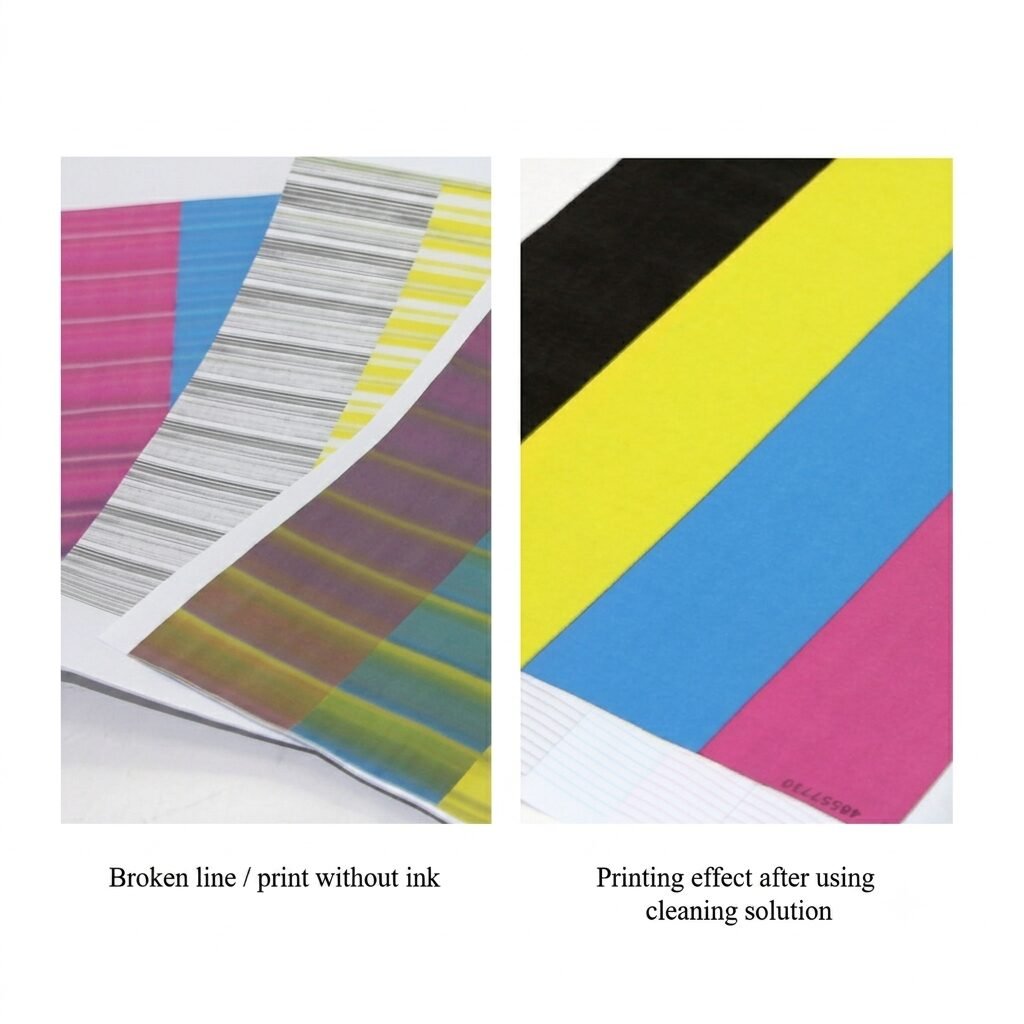
Side-by-side comparison showing streaky, broken lines on a test print before cleaning versus smooth, solid color blocks after using cleaning solution.
The purpose of a maintenance consumable
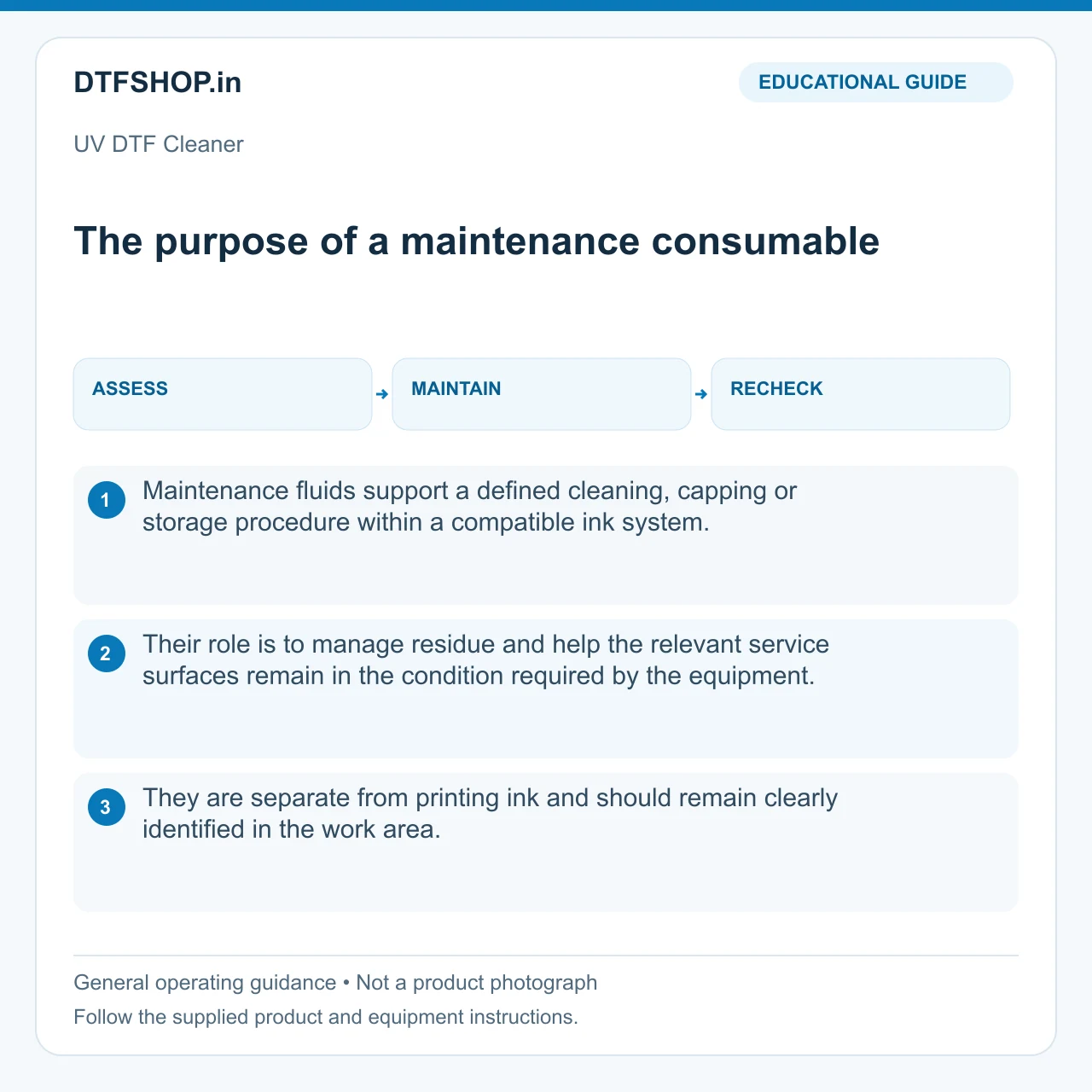
Maintenance fluids support a defined cleaning, capping or storage procedure within a compatible ink system. Their role is to manage residue and help the relevant service surfaces remain in the condition required by the equipment. They are separate from printing ink and should remain clearly identified in the work area.
The particular purpose described above is the starting point for using this item correctly. A clear liquid, coloured liquid or familiar bottle shape does not identify the underlying chemistry. Matching the fluid to the installed ink and machine procedure is more useful than treating every printer cleaner as interchangeable.
Illustrated guide: the purpose of a maintenance consumable. Educational illustration, not a product photograph.
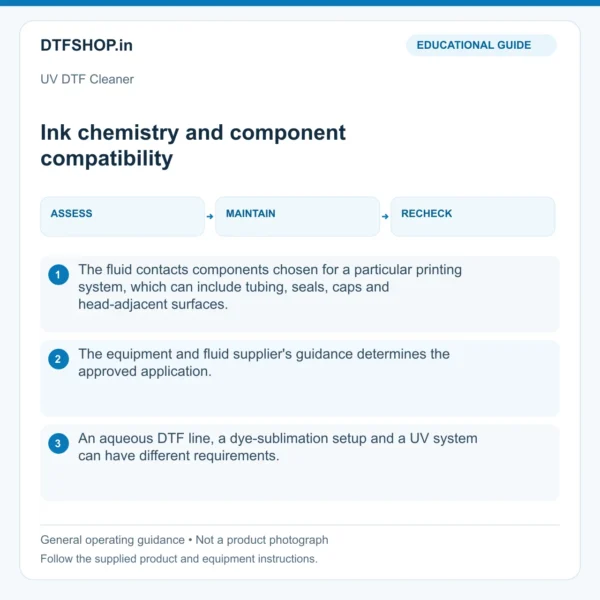
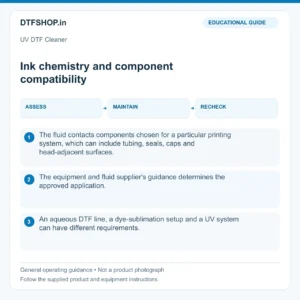
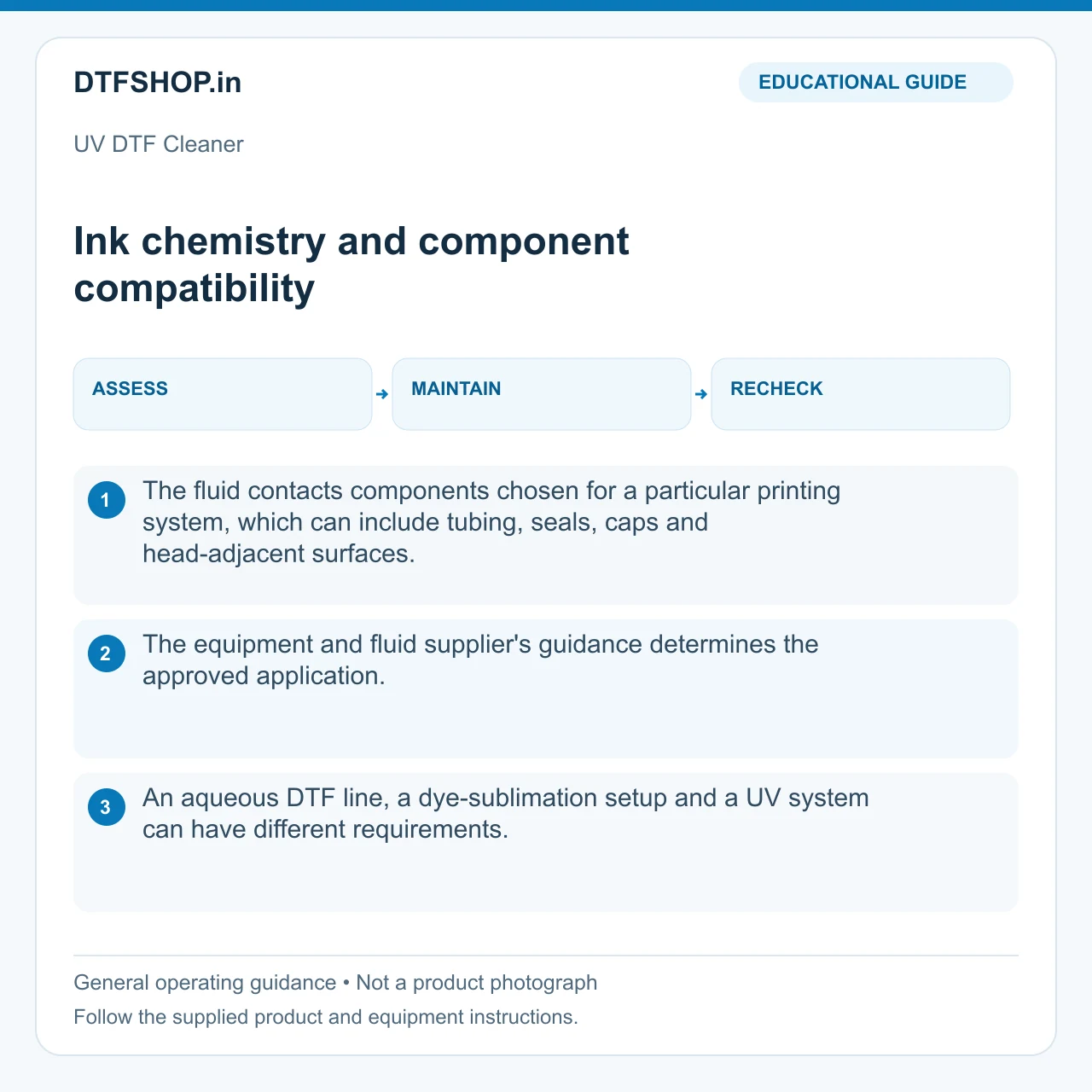
Ink chemistry and component compatibility
The fluid contacts components chosen for a particular printing system, which can include tubing, seals, caps and head-adjacent surfaces. The equipment and fluid supplier's guidance determines the approved application. An aqueous DTF line, a dye-sublimation setup and a UV system can have different requirements. Keep their service materials separate.
Mixing maintenance products or using an improvised substitute can make the result unpredictable and complicate later diagnosis. Read the label and supplied handling information, including any safety data, before starting. The correct consumable is one part of the service method; the amount, contact time and application route matter too.
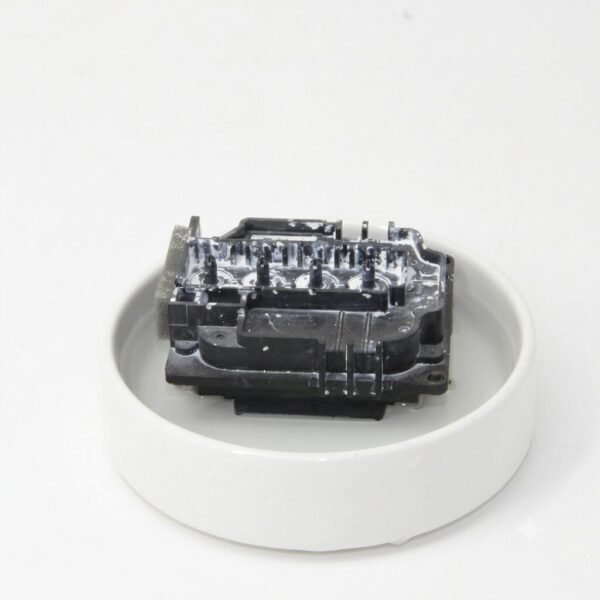
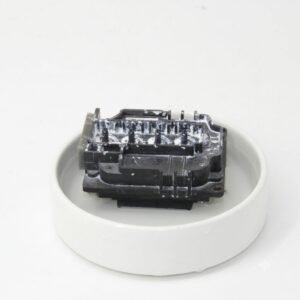
An Epson printhead sitting inside a shallow white dish filled with clear cleaning fluid for maintenance.Illustrated guide: ink chemistry and component compatibilit. Educational illustration, not a product photograph.
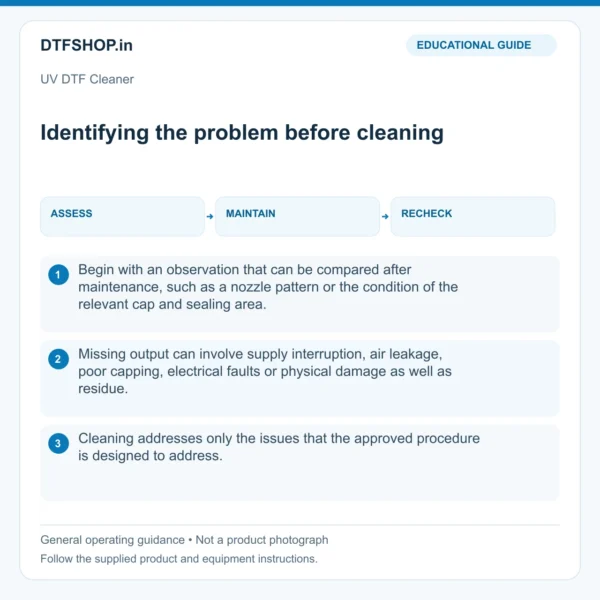
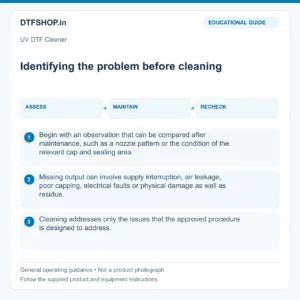
Identifying the problem before cleaning
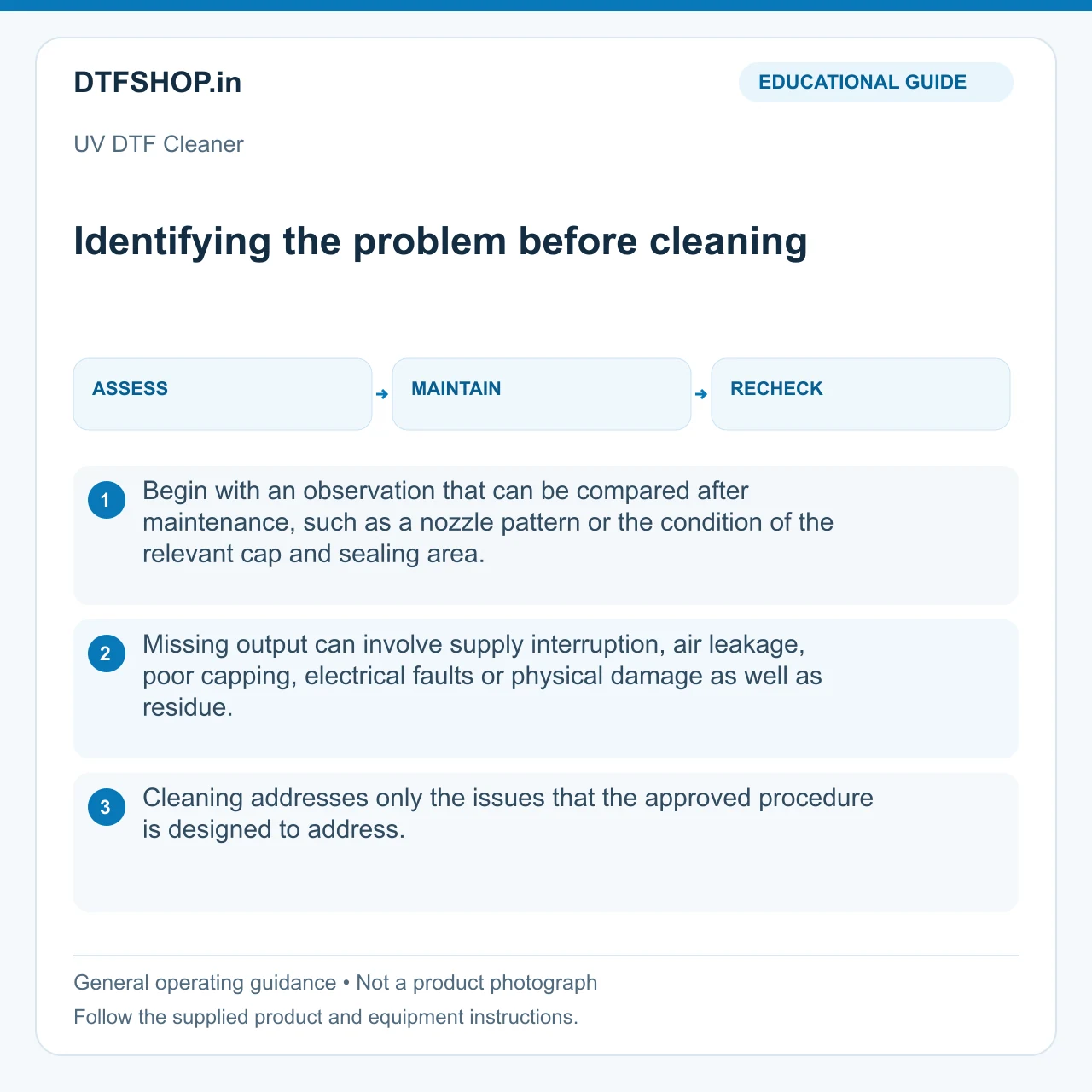
Begin with an observation that can be compared after maintenance, such as a nozzle pattern or the condition of the relevant cap and sealing area. Missing output can involve supply interruption, air leakage, poor capping, electrical faults or physical damage as well as residue. Cleaning addresses only the issues that the approved procedure is designed to address.
Record the starting condition and avoid a long sequence of unmeasured cleaning attempts. If the symptom does not respond as expected, review the diagnosis and the surrounding system. A maintenance liquid is useful when it is applied to the right problem through the intended method.
Illustrated guide: identifying the problem before cleaning. Educational illustration, not a product photograph.
Clean tools and controlled handling
Prepare a clean working area and keep filling or application tools labelled for their purpose. Avoid placing used tools back into the stock container or contaminating a fresh supply with removed residue. Follow the machine procedure for shutdown, access and protection of sensitive areas. Keep liquid away from electrical connections and use suitable handling precautions from the product information.
Head-adjacent work needs particular care because an improvised pressure or aggressive application can create damage. Use the required service tool and sequence rather than treating more liquid or more force as evidence of a more thorough maintenance operation.
Capping, idle periods and restart routines
Where a capping or storage procedure is supported, it depends on the condition of the seals and the rest of the parked ink system. A damaged or poorly seated cap can undermine the procedure. Idle-period preparation and restart should therefore follow the supplied machine or conversion instructions as a complete sequence.
Label the service record with the fluid used and the date. A bottle of maintenance liquid by itself does not establish that a printer can be left unattended for an unlimited period. The relevant components, environment and restart checks remain part of a sensible planned shutdown.
Assessing the outcome and storing the supply
After the specified maintenance sequence, reassemble the service area and repeat the relevant baseline check. Compare the result with the original observation before starting a production file. A partial improvement, no change or a recurring defect are different outcomes and should be recorded honestly. Keep unused fluid in its original identified container, closed and stored according to its supplied instructions.
Keep it separate from ink filling supplies and incompatible chemicals. An orderly maintenance record supports repeatable care and useful technical support, while avoiding unsupported promises that a fluid can repair every blocked head or restore a physically damaged component.
Recommended Add-ons from DTFShop
To complete the workflow, you may also check these related DTFShop products when they match your machine or printing process:
Reference videos explain a method or related model. They do not certify your supplied machine, consumable batch or print results. Follow the exact product manual and recommended settings.
Practical questions
Can this restore a damaged printhead?
A compatible cleaner can help remove ink residue during a supported maintenance procedure. It cannot repair electrical damage, a physically scratched nozzle plate or a leaking mechanical component. Diagnose the cause before repeating cleaning cycles.
Can I mix it with other fluids?
Do not combine cleaners or dilute the fluid unless its own supplied instructions explicitly call for that procedure. Keep cleaning tools dedicated and labelled. Colour alone does not identify a fluid’s chemistry or compatibility.
What is included with UV DTF Cleaner?
The package-contents section above lists the supplied item and quantity. Choose the stated option when alternatives are available; a gallery showing several examples does not turn one selected option into a combined set.
Additional information
Weight
1 kg
Dimensions
20 × 15 × 10 cm
3 reviews for UV DTF Cleaner – Professional Oil-Based UV Printhead Cleaning Fluid for Epson UV Printers | ProlificGeeks
5 out of 5
Suresh Kumar–
Incredibly powerful formula. Dissolved cured UV ink deposits from our printhead nozzles during flushing with ease.
4 out of 5
Abhishek Rao–
Excellent safe cleaner. Doesn’t damage internal manifold plastic walls but cuts clean through thick white ink crusts.
5 out of 5
Rahul Verma–
Essential maintenance solution for keeping continuous UV lines from hardening over long holiday breaks.






Suresh Kumar –
Incredibly powerful formula. Dissolved cured UV ink deposits from our printhead nozzles during flushing with ease.
Abhishek Rao –
Excellent safe cleaner. Doesn’t damage internal manifold plastic walls but cuts clean through thick white ink crusts.
Rahul Verma –
Essential maintenance solution for keeping continuous UV lines from hardening over long holiday breaks.