AvailabilityBackorder available
Dispatch after confirmation
DTFShop benefitSave up to 22.9%
Includes eligible prepaid saving before GST/fees
DTG Pretreatment is a garment-pretreatment liquid for a compatible HJD DTG workflow. Pretreatment prepares the fabric surface for the intended ink process.
DTG Pretreatment is a garment-pretreatment liquid for a compatible HJD DTG workflow. Pretreatment prepares the fabric surface for the intended ink process. It is applied to the garment and is not printhead ink, cleaning fluid or a DTF hot-melt powder.
What you receive for the listed price
One 1 kg pack of HJD DTG pretreatment liquid.
Application equipment, garments, inks and curing equipment are separate.
Applicable taxes and shipping, where relevant, are shown at checkout. Gallery guides and demonstration equipment explain use; they are not additional supplied items.
Availability: Special Order — estimated dispatch/availability in 20–20 daysSKU: PG-DTG-HJD-PTL-01Category: DTG Hybrid inks
Special OrderAvailable to order — expected in 20–20 days
Full online payment is required. COD is unavailable. This order is non-cancellable once paid.
GST invoice available / Shipping calculated at checkout / Product support
Smart Online SavingsYour order cost, explained
Compare automated website ordering—including COD, card/digital payments, rewards and coupons—with a manual/offline order.
Order on DTFShop.inRecommended
Product value₹5,000.00
Prepaid discount (7.5%)−₹375.00
Website shippingCalculated by weight at checkout
GST (18%)+₹832.50
Estimated platform fee (2.36% of total)+₹131.91
Estimated prepaid subtotal₹5,589.41
Weight-based shipping will be added at checkout
Online purchase rewardsEarn and use eligible rewards
Purchase + email couponsGet eligible coupon offers and free promotional coupons by email
✓ Order online anytime, from anywhere✓ Choose COD where available✓ Pay securely by credit card or available digital payment methods✓ Immediate digital payment proof and automatic order confirmation✓ GST invoice available without manual follow-up✓ Automatic tracking and WhatsApp order updates✓ Earn rewards on eligible completed online purchases✓ Receive eligible purchase coupons and free promotional coupons by email
Manual / Offline Order
Product value₹5,000.00
Manual / offline shippingCalculated by actual weight and location
GST (18%)+₹900.00
Prepaid website discount₹0
Website rewards / coupon₹0
Estimated manual order subtotal₹5,900.00
Actual weight/location-based courier charge is extra
• Payment coordinated manually through WhatsApp/bank transfer• Confirmation and invoice may require manual processing• Courier charged on the actual/manual booking basis• Shipment timing and updates are coordinated manually
Estimated saving by ordering prepaid on DTFShop.in₹310.59
before weight-based shipping and any additional eligible rewards or coupon saving
How this estimate works:
Website example uses the 7.5% prepaid discount only when the eligible value is ₹10,000 or below, plus GST 18% and an estimated non-EMI platform fee equal to 2.36% of the subtotal including that fee. Shipping, coupons and final taxes are confirmed at checkout.
Website and manual/offline shipping are excluded from these subtotals because courier charges are calculated from actual weight, dimensions and delivery location.
Final checkout or confirmed manual quotation is authoritative and can change with shipping, coupon, rewards, variation and payment method.
Frequently bought together
Complete your setup
Useful add-ons commonly paired with this product. Choose only what you need.
DTG Pretreatment is a garment-pretreatment liquid for a compatible HJD DTG workflow. Pretreatment prepares the fabric surface for the intended ink process. It is applied to the garment and is not printhead ink, cleaning fluid or a DTF hot-melt powder.
What you receive for the listed price
One 1 kg pack of HJD DTG pretreatment liquid.
Application equipment, garments, inks and curing equipment are separate.
Applicable taxes and shipping, where relevant, are shown at checkout. Gallery guides and demonstration equipment explain use; they are not additional supplied items.
Product view 1.
Fabric preparation for DTG printing
Pretreatment is part of garment preparation, particularly where a white-ink layer is used in the supported DTG process. Fabric type, ink and pretreatment chemistry need to be compatible. The application belongs on the garment; it is not part of the printer ink supply.
Daily use and practical checks
When working with DTG Pretreatment, treat quantity and uniformity as process settings. Too much or unevenly applied pretreatment can affect the look and feel of the finished print.
Uniform application and curing
For DTG Pretreatment, apply and cure according to the supplied liquid and printer instructions. Keep the treatment uniform across the intended print area and evaluate the finished garment. The correct process depends on the fabric and liquid, so a universal application quantity or curing temperature is not stated here.
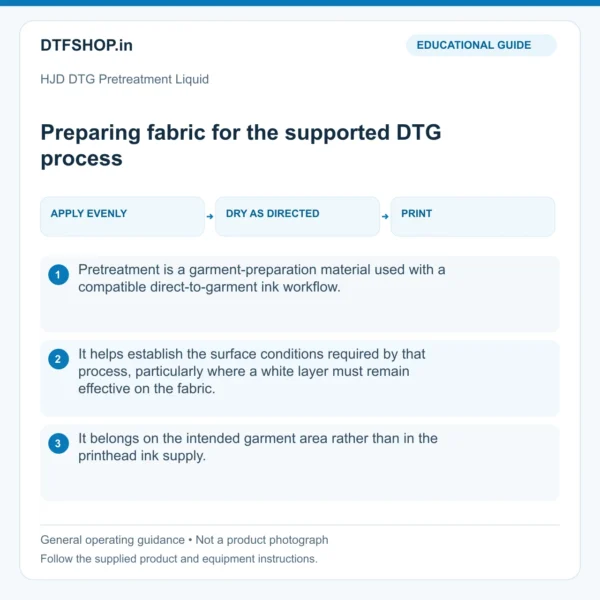
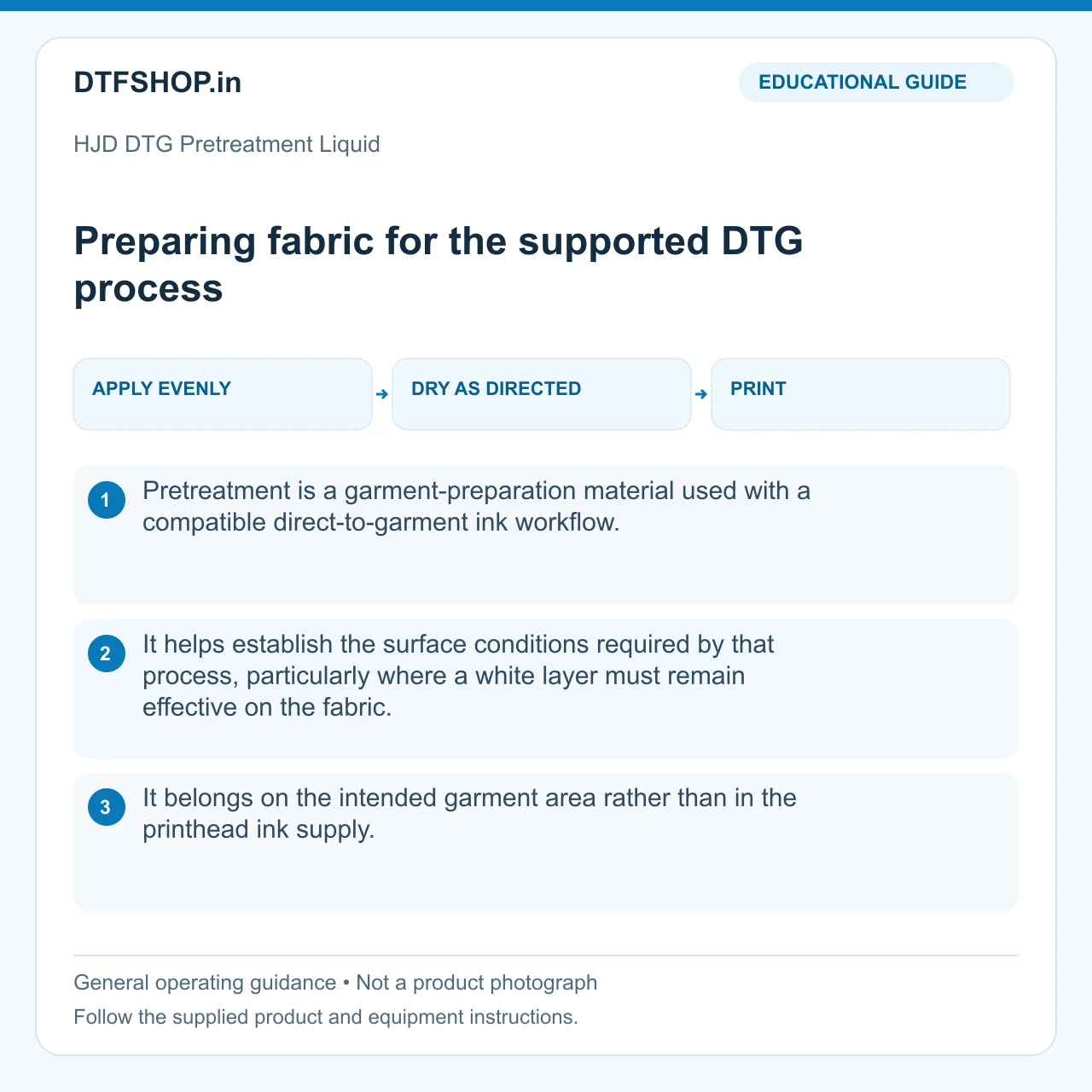
Preparing fabric for the supported DTG process
Pretreatment is a garment-preparation material used with a compatible direct-to-garment ink workflow. It helps establish the surface conditions required by that process, particularly where a white layer must remain effective on the fabric. It belongs on the intended garment area rather than in the printhead ink supply.
The liquid, ink and fabric need to be evaluated together. Different fabric constructions and surface treatments can behave differently, even when the garments have the same general colour. A representative garment from the actual job is therefore the right starting point for establishing the working preparation method.
Illustrated guide: preparing fabric for the supported dtg p. Educational illustration, not a product photograph.
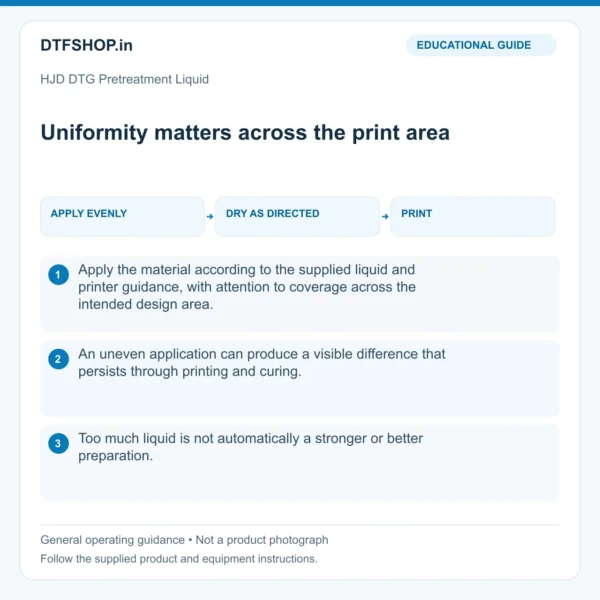
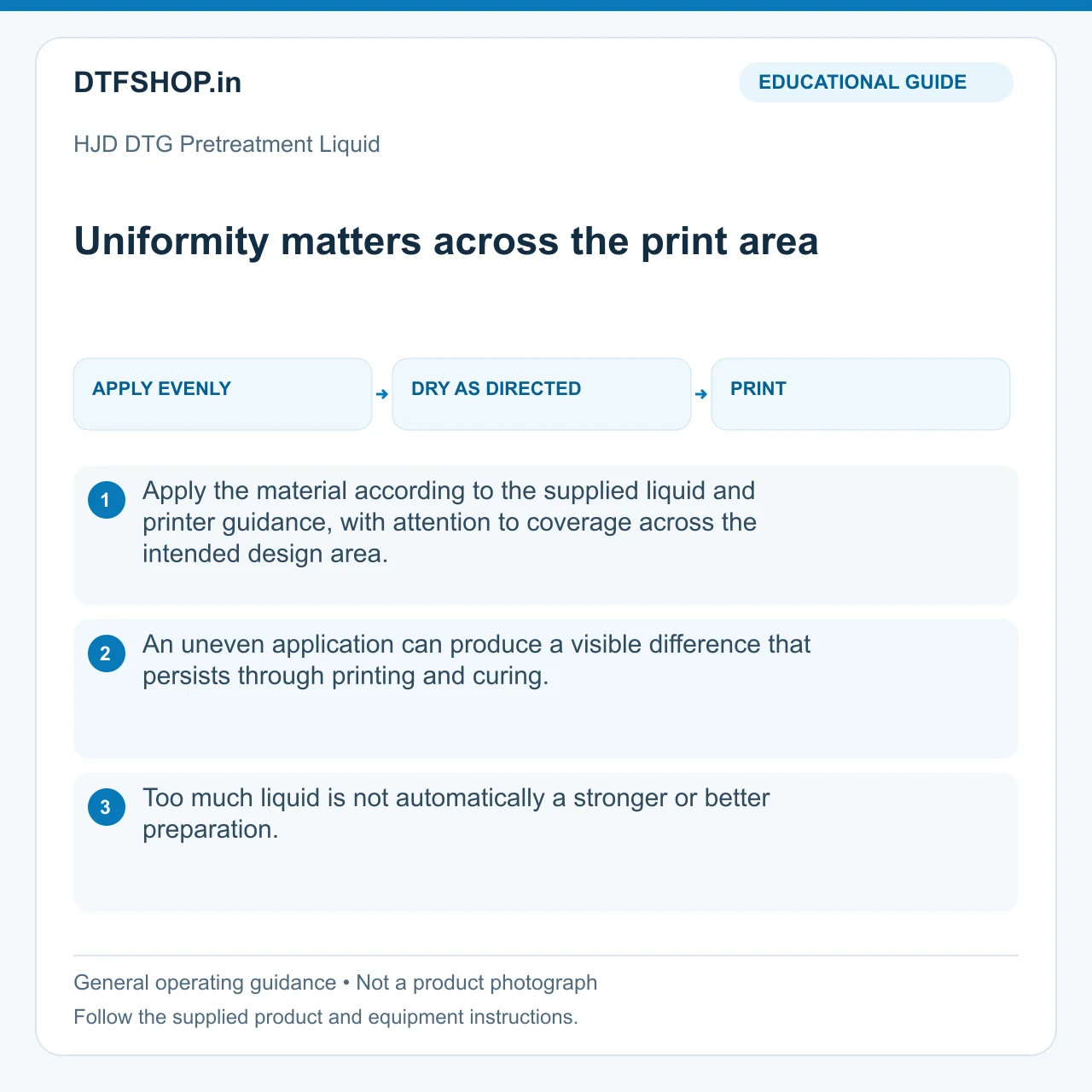
Uniformity matters across the print area
Apply the material according to the supplied liquid and printer guidance, with attention to coverage across the intended design area. An uneven application can produce a visible difference that persists through printing and curing. Too much liquid is not automatically a stronger or better preparation. The correct quantity and process depend on the supported system and the garment.
Keep the application method consistent between samples so the result can be interpreted. On repeat work, document the treated area, application method and garment identity alongside the print preset rather than relying on a visual impression of how wet the fabric looked.
Illustrated guide: uniformity matters across the print area. Educational illustration, not a product photograph.
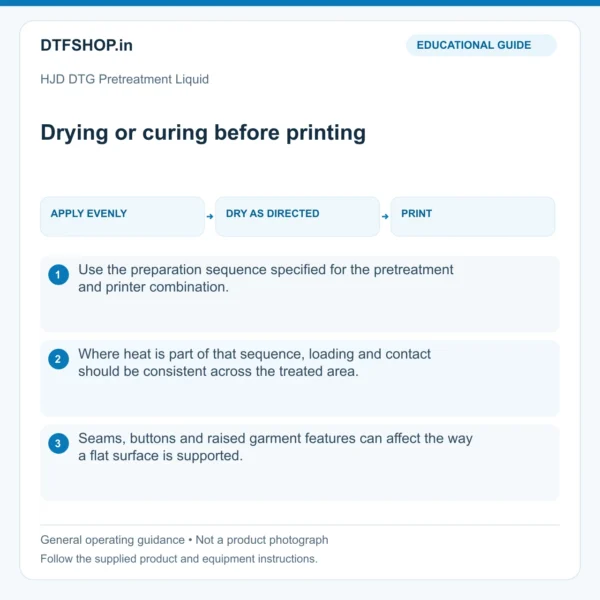
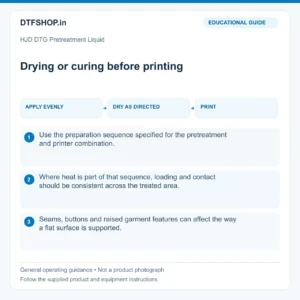
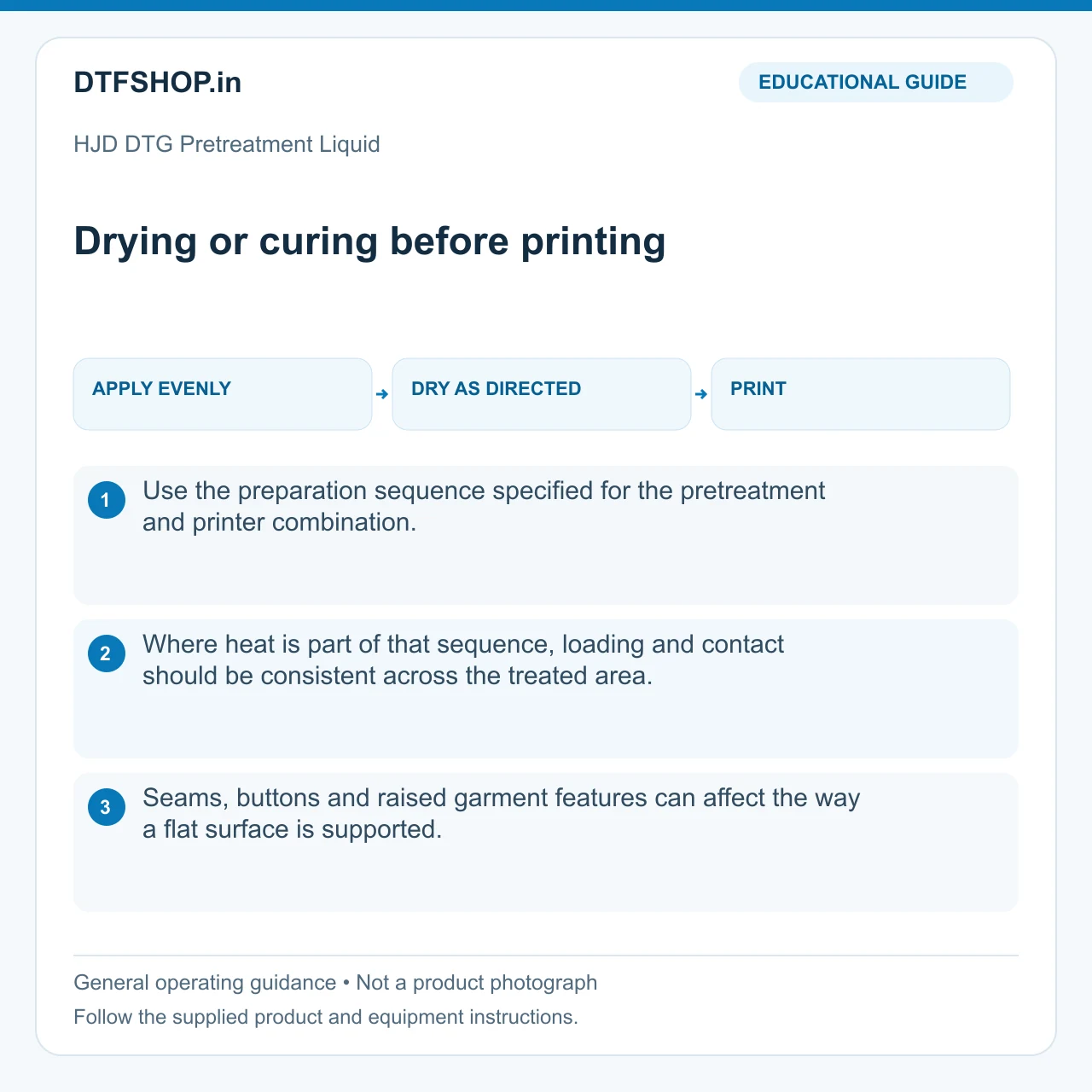
Drying or curing before printing
Use the preparation sequence specified for the pretreatment and printer combination. Where heat is part of that sequence, loading and contact should be consistent across the treated area. Seams, buttons and raised garment features can affect the way a flat surface is supported. Keep protective materials clean and suitable for the process.
The completed preparation should be judged as part of the final printed garment, not as an isolated liquid application. Avoid copying a temperature or dwell time from a different fluid or fabric because the correct recipe is tied to the material system actually being used.
Illustrated guide: drying or curing before printing. Educational illustration, not a product photograph.
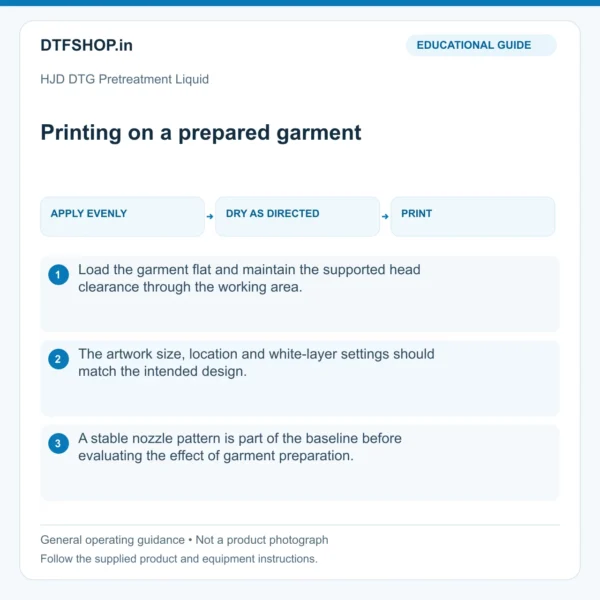
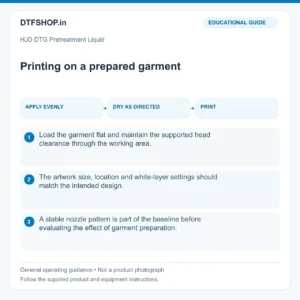
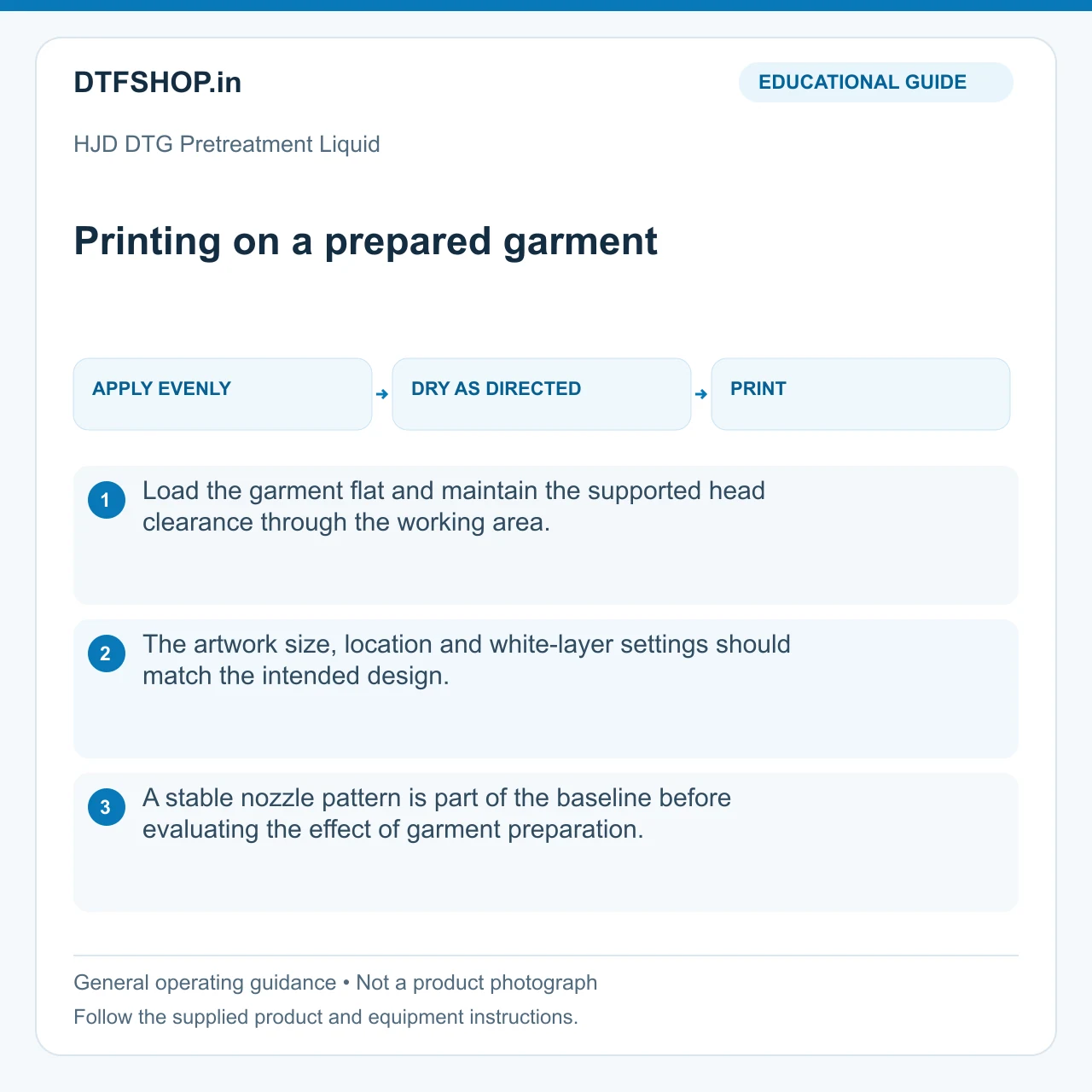
Printing on a prepared garment
Load the garment flat and maintain the supported head clearance through the working area. The artwork size, location and white-layer settings should match the intended design. A stable nozzle pattern is part of the baseline before evaluating the effect of garment preparation. If coverage changes, consider fabric fibres, preparation uniformity and the print setup together.
Adjust one variable at a time and keep an approved sample. This makes a useful distinction between a preparation difference and a printer fault, rather than repeatedly increasing white ink to compensate for a surface or handling problem elsewhere in the workflow.
Illustrated guide: printing on a prepared garment. Educational illustration, not a product photograph.
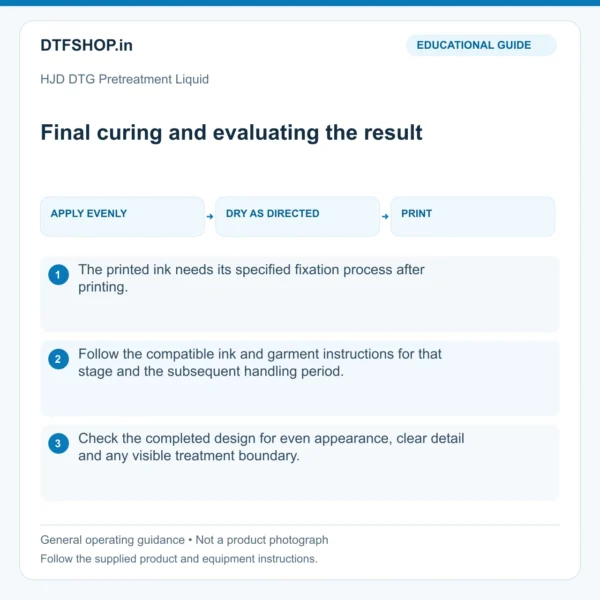
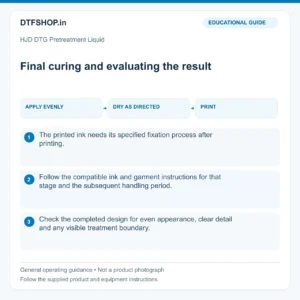
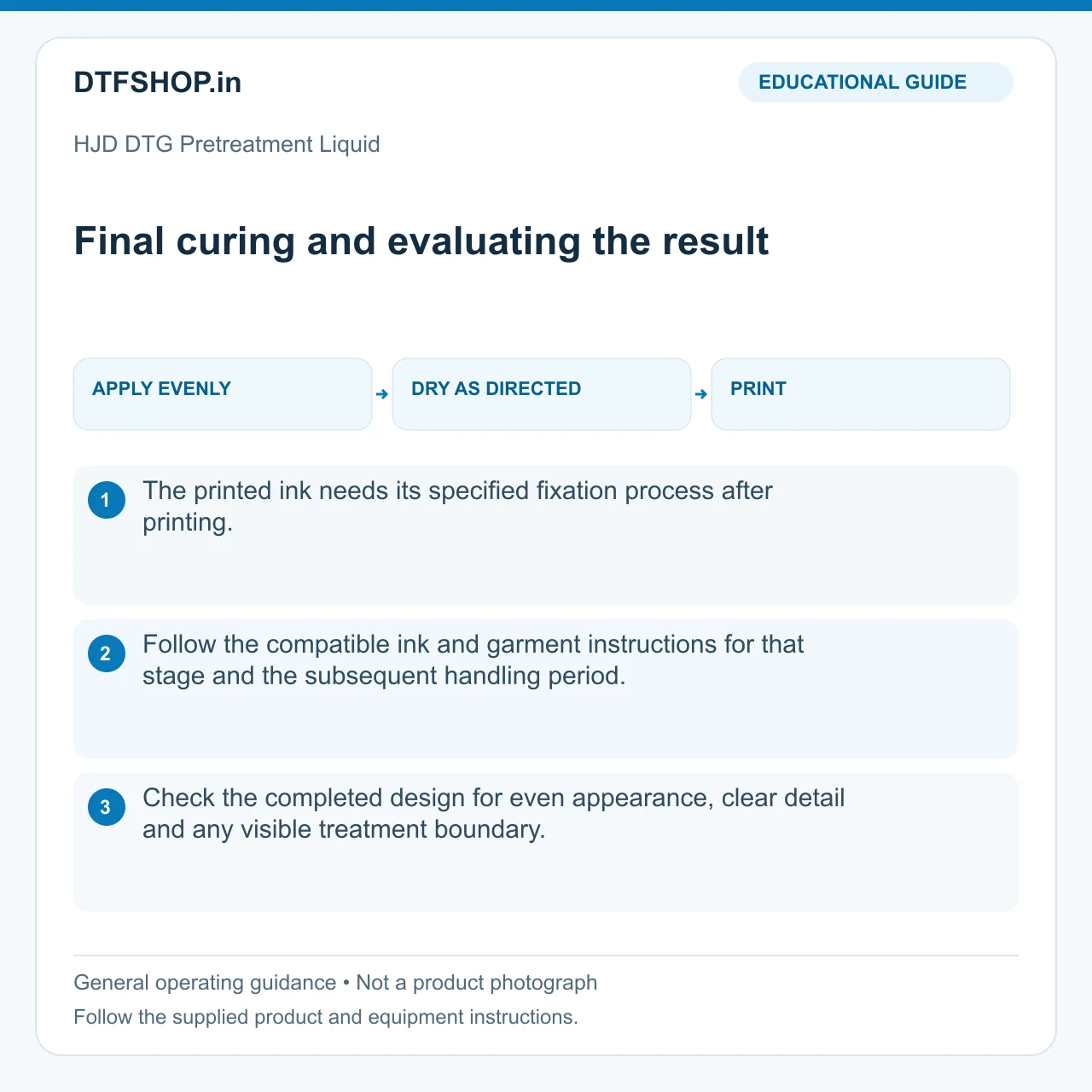
Final curing and evaluating the result
The printed ink needs its specified fixation process after printing. Follow the compatible ink and garment instructions for that stage and the subsequent handling period. Check the completed design for even appearance, clear detail and any visible treatment boundary. Use a finished-product test appropriate to the intended garment when assessing durability.
An immediate visual inspection is useful but does not establish every performance characteristic. Record the fabric, pretreatment, print preset and curing process together so a repeat order has a meaningful reference. Use the tested recipe for its recorded fabric and material combination; other blends may need different settings.
Illustrated guide: final curing and evaluating the result. Educational illustration, not a product photograph.
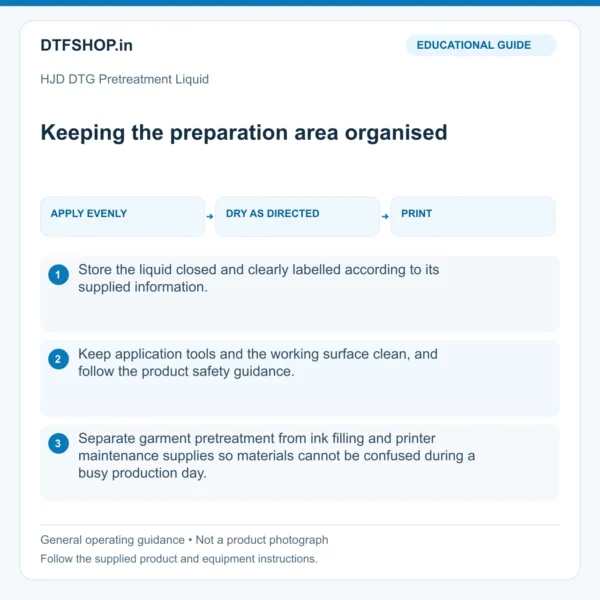
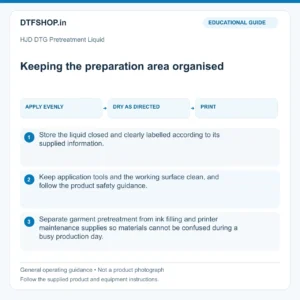
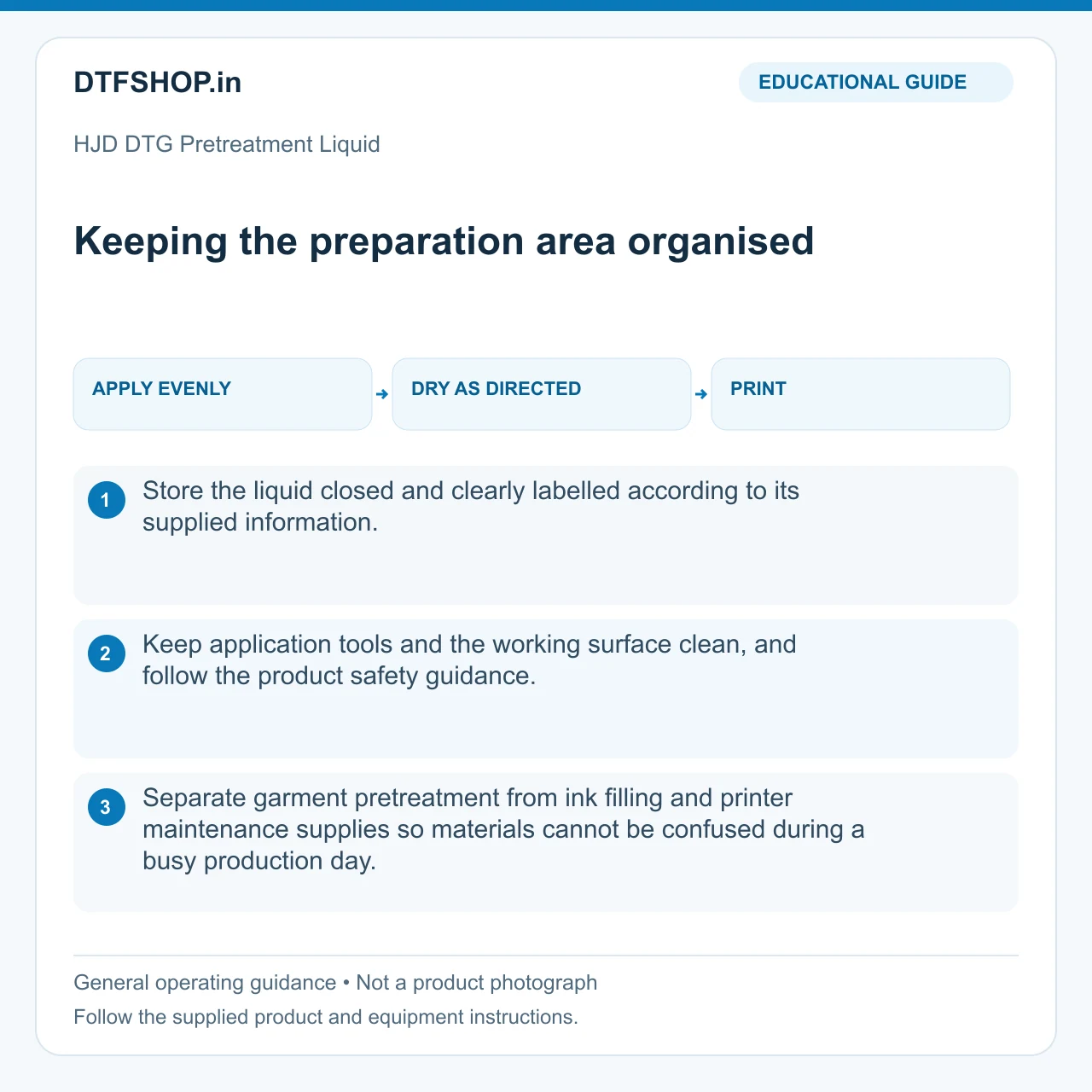
Keeping the preparation area organised
Store the liquid closed and clearly labelled according to its supplied information. Keep application tools and the working surface clean, and follow the product safety guidance. Separate garment pretreatment from ink filling and printer maintenance supplies so materials cannot be confused during a busy production day.
Keep untreated, prepared and completed garments identifiable as they move through the process. A simple record of the working sequence helps another operator reproduce the same result and makes technical support more useful if output changes. Consistency comes from controlling preparation, printing and curing together, with each material used for its intended job.
Illustrated guide: keeping the preparation area organised. Educational illustration, not a product photograph.
Product video guides
An exact-product installation and quality-test video is being verified. Unrelated demonstrations have been removed.
Practical questions
Is pretreatment poured into the ink tank?
No. Pretreatment is applied to the garment through the supported preparation method. It is separate from ink and printhead-cleaning fluid. Keep the application area and tools clearly identified.
How should I assess preparation quality?
Inspect a completed print on the actual garment type. Record treatment uniformity, ink preset and curing procedure together. A visibly wetter surface is not proof of better preparation or final durability.
What is included with DTG Pretreatment?
The package-contents section above lists the supplied item and quantity. Choose the stated option when alternatives are available; a gallery showing several examples does not turn one selected option into a combined set.
Additional information
Weight
1 kg
Dimensions
25 × 20 × 15 cm
Reviews
There are no reviews yet.
Be the first to review “HJD DTG Pretreatment Liquid – Premium Precoat Solution for DTG Printing India” Cancel reply








Reviews
There are no reviews yet.