The DFC30 is our DTF single head XP600 printer India listing for businesses producing garment-transfer artwork on PET film. Its single XP600 printhead forms part of a textile DTF system using colour and white ink.
The DFC30 is our DTF single head XP600 printer India listing for businesses producing garment-transfer artwork on PET film. Its single XP600 printhead forms part of a textile DTF system using colour and white ink. The printed film then needs adhesive powder, controlled curing and heat transfer onto the garment.
What you receive for the listed price
One DFC30 industrial printer with one XP600 printhead.
Matching powder shaker/curing unit.
600 ml starter ink in total for the CMYKWW six-channel setup.
1 kg adhesive powder; one 12-inch PET film roll, 100 metres long; 500 g cleaner.
RIIN RIP software and free installation.
Six-month dedicated warranty, subject to the store warranty terms. Service visits cost extra.
Warranty details: Printheads are excluded under the published store policy. Read warranty and service terms for coverage and exclusions.
Applicable taxes and shipping, where relevant, are shown at checkout. Gallery guides and demonstration equipment explain use; they are not additional supplied items.
Smart Online SavingsYour order cost, explained
Compare automated website ordering—including COD, card/digital payments, rewards and coupons—with a manual/offline order.
Order on DTFShop.inRecommended
Product value₹190,000.00
Prepaid discountNot applicable above ₹10,000
Website shippingCalculated by weight at checkout
GST (18%)+₹34,200.00
Estimated platform fee (2.36% of total)+₹5,419.01
Estimated prepaid subtotal₹229,619.01
Weight-based shipping will be added at checkout
Online purchase rewardsEarn and use eligible rewards
Purchase + email couponsGet eligible coupon offers and free promotional coupons by email
✓ Order online anytime, from anywhere✓ Choose COD where available✓ Pay securely by credit card or available digital payment methods✓ Immediate digital payment proof and automatic order confirmation✓ GST invoice available without manual follow-up✓ Automatic tracking and WhatsApp order updates✓ Earn rewards on eligible completed online purchases✓ Receive eligible purchase coupons and free promotional coupons by email
Manual / Offline Order
Product value₹190,000.00
Manual / offline shippingCalculated by actual weight and location
GST (18%)+₹34,200.00
Prepaid website discount₹0
Website rewards / coupon₹0
Estimated manual order subtotal₹224,200.00
Actual weight/location-based courier charge is extra
• Payment coordinated manually through WhatsApp/bank transfer• Confirmation and invoice may require manual processing• Courier charged on the actual/manual booking basis• Shipment timing and updates are coordinated manually
How this estimate works:
Website example uses the 7.5% prepaid discount only when the eligible value is ₹10,000 or below, plus GST 18% and an estimated non-EMI platform fee equal to 2.36% of the subtotal including that fee. Shipping, coupons and final taxes are confirmed at checkout.
Website and manual/offline shipping are excluded from these subtotals because courier charges are calculated from actual weight, dimensions and delivery location.
Final checkout or confirmed manual quotation is authoritative and can change with shipping, coupon, rewards, variation and payment method.
Frequently bought together
Complete your setup
Useful add-ons commonly paired with this product. Choose only what you need.
DTF single head XP600 printer India: DFC30 garment-transfer system
The DFC30 is our DTF single head XP600 printer India listing for businesses producing garment-transfer artwork on PET film. Its single XP600 printhead forms part of a textile DTF system using colour and white ink. The printed film then needs adhesive powder, controlled curing and heat transfer onto the garment.
This makes the machine relevant to T-shirt personalisation, small apparel collections and repeat logo orders where the operator wants control of the transfer-production process.
What you receive for the listed price
One DFC30 industrial printer with one XP600 printhead.
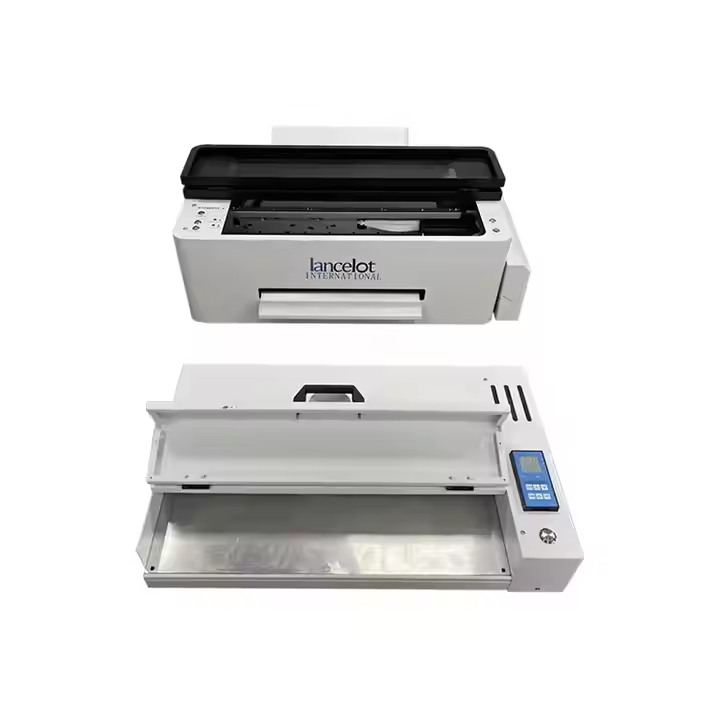
Matching powder shaker/curing unit.
600 ml starter ink in total for the CMYKWW six-channel setup.
1 kg adhesive powder; one 12-inch PET film roll, 100 metres long; 500 g cleaner.
RIIN RIP software and free installation.
Six-month dedicated warranty, subject to the store warranty terms. Service visits cost extra.
Warranty details: Printheads are excluded under the published store policy. Read warranty and service terms for coverage and exclusions.
Applicable taxes and shipping, where relevant, are shown at checkout. Gallery guides and demonstration equipment explain use; they are not additional supplied items.
A useful way to assess this printer is to start with your normal order: the size of the artwork, number of garments, colour coverage and required finish. A compact design repeated across a film layout presents a different workload from a dense full-size graphic. We recommend judging a sample at the quality setting you will use for customer work.
A good print is one that remains acceptable after curing, pressing and inspection, rather than one that simply leaves the printer quickly.
Product view with DFC30 powdershaker system.Product view.
What the single-head configuration means
One installed printhead makes the head arrangement different from a dual-head system. The RIP, channel configuration and white-layer settings must match the actual DFC30 setup. Colour and white output need to remain balanced: an uneven white base can change the way a coloured image looks on a dark garment even when the colour file itself has not changed.
Start each working session with the prescribed nozzle check before adjusting artwork to compensate for a printing fault.
When comparing a DTF single head XP600 printer India option with a dual-head model, look beyond the initial purchase price. Consider your batch sizes, operator availability and the curing capacity already in the workshop. A single-head printer can be a practical route into dedicated film printing, but it still needs routine ink-system care and an organised transfer workflow.
It is not an unattended or maintenance-free appliance.
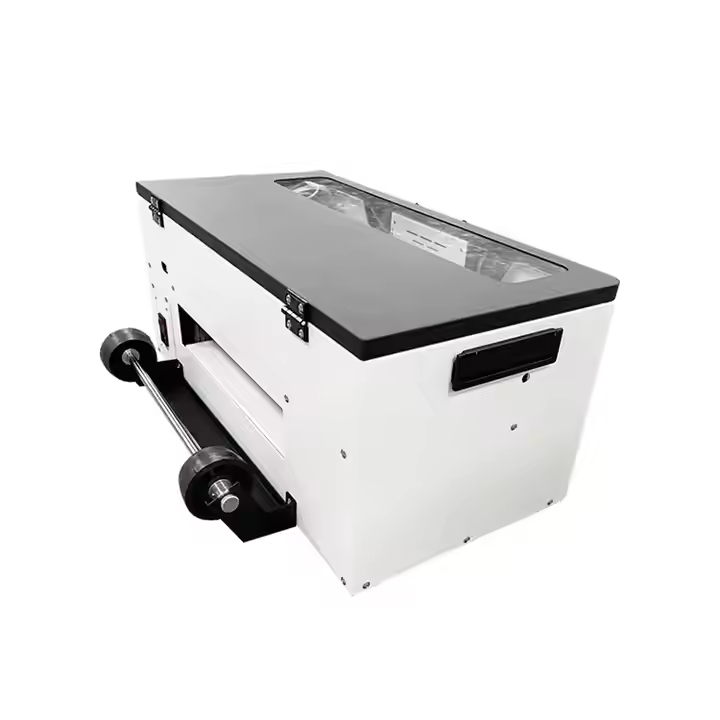
Product view.
Film width and artwork layout
Customers often describe this class of machine as a 12-inch or A3 DTF printer. Those descriptions are useful starting points, but roll width, maximum printable width and the margins used in the RIP are separate measurements. Lay out a representative job inside the confirmed printable area of the supplied configuration.
Leave suitable space between designs for handling and cutting, and check that the finished dimensions remain correct after the transfer process.
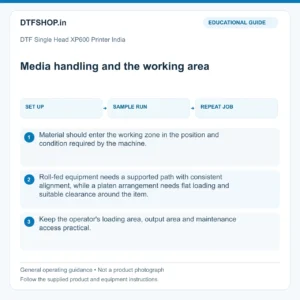
Choose a compatible coated PET film with a peel method that suits your production sequence. Keep the roll aligned and supported so it feeds without rubbing wet artwork or introducing wrinkles. Film tracking affects repeatability across a longer gang sheet; a clean nozzle pattern alone cannot correct a poorly supported media path.
Keep the output area clear so the printed surface reaches the powder stage without accidental contact.
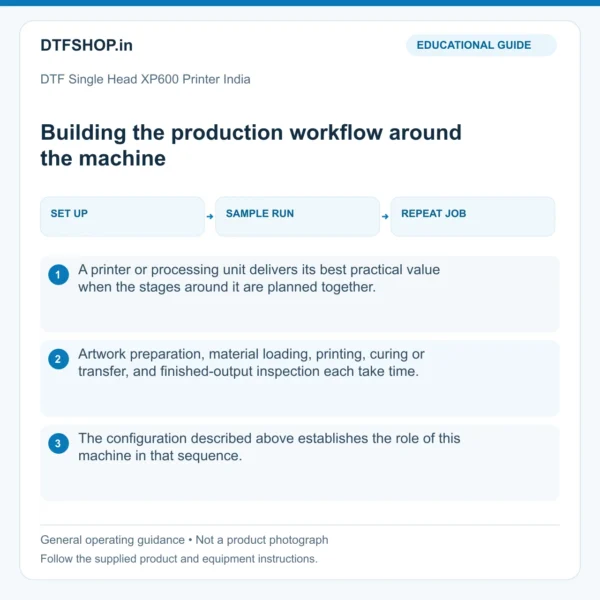
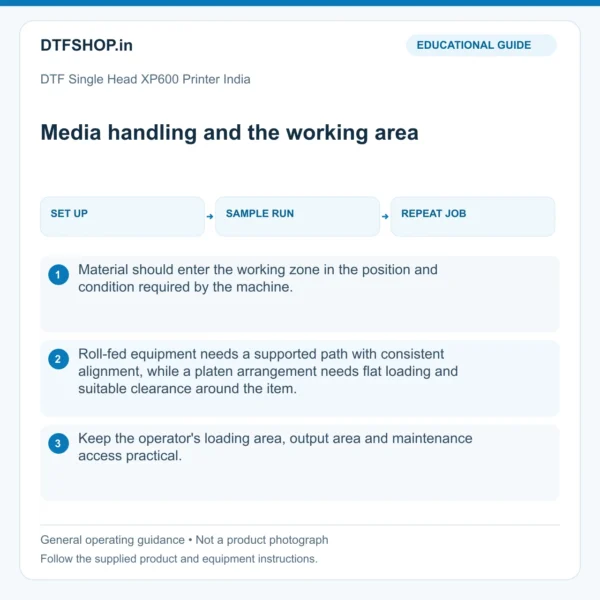
Illustrated guide: building the production workflow around . Educational illustration, not a product photograph.Illustrated guide: media handling and the working area. Educational illustration, not a product photograph.
Ink, white underbase and colour control
For this DTF single head XP600 printer India system, use textile DTF ink specified for the installed ink circuit. UV ink and sublimation ink are different technologies and should not be substituted because a bottle lists a similar head family. Keep colour channels identified when filling and avoid mixing unknown formulations.
Follow the supplied procedure for white-ink agitation or circulation where fitted; do not assume that a circulation feature removes the need for daily checks.
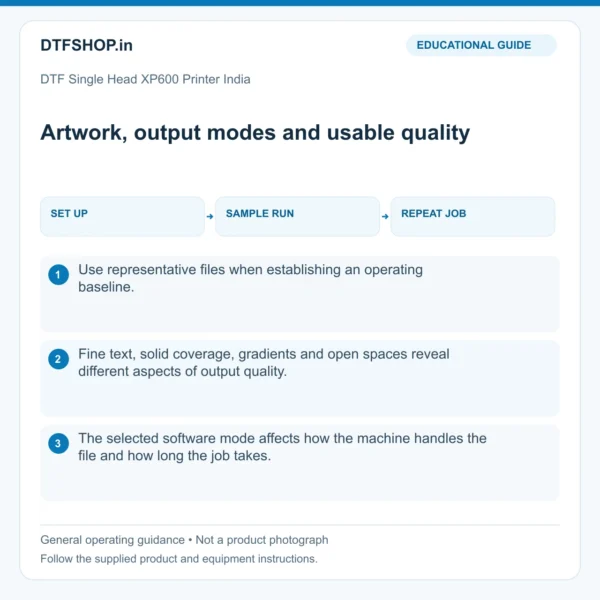
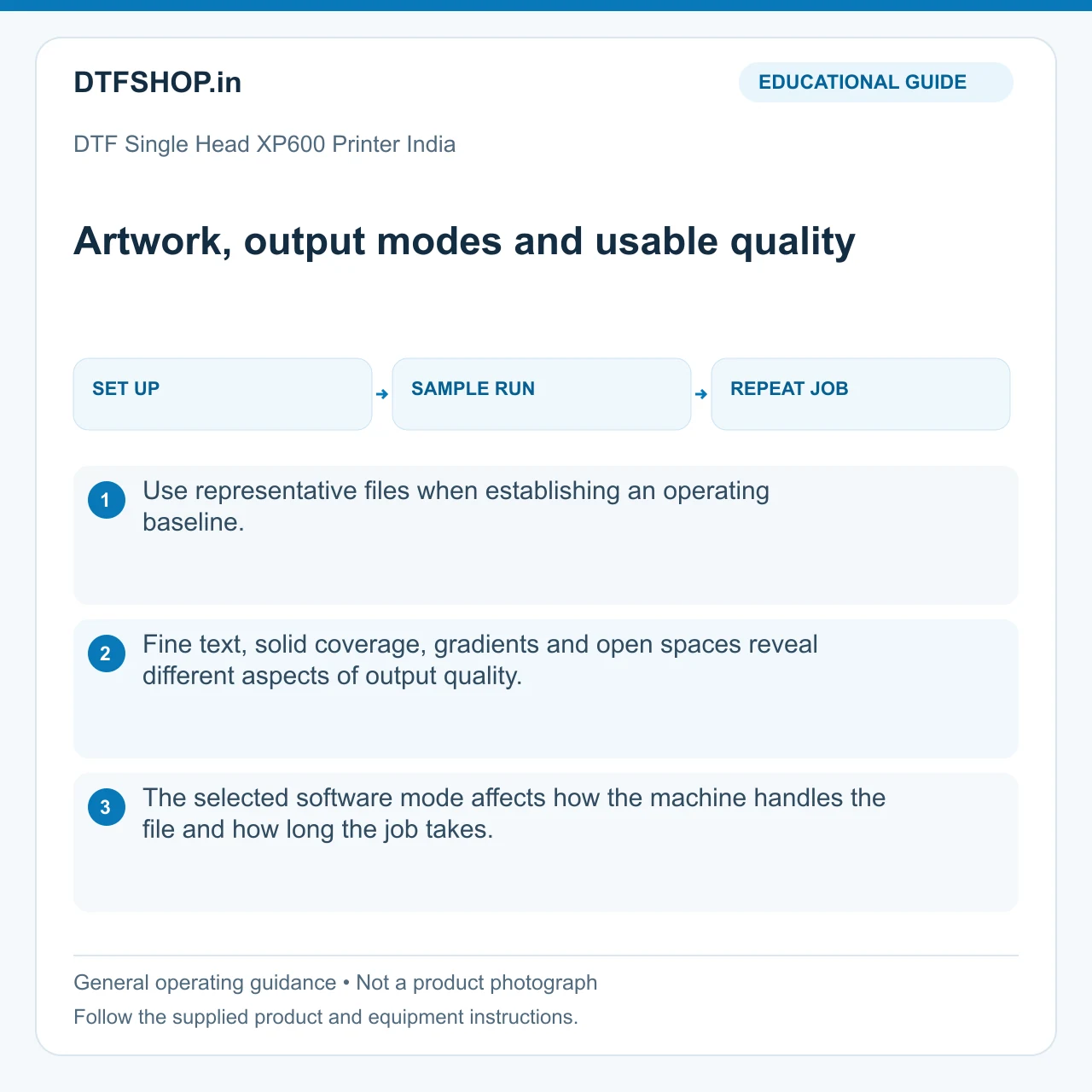
Save the RIP preset used for an approved sample. Record the artwork version, output dimensions, white-layer settings and ink/film combination. If a repeat order changes appearance, compare the production recipe before changing several settings at once. Fine text, gradients, solid areas and a white-backed colour patch are useful features to include in a test file because each reveals a different kind of inconsistency.
Product view.
Powder application, curing and garment pressing
The DFC30 printing stage is only part of the finished transfer. Apply compatible adhesive powder evenly while the printed area is in the condition required by the material instructions, remove loose excess, and cure using the validated process. Powder that remains outside the artwork can create unwanted residue.
Inconsistent coverage or curing can reduce transfer quality even when the original film print looks clear.
Transfer onto a sample of the actual garment before approving a batch. The press temperature, time, pressure and peel sequence must suit the film, powder and fabric together. Check adhesion, edges, hand feel and the care performance required for the job. The working demonstration associated with this page explains the process, while the supplied package and any shaker or curing equipment remain those stated in your order confirmation.
Daily operation and sensible production planning
Keep a consistent opening routine for the DTF single head XP600 printer India: inspect nozzle condition, confirm the film path and check the maintenance areas identified in the supplied instructions. Use the correct cleaning liquid and tools for the aqueous DTF system. Repeated aggressive cleaning is not a substitute for finding an air leak, contaminated cap or other underlying ink-delivery problem.
Electrical or printhead work should follow the service procedure with power safely isolated.
Allow time for setup, film changes, powdering, curing, cutting and pressing when estimating daily capacity. Count accepted finished transfers and rejected output, not just printing minutes. Keep consumables protected from dust and moisture, and provide the working space, power arrangement and extraction required by the equipment documentation.
Establish a stable process first; then improve throughput one stage at a time.
Compare the right system and consumables
If you are choosing a DTF single head XP600 printer India for a new workshop, compare it with our single-head and dual-head industrial DTF printer guide. Review the Audley dual-head XP600 listing when your workflow needs a different head configuration. Compare the stated package, installation scope and operating requirements rather than assuming that similarly named machines include identical accessories.
Reference videos explain a method or related model. They do not certify your supplied machine, consumable batch or print results. Follow the exact product manual and recommended settings.
Practical questions
What is a useful production demonstration?
Use artwork and materials similar to the jobs you intend to sell. Inspect finished output, setup time and the downstream processing stage. Head count or nominal width alone does not establish usable production speed at your required quality.
What should the operator save for repeat jobs?
Keep the artwork version, print preset, material identity and approved finished sample together. Record routine maintenance and any setup changes. A known reference job helps distinguish a file change from a transport, ink or calibration problem.
Additional information
Weight
80 kg
Dimensions
90 × 70 × 60 cm
3 reviews for DTF Single Head XP600 Printer India – Professional DFC30 System
5 out of 5
Kavita Reddy–
Excellent build quality. Solved our production bottleneck instantly. Highly recommended for commercial print environments.










Kavita Reddy –
Excellent build quality. Solved our production bottleneck instantly. Highly recommended for commercial print environments.
Manish Tiwari –
Outstanding performance! Drastically lowered our maintenance overhead and printhead clogging issues.
Divya Sharma –
Very reliable over long production runs. Colors are accurate and consistency remains solid throughout the week.